Archive for the ‘Usage advice’ Category

The scandal of English grammar

February 12, 2013

The main title of a talk that Geoff Pullum gave tonight (in competition with the State of the Union address), at the University of Washington (in Seattle). Subtitle: “Ignorance of grammar, damage to writing skills, and what we can do about it.”

It’s a topic that Geoff and Mark Liberman and I and others have railed about for years and years.

(more…)

Another invented “rule”

January 30, 2013

From a correspondent in Germany, an e-mail query about there vs. over there in English. My correspondent reports that when he was in vocational college (in Germany) he had a teacher from Great Britain who explained to the class that the difference between the two expressions was that there was used for relatively short distances, over there for significantly longer distances.

She said you can ask someone over the phone, who lives in China “How’s the weather over there?”. But asking “How’s the weather there?” is, according to her, grammatically incorrect.

Oh lord, another invented “rule”, of a sort that linguabloggers (notably on Language Log) have been wrestling with for years. Teachers and amateur usageists are especially prone to come up with misguided advice — for reasons that are pretty clear.

(more…)

Possessive controller for SPAR

October 20, 2012

From NPR’s Morning Edition on the 17th, in the story “Farmers Cautious of Drought-Resistant Seeds”:

Z4.72. Like many Iowa farmers, [Gary] Plunkett’s corn harvest numbers have gyrated …

Some usage critics (like Philip B. Corbett, the NYT‘s associate managing editor for standards, in charge of the paper’s style manual) would reject the initial like-phrase out of hand as a “dangling modifier” — see below — but people not under the sway of an explicit rule about these things tend not to see anything at all notable in examples like this one, which are very common, even in careful writing.

(more…)

Avoiding a split infinitive

October 13, 2012

From the 12/3/11 Economist, p. 43, in “Marijuana in California and Colorado: Highs and laws”:

In October, California’s four federal prosecutors threw the state (and drug-lovers everywhere in the country) into confusion when they announced their intention aggressively to go after landlords who rent their buildings to dispensaries of medical marijuana, and even after newspapers, radio and television stations who accept advertising from sellers of the weed.

The placement of the adverb aggressively (which modifies the VP in go after… that follows) before the infinitive marker to struck me as awkward, suggesting (momentarily) that the intention was aggressive, that is, that the prosecutors intended something aggressively. This brief potential ambiguity in the scope of aggressively isn’t problematic in itself, but if the writer had alternatives that are better stylistically, they’d have done better to go with one of them.

And there is a clearly better placement for aggressively: snuggled right up to the head V, go, of the VP it modifies (go after landlords …): the intention to aggressively go after landlords … Why not go for it?

Presumably because that involves the configuration misleadingly known as a “split infinitive”, against which some people bear an irrational prejudice. More on this in a moment. First, a note on why I’m resurrecting a quote from last year.

(more…)

The hedonistic monks of Mount Syntax

October 11, 2012

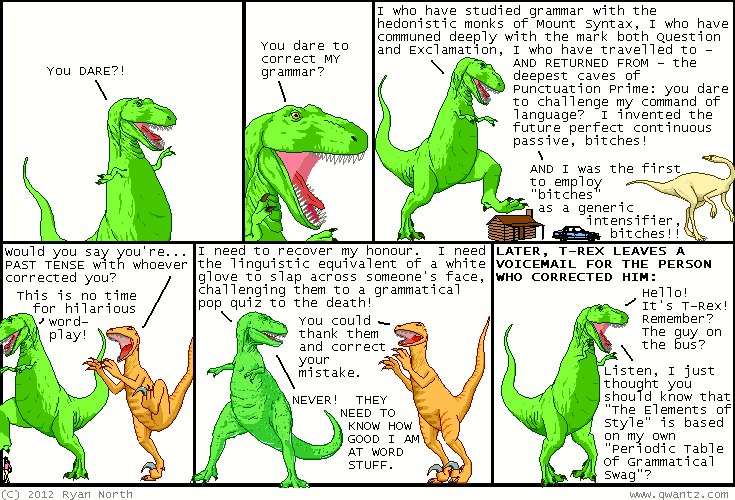
Today’s Dinosaur Comics:

A lot of stuff thrown in there. Soon T-Rex will have been being vindicated (in the future perfect continuous — a k a progressive — passive), bitches. Meanwhile, he claims precedence over Strunk & White.


Writing advice

September 25, 2012

From Henry Mensch on Facebook, this advice on the lifehacker (“Tips and downloads for getting things done”) site (by Adam Pash):

Email Writing Values: Concision, Concision, Concision (by Adam Pash)

Before we get started, I should preempt this post with a concise summary of the helpful suggestions below, in case you don’t want to wade through all that pesky text:

In your email, be brief and to the point.
Cut it down to subject only if you can with EOM.
For most email, try to keep it under five sentences.

What I noticed first was preempt, which is certainly the wrong word. Then the wordiness of the advice, going exactly against content of the advice. And, finally, the choice of concision rather than conciseness. Three very different considerations.

(more…)

From the reflexives files

September 23, 2012

From Steven Weinberg‘s article “Why the Higgs?”, New York Review of Books 8/16/12, p. 78, two conjoined objects with a personal pronoun as 2nd conjunct. First, in par. 5, with the first 1sg pronoun in the piece:

This is what happens in the theory of weak and electromagnetic forces proposed in 1967–1968 by Abdus Salam and myself.

and then, in par. 8, after an occurrence of Salam and I as subject:

One of the consequences of theories in which symmetries are broken by scalar fields, including the models considered by Goldstone and the 1964 papers and the electroweak theory of Salam and me, is that …

That is, Weinberg introduces himself into the text with a reflexive pronoun, myself. A nominative  form I follows, in When Salam and I used ...; after it, an accusative me (and then another nominative I, in Salam and I found …). Those exhaust the 1sg pronouns in the text.

What’s notable about this is the myself, an “untriggered” reflexive, neither anaphoric (with an antecedent in its clause) nor emphatic (doubling another NP, as in He himself did it). The usage literature is pretty much dead set against untriggered myself, which means that this literature doesn’t even consider what writers like Weinberg are doing with it.

(more…)
More perils of advice

September 7, 2012

From the Daily News (of the central San Francisco peninsula) yesterday, in “Man faces federal drug distribution charges: Perry Mosdromos, 46, allegedly sold medications to pay mother’s medical bills” by Jason Green:

Mosdromos, who remains in custody, hinted that the enterprise involves more than one person, according to the affidavit.

“Mosdromos stated the operation is much bigger than he,” [FBI Special Agent Matthew] Beaupain wrote, “however, Mosdromos did not disclose any co-conspirators or elaborate as to how the operation works.” (p. A4)

I’ve boldfaced the relevant clause, which has a nominative pronoun, he, in construction with than — in a context where the nominative strikes me as simply unacceptable; the operation is much bigger than him would have been the way to go.

(more…)

Incorrection

September 3, 2012

Hanged vs. hung came up today on ADS-L, so I quoted from MWDEU‘s nice entry on the subject, with this admirable (and somewhat testy) conclusion:

The distinction between hanged and hung is not an especially useful one (although a few commentators claim otherwise). It is, however, a simple one and certainly easy to remember. Therein lies its popularity. If you make a point of observing the distinction in your writing, you will not thereby become a better writer, but you will spare yourself the annoyance of being corrected for having done something that is not wrong.

That is, the annoyance of being incorrected, a k a miscorrrected.

(more…)

MLC in the news

August 23, 2012

A side-product of abortion in the news: many many cites like these two:

[coordination with and] Mr. Romney has said that abortion should be allowed only in cases of rape, incest and when it would save the mother’s life. (Jim Rutenberg, “The Lowest Common Denominator and the 2012 Race for President”, NYT 8/17/12, p. A15)

[coordination with or] Generally, federal law prohibits federal funding for abortions except in the cases of rape, incest or when the mother’s life is in danger. (Louise Radnofsky, “Remarks Put Spotlight on Definition of Rape”, WSJ online, 8/22/12, here)

These are routine examples of a construction type that has been disparaged as unacceptable — because of a failure of parallelism — by usage critics for at least a century; thanks to the work of Neal Whitman, it’s now known as multiple-level coordination (MLC).

(more…)