Archive for the ‘Constructions’ Category

lx and g&s

August 6, 2025

(Not lox and Gilbert & Sullivan, though that’s a charming idea for a matinee; I’d prefer to think of lx (linguistics) and g&s (gender and sexuality studies) as two gay linguists, Lex and Gus, who go together like, oh, politics and poker (from Act I of the 1959 Broadway musical Fiorello!) — or, more relevantly, like mind and body)

A non-academic friend, new to my net presence, wondered what the things I said my blog is mostly about — lx and g&s — have to do with one another. My immediate, overly glib, reply:

Nothing intrinsic, but they happen to come together in me, along with gardening, Sacred Harp singing, an interest in food and cooking, Mozart and Haydn, and more. Various accidents of history and outgrowths of different parts of my make-up.

Strictly true, but in fact my postings about lx tend to have a lot of g&s content, and my postings about g&s very often end up illustrating points of lx. And sometimes they meld together — as in my recent (from 7/26/25) posting “F-lexicography”, on the semantics of the sexual verb fuck.

So now a quick visit to Lex and Gus’s world, just picking out things from here and there in work by me and my colleagues. Not a systematic survey, just the odd snapshots.

(more…)

The chronicler of lives

June 28, 2025

From  6/19 on Facebook, an exchange between Aaron Broadwell and me (somewhat expanded in this version):

— AB > AZ: Arnold, I wonder if you knew Miriam Petruck, who died about two months ago. [with the link below:]

Linguist List 36.1873, 6/17/25, “In Memoriam Miriam R.L. Petruck (1952-2025)”: by Hans C. Boas, dated 6/14/25

[beginning:] Dr. Petruck was born April 11, 1952. She received her B.A. in Linguistics from Stony Brook University in New York in 1972 and her M.A. in Linguistics from the University of California, Berkeley, in 1976. In 1986, she received her Ph.D. in Linguistics from the University of California, Berkeley, with Prof. Charles J. Fillmore as the head of her dissertation committee. Her dissertation on Hebrew body-part metaphors combined two of her lifelong interests, the scientific study of the Hebrew language and Cognitive Linguistics. Her dissertation was the first one to apply Frame Semantics to linguistic analysis. She became involved in the major research projects which Prof. Fillmore and his colleague Prof. Paul Kay undertook in the 1990s, developing the twin theories of Frame Semantics and Construction Grammar. She participated in the discussions leading to the creation of the FrameNet project (the practical implementation of Frame Semantics) in 1997, helping to define frames and to annotate some of the data in the FrameNet database.

For the rest of her life, she continued to publish and speak about both theories (particularly about Frame Semantics and its application to NLP), at conferences and seminars around the world.

— AZ > AB: I did indeed. Through my regular association with the Berkeley Linguistics Society in the old days. The death notice by Hans Boas on Linguist List focused on her position as a kind of international ambassador for FrameNet.

(more…)

Hooray for constructions, positive licensing, and GKP

January 30, 2025

Yesterday, Laura Michaelis (Univ. of Colorado-Boulder co-author of, among other things, the 2020 Cambridge book Syntactic Constructions in English) alerted me to an article by Philip Miller (Université Paris Cité) & Peter W. Culicover (Ohio State Univ. & Univ. of Washington), “Lexical be“, Journal of Linguistics (2025), 1-24 — truly, hot off the press — which argues, in elegant detail, for a constructional approach to syntactic description, involving the positive licensing of constructions (rather than (negative) constraints on syntactic structures), and also honors Geoffrey K. Pullum (Professor Emeritus of General Linguistics at the University of Edinburgh).

So, yes, a fair amount of technical stuff, showing a bit of how (some) linguists approach the description of the syntax of one language and how they dispute with one another over the form of such descriptions. (I’m mostly just an observer here, but you should know that everyone I just mentioned — Michaelis, Miller, Culicover, Pullum — has been a departmental colleague or co-author of mine, so I have to be seen as a participant-observer, as we say in sociolinguistics.)

(more…)

striking language

October 19, 2024

From Ellen Kaisse in e-mail to me on 10/4 (yes, the blog mill grinds very very slowly on Ramona St.): a nice ambiguity from the Seattle Times, in the first sentence of the story:
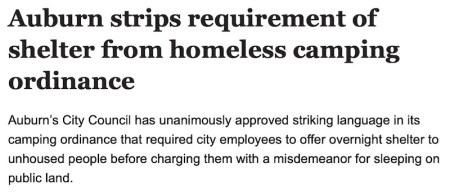

[what EK wrote, with some bracketed amendments by me:] I read striking as an adjective meaning ‘notable’ and modifying language rather than the intended reading where striking is [the nominalization of] a verb with language as its direct object [AZ: the nominalization (together with language and a very long relative clause modifying language) is itself the direct object of the verb approved]. It was only the headline that alerted me that my first reading was the opposite of what was actually approved.

Now if you ask an ordinary person what’s gong on with that sentence, they’ll tell you that it’s ambiguous, and they’ll provide some attempt at a paraphrase (as a sufficient account of the ambiguity), but they’ll simplify things somewhat by disregarding that long relative cause and, in effect, localizing the source of the ambiguity in the expression striking language, telling you that in the Auburn City Council sentence this expression means two different things, ‘notable language’ or ‘removing language’ (from something), and maybe they’ll go on to localize the source even further in the word striking, saying that striking in striking language can mean either ‘notable’ or ‘removing’ (from something).

Ask a linguist, like Ellen or me, and even our briefest answer will go immediately to localizing the ambiguity in specific words that are the crux of the matter. We’ll identify the lexical items involved and supply some relevant properties of the words — what syntactic category they belong to (EK refers explicitly to adjective (Adj) and verb (V) and implicitly to noun (N)); perhaps what derivational and inflectional categories they belong to (implicit in our references to nominalization). And then, especially, we’ll tell you something about the syntactic constructions in which the words are related to one another (we’ll refer to modifying / attributive adjectives, to verbs with direct objects, and so on). Our very brief comments are laden with allusions to the structure of English — its morphology and syntax — as well as to its lexicon.

The linguists’ view is that the lexicon, morphology, and syntax of the language work together in such a way that a stretch of phonological material can convey two different meanings; when we confront an ambiguous expression, we see it not as a brute fact (as if people somehow memorize how phonological substance and semantics are paired with one another, expression by expression), but as the consequence of the system of the language. Surprise! There are two ways you can end up with striking language, two ways the expression can be analyzed. (There are, in fact, more than two; but there are at least the two EK told us about.)

Now I’m going to wade hip-deep into the system of English involved in striking language (and some similar expressions). Not to tell you everything, but to tell you just enough to show you that the system is both big and complex. Therefore, challenging. And therefore, wonderful to figure out. Contemplating stuff like this makes me happy.

(more…)
Making room for new construction grammarians

August 29, 2024

In my mail this morning, from Research Gate, the text of Laura A. Michaelis’s long and rich “Staying terminologically rigid, conceptually open and socially cohesive: How to make room for the next generation of construction grammarians”, in the John Benjamins journal Constructions and Frames 16.2 (August 2024) — in part an homage to Chuck Fillmore (Charles J. Fillmore, 1929 – 2014), but primarily a development of his ideas. And there, in the middle of the abstract, was a reference to my 1994 Berkeley Linguistics Society paper “Dealing out meaning”  (available on-line here), which LM calls my “classic paper” in her article (Chuck himself liked it a lot, but mostly it seemed to have gone without citation, so I thought it had been largely forgotten).

(the Research Gate PDF of LM’s text can be accessed here)

The abstract:

(more…)

The marine biologist on duty

May 25, 2024

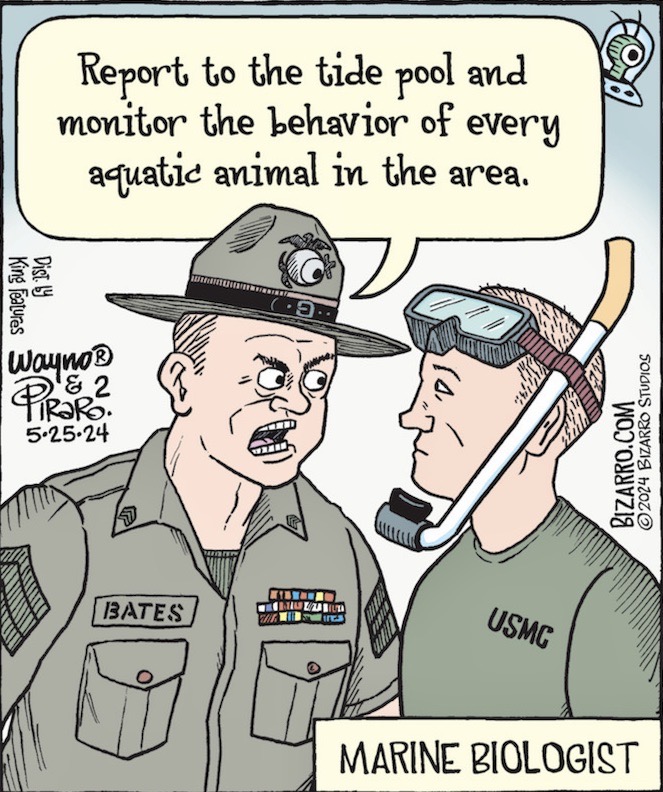
Today’s Wayno / Piraro Bizarro is a little treasure chest of interesting morphosemantics, all from a pun on marine biologist, whose everyday use is to refer to a scientist specializing in marine biology:


But instead we get, unexpectedly,  a biologist who is a marine, assigned to duty monitoring aquatic animals (if you’re puzzled by the odd symbols in the cartoon — Dan Piraro says there are only 2 in this strip — see this Page)

The pun has the USMC noun marine; its base has the sea adjective marine. But that’s just the beginning of the fun.

(more…)

Into the N1 of N2 rat’s nest

May 2, 2024

This is a follow-up to yesterday’s posting “N1 of N2”, where my central point was about two English NP constructions of the form N1 of N2; I claimed to be providing only

a compact [account] that covered the important facts [relevant to the example a variety of celebrations] but didn’t wander into the rat’s nest of related matters

Today is rat’s nest day. The fact is that English has a whole heap of constructions of the form N1 of N2, but only a few are relevant to that example; however, the number of relevant constructions is (by my current reckoning) four, not two; and some of these are related by the processes of historical change.

(more…)

N1 of N2

May 1, 2024

🐇 🐇 🐇 from my 5/1/20 posting “Trois lapins pour le premier mai”:

It’s the first of the month, which I have learned to greet with three rabbits — by starting the day saying “rabbit, rabbit, rabbit”. More than that, it’s the first of May — by some cultural reckonings the beginning of spring in the northern hemisphere and also (in some countries) International Workers Day, so: dance around the maypole, set bonfires for Beltane or Walpurgis, prepare for outdoor bo(i)nking (rabbits again!), break out the lilies of the valley (muguets pour le premier mai), cue the choruses of L’Internationale, and march in solidarity with the workers. (Feel free to choose from this menu, as your taste inclines and your schedule allows.)

But enough of lapins; time to attend to our moutons, the sheep of the day being English NPs of the form N1 of N2 (like bouquet of flowers and tons of stuff) and how they work as subjects of clauses. These sheep came to us on 4/29 from Steven Levine, who wrote on Facebook:

Here’s a sentence I just came across that seems odd to my ears:

By the mid century a variety of celebrations was engaging morris dancers.

I know that the subject is variety [AZ: no no no; the subject is a variety of celebrations; this is important] and the verb is was, and yet it seems off to me — I was expecting were. I’m not asking for a grammatical analysis, I’m asking if this would stop you for a second if you were just reading along.

To which I wrote:

Steven said he didn’t want a grammatical analysis, but here it comes anyway.

I warned you.

(more…)

Love what Scrivan did with the rabbit pun!

April 1, 2024

🐇 🐇 🐇 three rabbits to inaugurate the new month, 🃏 🃏 🃏 three jokers for April Fool’s Day, and 🌼 🌼 🌼 three jaunes d’Avril. yellow flowers of April, all this as we turn on a dime from yesterday’s folk-custom bunnies of Easter to today’s monthly rabbits; for this intensely leporine occasion, a Maria Scrivan hare-pun cartoon:


(#1) (phonologically perfect) pun hare on model hair, taking advantage of I love what you’ve done with your hair as an common exemplar of the stock expression (I) love what you’ve done with X; a cartoon posted on Facebook by Probal Dasgupta, who reported, “Even I groaned at this one”

Things to talk about here: my use of turn on a dime just above; Easter + April Fool’s; the yellow flowers of April (which will bring us to Jane Avril — Fr. Avril ‘April’); and the stock expression (I) love what you’ve done with X.

(more…)

Stand Up To Hate

April 1, 2024

That’s what the fuzzy sign said that was being passed around on Facebook, in appreciation of its unintended ambiguity: it’s supposed to be exhorting us to oppose hate (with noun hate), but it could be telling us to do our hating on our feet (with verb hate); consider some parallels in which the N and V readings are pulled apart:

Stand Up To Hatred [N reading]  OR  Stand Up To Execrate [V reading, with understood object]

Stand Up To Yelling [N]  OR  Stand Up To Yell [(intransitive) V]

Stand Up To Urination [N]  OR  Stand Up To Urinate [ (intransitive) V]

I’ll look at the ambiguity in detail in a little while. But first some words about slogans, like the one on that fuzzy sign.

(more…)