A Zippy with a plaint of minorities of many sorts:

They stare at us. But we are everywhere.
A Zippy with a plaint of minorities of many sorts:
They stare at us. But we are everywhere.
Posted in Linguistics in the comics, Social life | Leave a Comment »
The latest Scenes From a Multiverse:

A play on Google+ and The Social Network.
Posted in Linguistics in the comics, Social life, These modern times | 2 Comments »
From this weekend’s Daily Post (San Francisco peninsula), a front-page story on the “SlutWalk” at Stanford on Friday, with this wonderful photo:

The headline is the rhyming slogan:
A dress is not a yes
on the t-shirt that the young man is wearing (I want this t-shirt); the young woman’s shirt says, forthrightly:
I’m a slut
don’t rape me
Posted in Gender and sexuality, Snowclones, Social life, Taboo language and slurs | 6 Comments »
On the More Is Always Better front, this observation (from Simona Vigna) from the NYT‘s “Metropolitan Diary” of May 9:
My 5-year-old daughter had just finished an instructive week at preschool that revolved around a family theme, when she hit me with this request: “I want 15 moms. I don’t want just you. I want to have 15 mommies.”
Bewildered and with a hint of resentment, I asked why.
She said: “Because some of my friends in school have two mommies. And some have two mommies and one dad. And I want to be like them. I want more mommies, like they have.”
So much for politically correct teaching to preschool children!
Posted in Social life | 1 Comment »
From the NYT obit for actor Farley Granger (written by Neil Genzlinger):
[Alfred Hitchcock, who directed Granger in Rope and Strangers on a Train] “could make the phone book sound intriguing,” Mr. Granger said in his 2007 autobiography, “Include Me Out: My Life from Goldwyn to Broadway,” written with his longtime romantic partner Robert Calhoun.
Yes, longtime romantic partner.
Posted in Categorization and Labeling, Gender and sexuality, Social life, Words | 4 Comments »
One more from the “Metropolitan Diary” in yesterday’s NYT: a letter from Susan Rosenfeld illustrating some cross-cultural differences:
Posted in Language and society, Social life, Sociocultural conventions | 2 Comments »
From The Jack Wrangler Story (by Jack Wrangler and Carl Johnes, 1984), p. 30:
… I hadn’t figured all that [that his father was a perfectionist, an achiever, and a pessimist, and had judged his son to be doomed to failure] out by my seventh birthday. I just knew I felt a new sense of uneasiness. The Big Seven. Seven is that point in life where precocious children start writing sonatas, creative children do murals in the bathroom, tough children hit the hard stuff, and healthy, normal children receive birthday cards showing a brown teddy bear holding up a big orange 7. But if you’re growing up in Tinsel Country [L.A.] and your father is a motion picture producer and your mother is glamorous and you have two gorgeous older sisters and you’re skinny and your ears are too big and your hair is so blond and short that you look bald–well, then seven is the time when the heavy insecurities set in permanently.
Posted in Childhood, Social life | Leave a Comment »
Passed on, without comment for the moment, from Ariel Levy’s “Reservations” (New Yorker of December 13), on the Shinnecock tribe’s push for a casino in the Hamptons of Long Island:
Long Island’s Native Americans have been marrying African-Americans since the seventeenth century, when the Dutch started bringing slaves into New York. John Strong, the premier historian of Native Americans on Long Island, told me, “Slave status was defined by law in terms of the woman–a child becomes property of the mother’s owner. If you’re a slave and you want to make sure your children are free, you marry an Indian woman.”
But if slave status was defined by maternity, racial status was defined by color. “If the father was black and the mother was Indian, or vice versa, and the child comes forward with a claim to Native American identity, the white arbiters say, ‘Oh no, you can’t jump up a notch in the hierarchy–you’re black,’ ” Strong said. “When I came here, in ’65, you’d go into any of the local bars and they would talk about the Shinnecocks as ‘monigs’: more nigger than Indian.” It’s a slur that you still sometimes hear in the Hamptons.
And in conclusion:
Despite the economic transformation that casino would likely bring, she did not think federal recognition was going to change anything. “You’ve got to know that the white man wants this reservation,” [Harriett] Crippen Gumbs said, her white hair shooting out from under a baseball cap. “You know what their excuse would be now?” she asked, and leaned in close over her jewelry counter. ‘You’ve intermarried too much. You’re no longer Indian.’ Well, who the hell are we?”
This, despite their maintaining many customs, including their annual pow-pow and their pattern of tribal governance.
If this were only a matter of folk categorization and labeling, then we could all muddle through with varied, disputed, and changing customs (though monig is just flat ugly). But in this case, as with African-Americans and the labels for them, there are legal consequences of some significance.
Posted in Categorization and Labeling, Language and the law, Social life, Taboo language and slurs | 1 Comment »
A Zippy on reinventing yourself:
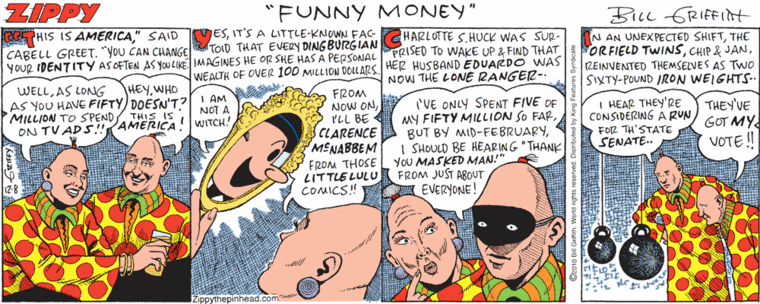
Which brings me to Alexis de Tocqueville and to Alan Ryan’s review of Leo Damrosch’s Tocqueville’s Discovery of America (New York Review of Books, December 9). (more…)
Posted in Categorization and Labeling, Language and society, Linguistics in the comics, Social life | 3 Comments »
A letter to Scientific American Mind (in the November/December 2010 issue) from Greg O’Brien of Gray, Maine:
In Erica Westly’s article “Too Much, Too Young” [Head Lines]. she uses the phrase “autistic toddlers.” I feel it is important that the editors recognize the disrespect inherent in that construction. The reverent phrasing would have been “toddlers with autism,” because people with autism (or any disability) are people first! This sentiment is exactly why we have the Americans with Disabilities Act and not the Disabled Americans Act. I would recommend, or at least request, editing articles of this ilk with an eye out for lapses in judgment.
There’s a shorter expression, autistic toddler, and a longer one, toddler with autism, both have toddler as the head noun, and they’re truth-functionally equivalent. In addition to the length difference, though, they differ as to which of the characteristics, autism or toddlerhood, is mentioned first. Perhaps that’s why O’Brien sees the shorter expression as disrespectful; perhaps he judges that mentioning the autism first highights it. (Though you could also argue that the highlighted characteristic comes with the word that gets the heavier phrasal accent: toddler in the shorter expression, autism in the longer.)
Posted in Language and society, Social life, Terminology | 5 Comments »
You are currently browsing the archives for the Social life category.