Archive for the ‘Social life’ Category

widowered

November 4, 2010

I see that a colleague of mine lists her relationship status on Facebook as “widowed”. Clear enough.

But I say I’m “single”, because that’s the term I have to use on the census and other surveys. I had a wife, but she died 25 years ago. Then I had a male partner, for almost as many years, but then we didn’t count as “married”, so I was “single”. Then he too died, and I was still “single”. By my calculation, I’ve been made a widower twice, but I’ve been “single” since 1985.

What to say about widowered?

(more…)

Update: the law of attraction

September 17, 2010

That’s “like attracts unto like”, pursued with respect to sexual attraction here, though the discussion in that posting veers off at one point into Esther Hicks and the Teachings of Abraham — Abraham is a group consciousness — and somewhat loopy self-improvement material with religious overtones.

Now the loopy stuff is featured in a short “Critic at Large” piece in the September 13 New Yorker: “Power Lines: What’s behind Rhonda Byrne’s spiritual empire” by Kelefa Sanneh, about Byrne’s fabulously successful documentary and book The Secret and its successor The Power (just out, and already topping the best-seller lists). Hicks figures prominently in early versions of the documentary but is erased from later versions and from the two books.

Sanneh manages to be critical and analytical without lapsing into mockery — quite an achievement — though he does get in some wonderful sly digs:

In one passage [of The Power], [Byrne] advises readers to imagine that the front side of a dollar bill is the “positive side,” associated with “plenty of money,” and the back side is the “negative side,” associated with “a lack of money.” Accordingly, she suggests a ritual: “Each time you handle money, deliberately flip the bills so that the front is facing you. Put bills in your wallet with the front facing you. When you hand over money, make sure the front is facing upward.” One can imagine devotees in the distant future holding fast to this practice and repeating this explanation to one another, doing this in remembrance of her.

And this comes in a work that offers (in Sanneh’s words) “a spritual message that claims to be compatible with all religious traditions.”

Who or which?

August 2, 2010

From the Lousy Linguist this morning:

… I stumbled across what appears to be a legitimate, well-meaning, but perhaps somewhat misguided research project: The who/which project. From the project web page:

(more…)

Apology in order?

August 1, 2010

A cartoon to say goodbye to the weekend, from Zits:

This is a stock scene from the parent-child drama: parents examine (by whatever route) things the child intended to keep private from them, and they are distressed, enraged, etc.; the child is distressed, enraged, etc. at this invasion of privacy (Jeremy’s apparent contrition is unusual).

It used to be diaries, letters, face-to-face conversations, and phone calls, but now it’s electronic communications of new sorts, including social media where the expectation of privacy can be much reduced. Still, looking on someone’s computer is like looking at their diary, so Jeremy has some justification for hoping for an apology.

Fair and balanced

July 12, 2010

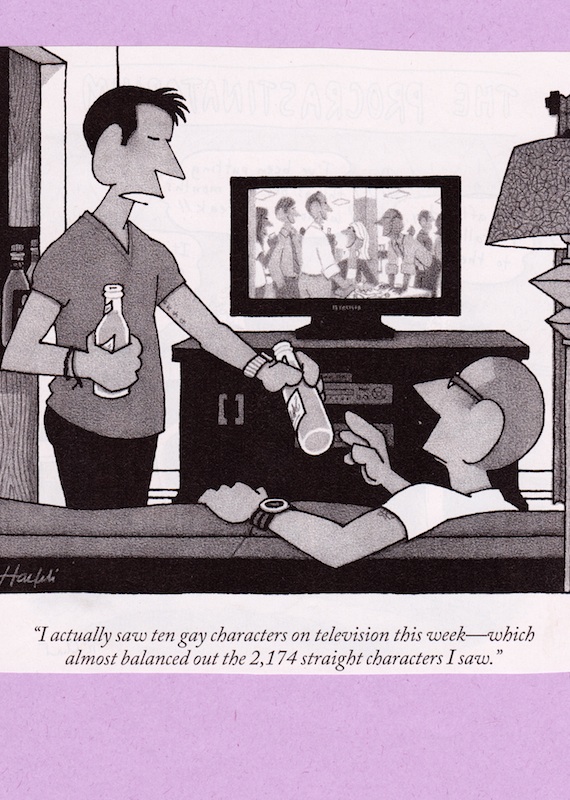
Another cartoon by William Haefeli on gay male life, this time in the May 31 New Yorker:

(Note that the cartoon guys seem to be getting the Haefeli Channel on their tv. Or maybe that’s just the way everyone looks in HaefeliWorld.)

Several things here, some linguistic, some not.

(more…)

Domestic class rebellion: a good haircut ruint

July 10, 2010

(Not a good walk spoiled, but a good haircut ruined.)

Kids often rebel, boldly or subtly, against their parents on norms associated with social class, ethnicity, propriety, gender, and the like. Here’s a Bizarro kid going against his working-class dad:

(more…)

Images of masculinity

July 4, 2010

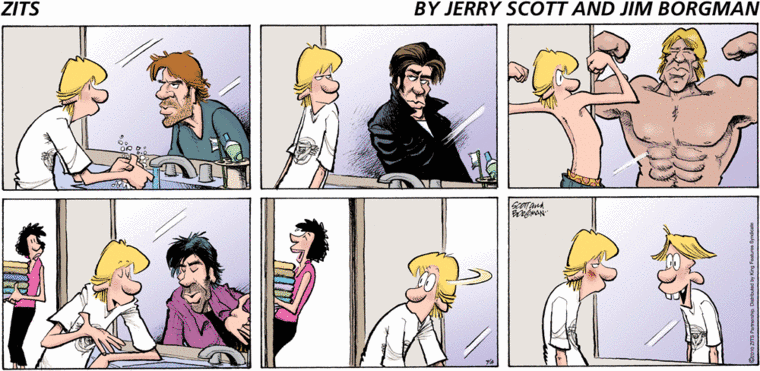
In a poignant episode of Zits, the teenage Jeremy tries out a series of images of grown-up masculinity — what kind of man will I, can I, be? — only to be deflated by seeing himself through his mother’s eyes:

Yes, there’s going to be damn little about language in my brief discussion, so if that’s what you’re after, maybe you should just appreciate the cartoon and go on to something else.

(more…)

We need to talk

July 3, 2010

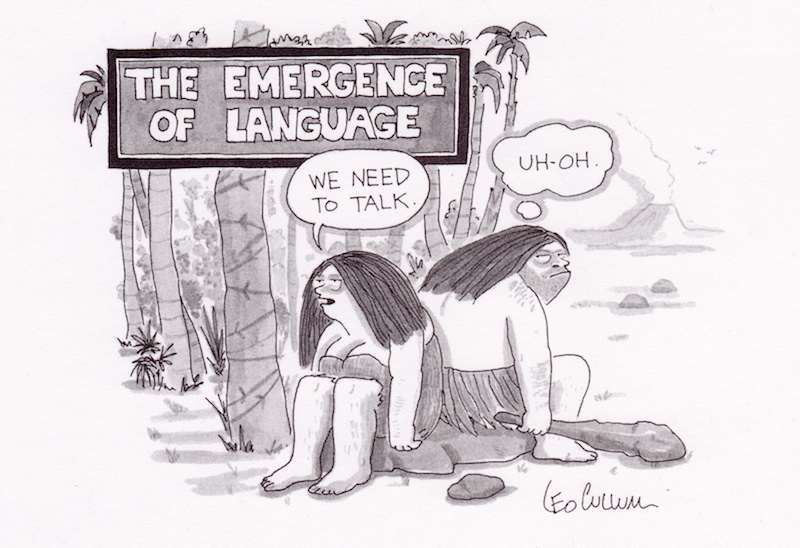
A little while back, we looked at language and the sexes through the eyes of a cartoonist, Don Piraro on “We need to text”. Back in the New Yorker of 12/25/95, Leo Cullum took on “We need to talk” in a different context:

“We need to talk” in this context can have two different imports: as a (socially fraught) statement of necessity implicating a request for couples-talk, or as a statement of necessity for the two of them to begin the evolution of language. The difference between the two can be traced back to the interpretation of the intransitive verb talk, as (respectively) an intransitive verb understood reciprocally (‘We need to talk to/with one another’) and as a plain intransitive; it’s the difference between “Kim and Sandy didn’t talk until they’d known each other for six months” and “As a baby, Kim didn’t talk for six years”.

That’s so gay

June 27, 2010

(Somewhat out of the expected order of postings, so that I can get this out on Pride Day itself — or Priday, as I’ve taken to calling it. This is another posting inspired by randomly selected tracks that have popped up on my iTunes.)

This time it was Pansy Division’s “He Whipped My Ass in Tennis, Then I F****d His Ass in Bed” (as iTunes prudishly insists on printing it; ass-whipping ok in print, ass-fucking not). Which then led me to the Pansies’ most recent album, “That’s So Gay” (2009).

But first a bit of academic play with the word pansy (from the Middle French pensée ‘a thought’):

(The OED draft revision of June 2010 has “frequently derogatory” pansy ‘a male homosexual, an effeminate man, a weakling’ with cites from 1926, in the first sense, through 2003, in the third. The name of the flower goes back to about 1450.)

(more…)

Rivers of Babylon

June 22, 2010

(A posting inspired by a random iTunes playlist. There will be more.)

What came by was the “Megamix” track from Gay Happening — a mix of five Boney M. songs: Rivers of Babylon, Sunny, Ma Baker, Daddy Cool, Rasputin. Boney M. is a disco band that originated in Germany (with West Indian members) in 1975; “Rivers of Babylon” was their greatest hit.

Gay Happening is also German. It stages “die groesste Party fuer Schwule und Lesben in Deutschland” (according to its website) and also puts out, through Dance Street Records, (re)mix albums, lots of them, from these events, suitable for home use with a few hundred of your sweatiest, most sexed-up friends (or for recollecting, or imagining, the pleasures of gay dance parties in the privacy of your own home). In the U.S., other sources put out collection after collection from gay Circuit Parties (more on the Circuit below). Although I’ve never been to a Circuit Party or a Gay Happening (but put in my disco dancing time in gay clubs in the late 70s), I have a rather large collection of these recordings, most of them freebies from gay magazines and gay porn distributors.

So one of the versions of Boney M.’s “Rivers of Babylon” — there are many — came my way. And though I’ve of course been aware, ever since the Boney M. recording came out in 1978, that there was such a thing, I had somehow never reflected on just how peculiar a disco version of this song is: the song is, after all, a Rastafarian lament for the Babylonian captivity of the Jews, scarcely consonant, I would have thought, with the sex-drenched context of gay disco dancing. It’s like dirty dancing to the pulsing beat of the Ave Maria.

(more…)