Archive for the ‘Semantics of compounds’ Category
December 30, 2022
The Wayno / Piraro Bizarro for New Year’s Eve Eve is a goofy amalgam of two different cartoon memes with an egregious pun; Wayno’s title is “Reclusive Russets” (russets being a type of potato). No, of course it doesn’t cohere; that’s what makes it delightful (remember that this strip is called Bizarro).

(#1) If you’re puzzled by the odd symbols in the cartoon — Dan Piraro says there are 5 in this strip — see this Page.
The Potato Head meme (all three characters are Potato Heads) and the seeker and the seer meme (one character is seeker, the other two seers), plus some CRAB / CARB play on the compound noun hermit crab, mountain-top seers being hermits who have removed themselves from ordinary life, and potatoes being carbs, specifically starches (complex carbohydrates )
(more…)
Posted in Abbreviation, Comic conventions, Compounds, Gender and sexuality, Language and animals, Language and food, Linguistics in the comics, Metaphor, Puns, Race and ethnicity, Semantics of compounds | 2 Comments »
October 19, 2022
… and, eventually, how to abracadabra things out of sight. Yes, it’s Verbing Day on AZ Blog!
Politics and real estate: to door knock. It started on the Rachel Maddow Show on MSNBC on 10/11, with the cite presented here in its larger context:

(#1) to door knock / door-knock ‘knock on doors’ (in political canvassing): a N + V verb, whose origin lies in a back-formation from the synthetic compound door knocking / door-knocking
The semantics / pragmatics of the synthetic compound is specialized — not merely knocking on doors, but doing so in specific sociocultural settings (political canvassing and door-to-door solicitations by real estate agents, in particular) — and this specialization is shared by the 2pbfV (two-part back-formed V)
(more…)
Posted in Back formation, Compounds, Context, Conversion, Innovations, Lexical semantics, Nouning, Pragmatics, Semantics of compounds, Synthetic compounds, Verbing | 1 Comment »
September 9, 2022
The 8/11/22 Rhymes With Orange, exploiting an ambiguity in the noun killer as the modifier N1 in N1 + N2 compounds, in this case in killer abs (literal ‘abs that are killers, abs that kill’ vs. figurative ‘abs that are killer / remarkable’):

(#1) In the worlds of advertisements featuring beautiful people, the health and fitness literature, and soft porn, figurative killer abs are commonplace; abs that kill, however, have (so far as I know) never once appeared on a police blotter
Wider topic: the figurative modifiers of mortal power — premodifying killer (killer abs, a killer app), postmodifying of death (the cruise of death, referring to a penetrating sexual facial expression).
Male body parts and sexual connections between men plus a ton of linguistic expressions in their social contexts, what more could I ask for?
(more…)
Posted in Address terms, Beheading, Clipping, Facial expressions, Language and the body, Lexical semantics, Linguistics in the comics, Nicknames, Penguins, Semantics of compounds, Truncation | Leave a Comment »
August 3, 2022
The killing of Al Qaeda leader Ayman al-Zawahiri by a targeted U.S. drone strike (taking him down as he stood on a balcony) over the weekend in Afghanistan was described by an MSNBC commentator yesterday morning as
a stiletto strike: with the N1 + N2 compound N stiletto strike ‘sudden (military) attack resembling a stiletto (in being very narrowly focused lethal weaponry)’; the sense of the N2 strike here is NOAD‘s 2 [a] a sudden attack, typically a military one
Possibly it was stiletto airstrike; it went by very fast, I haven’t seen another broadcast of it, and it’s not yet available on-line, so I can’t check — but I am sure of the N stiletto and the N strike and the intent of the commentator to commend the pinpoint accuracy of the operation.
It seems that the metaphor has been used occasionally in military circles for some years, but very rarely outside these circles, so that it came with the vividness of a fresh, rather than conventional, metaphor — but while it worked well for me (evoking the slim, pointed, lethal daggers of assassins), it might not have been so effective with others, whose mental image of a stiletto is the heel of a fashionable women’s shoe (slim and pointed, but alluring rather than lethal).
Yes, the two senses (plus a few others that I won’t discuss here) are historically related, with the dagger sense the older and, in a series of steps, the source of the shoe sense. But of course ordinary speakers don’t know that, nor should they be expected to (such information is the province of specialists, historical linguists and lexicographers); what they know is how stiletto is used in their social world, and that’s likely to involve trendy footwear rather than medieval weaponry.
(more…)
Posted in Beheading, Beheading, Clothing, Compounds, Conversion, Derivation, Fashion, Lexical semantics, Lexicography, Metaphor, Metonymy, Morphology, Semantics of compounds, Shoes, Truncation, Verbing | Leave a Comment »
July 31, 2022
On this blog, a Bob Richmond comment on my 7/29 posting “Many a pickle packs a pucker”, with an old dirty joke that turns on the line “I stuck my dick in the pickle slicer” — with Bob noting, “I’m sure Arnold can provide an appropriate grammatical analysis”. The hinge of the joke is a pun on pickle slicer, which is ambiguous between ‘a device for slicing pickles’ and ‘someone who slices pickles (esp. as a job)’. You don’t need a syntactician to tell you that, but what I can tell you is that this isn’t some isolated fact about the expression pickle slicer, but is part of a much larger pattern that a linguist like me can bring to explicit awareness for you, so that you can appreciate something of the system of English that you (in some sense) know, but only tacitly, implicitly.
(more…)
Posted in Alliteration, Ambiguity, Argument structure, Compounds, Constructions, Derivation, Jokes, Language play, Lexical semantics, Morphology, Morphology and syntax, Puns, Semantics of compounds, Syntax, Synthetic compounds | 9 Comments »
July 13, 2022
(What can I say? There will be dipsticks and dipshits, so eventually this posting will be at best borderline for kids and the sexually modest.)
News commentator explains that in citing the slogan
You can pay me now, or pay me later. (the pay-me slogan)
the day before, he’d attributed it to the wrong advertiser, adding that the right one was FRAM oil filters. The slogan conveying that you can pay some money now for a good oil filter — or you’ll pay more later when your car breaks down (though of course with wider applicability, conveying at least that you can pay for prevention, or you’ll have to pay more for the remedy).
And then added with a big grin that FRAM was also responsible for the slogan
The dipstick tells the story. (the dipstick slogan)
conveying that you should check the dipstick regularly (and change the oil when it looks dirty) and serving more generally as an exhortation to monitor the state of any important mechanism regularly — in particular, using the sexual slang dipstick ‘penis’, as urging men to check their dicksticks regularly to make sure they’re in working order.
The dipstick slogan came first, 80 years ago. By thirty years into its career, the slang uses of dipstick (for both ‘penis’ and ‘fool, stupid or incompetent person; obnoxious person’) were spreading, so FRAM switched to the pay-me slogan, which is much harder to raunch up (but not impossible, in a world in which high-end prostitutes, of both sexes, accept payment by credit card).
(more…)
Posted in Etymology, Language in advertising, Masculinity, Metaphor, Semantics of compounds, Slogans | 2 Comments »
June 3, 2022
A little study in N + N compounds in English, their great utility and versatility (they pack a lot of content into two-word expressions), and their consequent massive potential ambiguity (so that divining the intended meaning can require vast amounts of background knowledge and appreciating details of the context in which the compound is used). You can have (great) brevity, or you can have (great) clarity, but you can’t have both at once.
From the world of commerce, the compound dog spot (which many of us will not have encountered before, or will take to be a reference to the coat pattern of Dalmatian dogs). From the comic strips, two compounds that have conventional interpretations but can also be understood in fresh and unconventional ways: from One Big Happy, dancing school; from Bizarro, cowboy.
(more…)
Posted in Ambiguity, Brevity vs. Clarity, Compounds, Context, Lexical semantics, Linguistics in the comics, Music, Pragmatics, Semantics of compounds, Snowclonelet composites | 2 Comments »
May 16, 2022
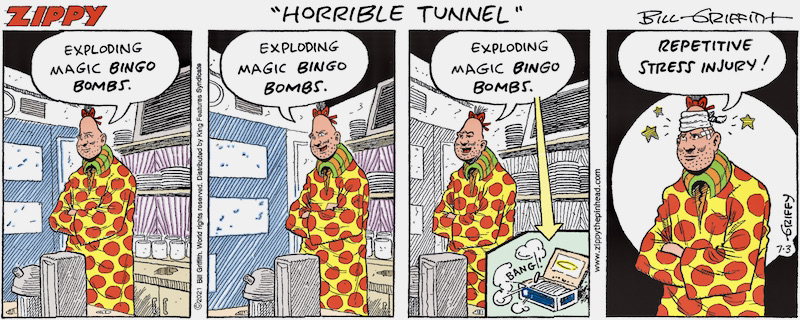
Today’s morning name, which led me back to an onomatomanic Zippy strip from 7/3/21 (yes, I work extremely slowly):
(#1) Zippyesque repetitive phrase disorder, aka onomatomania, fixated on exploding magic bingo bombs
This being a Zippy strip, exploding magic bingo bombs are a real thing; Bill Griffith doesn’t just make up stuff like this.
(more…)
Posted in Books, Gender and sexuality, Language play, Lexical semantics, Linguistics in the comics, Morning names, Pranks, Semantics of compounds, Toys and games | 2 Comments »
May 11, 2022
Today’s Mother Goose and Grimm, with the POP (phrasal overlap portmanteau) Edgar Allan Po’ Boy = Edgar Allan Poe (the American writer and poet) + po’ boy (the superb New Orleans submarine sandwich):

(#1) Edgar Allan Po’ Boy is a N1 + N2 compound N, understood as having the head, N2, semantically associated with the modifier, N1, by (the referent of) N2’s being named after (the referent of) N1 — parallel to the Woody Allen Sandwich (a tower of corned beef and pastrami) at NYC’s Carnegie Deli
(Plus the allusion to Poe’s poem The Raven — Quoth the raven, “Nevermore” — in Grimm’s, “I had it once, but… nevermore”.)
If you were a betting person, you would surely put some money on this MGG strip as not being the first to use this particular POP — of course, that would be fine, it’s all in how you develop the joke — and you would win.
Just on this blog, in Zippy postings from 2016 and a Rhymes With Orange posting in 2017.
Plus bonuses: a texty with a pun turning on the ambiguity of /póbòj/ as either po’ boy or Poe boy; and two cartoons turning on Edgar Allan Poe / Po’ Boy understood as a Source or Ingredient compound (parallel to shrimp po’ boy) — yes, Edgar Allan Poe in a po’ boy, in it, good enough to eat.
(more…)
Posted in Ambiguity, Compounds, Language and food, Lexical semantics, Linguistics in the comics, Parodies, Phrasal overlap portmanteaus, Poetry, Puns, Semantics of compounds | Leave a Comment »
May 3, 2022
(Men’s genitals, man-on-man sex, lots of street talk about them, entirely unsuitable for kids and the sexually modest.)
The Merry Homomonth of May on my two male calendars for 2022: the Tom of Finland calendar (which is mostly free of naughty bits) in my living room, where visitors (I do have an occasional one) can see it; the Cocky Boys / CockyBoys / Cockyboys calendar (which is all about the naughty bits) stashed away in my bedroom, where it can be viewed from my bed and so can provide me with an inspirational penis boost as called for by the exigencies of the moment.
So, in order: the ToF, which turns out to be primarily (though not exclusively) about gay men’s nipples, or tits, as we usually call them (metonymically); and then three months of CockyBoy cocks (April through June).
(more…)
Posted in Categorization and Labeling, Compounds, Effeminacy, Gay porn, Gender and sexuality, Homosexuality, It's Just Stuff, Language and the body, Male art, Masculinity, Metaphor, Metonymy, My life, Semantics of compounds | Leave a Comment »