Archive for the ‘Semantics of compounds’ Category
May 1, 2022
🐇 🐇 🐇 pour le premier mai. A follow-up to yesterday’s posting “My allergic ass”, which was (mostly) about pronominal ass — possessive pronoun + ass, used of a person, to refer not to their buttocks but to that person: his ass ‘he, him’, your ass ‘you’, my ass ‘I, me’.
[Ambiguity may ensue: my ass is warm can mean either ‘my buttocks are warm’ or ‘I am warm’ (you have to figure out from context which was intended); while my ass is heart-shaped is probably about my buttocks (well, I might be Candy Man, shaped like a candy heart), and my ass is allergic is probably about me (though I might conceivably have buttocks afflicted by contact dermatitis).]
Now: through Facebook discussions, two different threads have emerged from that posting: one about material in a long citation in the 2006 Beavers and Koontz-Garboden paper on pronominal ass; the other about the source of the example — my allergic ass — that provoked my posting.
(more…)
Posted in Clothing, Compounds, Expressive language, Gender and sexuality, Homosexuality, Language and food, My life, Phonetics, Phonology, Phrasal overlap portmanteaus, Puns, Semantics of compounds, Underwear, Variation | 1 Comment »
April 27, 2022
(This has turned out to be quite a large meze, but it’s only about one idiomatic slang expression. Well, men and masculinity come into the thing, and you know what can happen then.)
Reflecting a couple days ago on my Princeton days (1958-62) and the tangle of the attitudes of the (all-male) students at the time towards (among things) masculinity, male affiliation (as systematized in a pervasive system of male bands, the eating clubs of the time), women, homosexuals, race, and social class. The topic is vast, also deeply distressing to me personally, and I suspect that I’ll never manage to write about the bad parts of it in any detail — note: there were some stunningly good parts — but in all of that I retrieved one lexical item of some sociolinguistic interest (and entertainment value), one slang nugget: the idiomatic N1 + N2 compound noun face man / faceman / face-man.
A common noun frequently used among my friends, which was then also deployed as a proper noun nicknaming one of our classmates, a young man notable for his facial male beauty: everybody had to have a nickname (mine was Zot, for the Z of my name and the cartoon anteater), so we called him Face Man because he was a face man.
(more…)
Posted in Categorization and Labeling, Common vs. proper, Faces, Gender and sexuality, Homosexuality, Idioms, Innovations, Language and gender, Lexicography, Masculinity, Metaphor, Movies and tv, Music, Nicknames, Semantics of compounds, Slang | Leave a Comment »
June 16, 2021
Smells like queer teen spirit.
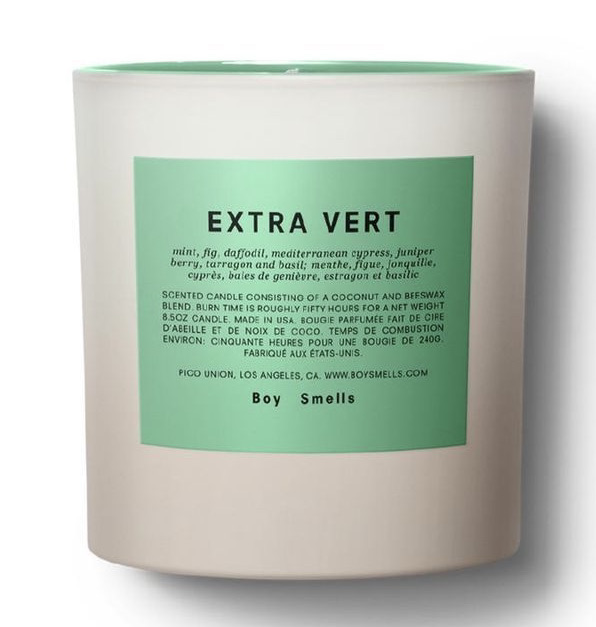
Ads for the Boy Smells company have been popping up with some regularity in my Facebook feed — no doubt because I posted a while back on some fragrances for men, one of the two scented product lines the company offers, the other being candles. A third line is underwear, all of it explicitly labeled by the company, “This comes unscented”, but in an ad for Boy Smells products, it’s hard not to think of pungent teenager skivvies. Some ads combine the boy image of actor Tommy Dorfman with an Extra Vert Candle. Ad copy:
Discover the intimate world of Boy Smells with unique candles, fragrances & underwear. 10% of Proceeds From The Pride Collection Will Be Donated to Support the Trevor Project [providing suicide prevention efforts among LGBT+ youth].

(#1) The boyish Tommy Dorfman, something of a queer, and genderqueer, icon — attired in jade

(#2) French vert ‘green’ (suggesting the green herb tones in the scent) + extravert / extrovert ‘an outgoing, expressive person’
(more…)
Posted in Ambiguity, Gender and sexuality, Movies and tv, Semantics of compounds, Smell, Trade names, Underwear | 1 Comment »
April 13, 2021
An ad in my Facebook feed for a Gay Therapy Center, which briefly gave me pause because of an ambiguity in the Adj + N composite gay therapy. Now, Adj + N composites, like N + N compounds, are notoriously open to multiple understandings, even if we restrict ourselves to general patterns for the semantic relationship between the two parts. In this case, I had a moment of deep unease that gay therapy was to be understood as a treatment composite, parallel to treatment compounds: pain therapy, flu therapy, cancer therapy, etc. ‘therapy to treat condition or disorder X’. Thus viewing homosexuality as a disorder, which would make gay therapy here a synonym of the now-conventional label conversion therapy, for a scheme that proposes to treat homosexuality and cure it.
But, whew, no. The Gay Therapy Center in San Francisco (with a satellite center in Los Angeles) offers “LGBTQ therapy to help LGBTQ people love themselves and each other” — with the composite gay therapy understood as ‘therapy for gay people, to help / benefit gay people’. Indeed, the Facebook ad offered brief videos showing male couples embracing affectionately (other ads have female couples as well). A still from one of these:

(more…)
Posted in Ambiguity, Compounds, Gender and sexuality, Language and medicine, Semantics of compounds | 1 Comment »
February 21, 2021
Two One Big Happy cartoons recently in my comics feed. Originally from 1/29, a strip in which Ruthie misunderstands “Randi with an “I””, taking it to be “Randi with an eye”. And originally from 1/25, a Sunday strip in which Ruthie misunderstands “pole dance”, taking it to be “Pole dance”.
(more…)
Posted in Ambiguity, Dance, Linguistics in the comics, Names, Nicknames, Semantics of compounds | Leave a Comment »
February 19, 2021
(The kinky sense of band — ‘restraint’ — in the Rhymes cartoon drifts into some hard-core sex between men, so that partway through, this posting becomes no longer suitable for kids or the sexually modest.)
The Rhymes With Orange cartoon from yesterday (2/18) has two lobsters arranging a hookup for some kinky sex with lobster bands:
 (#1)
(#1)
The elastic bands in question are rubber or silicone bands referred to commercially as lobster bands. They function as restraints on the lobsters’ ability to use their claws — so that they’re roughly analogous to the cuffs / bands / restraints of bondage sex, hence the kinkiness in the cartoon.
(more…)
Posted in Ambiguity, Gender and sexuality, Language of sex, Linguistics in the comics, Names, Semantics of compounds | 2 Comments »
December 29, 2020
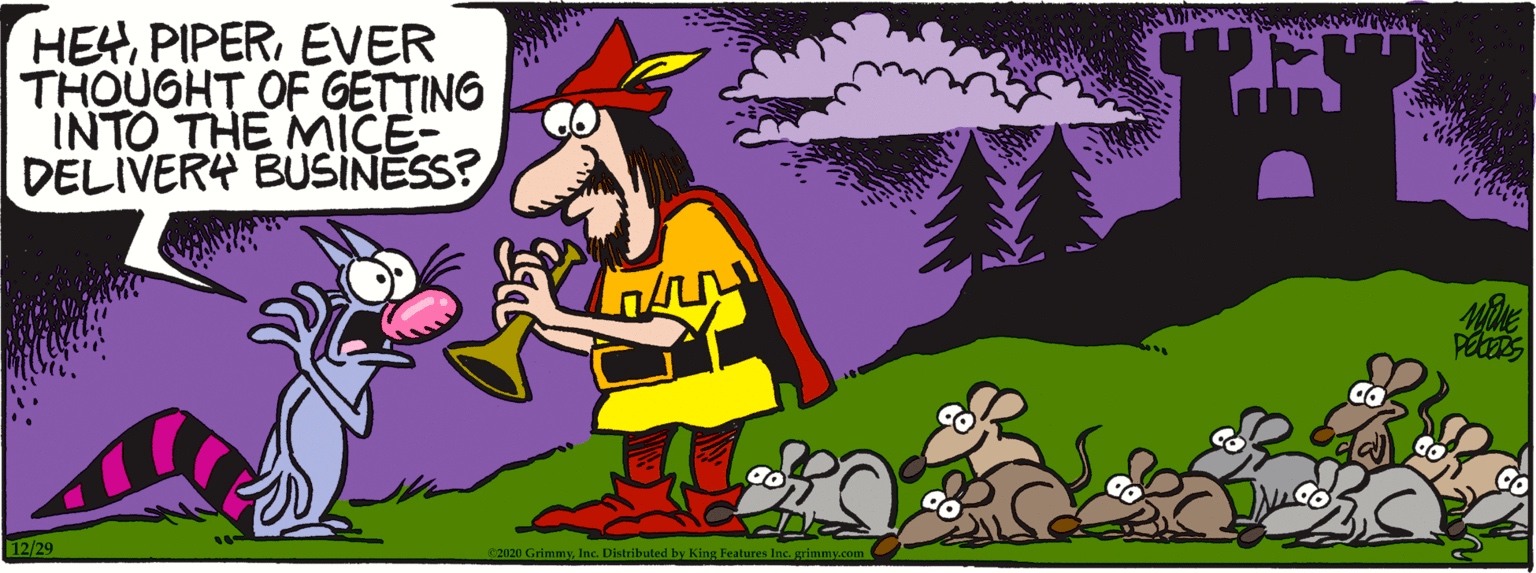
Today’s Mother Goose and Grimm cartoon has the cat Attila appealing to the Pied Piper for his help in the mice-delivery business:

mice-delivery business is a N+N compound with first element mice delivery — itself a N+N compound, with first element mice. And mice is quite clearly a plural form.
It then turns out that compounds of the form mice + N (with a clearly plural first element) have a certain degree of fame in linguistics.
(more…)
Posted in Compounds, Linguistics in the comics, Morphology, Semantics of compounds | Leave a Comment »