Archive for the ‘Lexical semantics’ Category

The headline writer’s dream story

March 21, 2024

Yesterday’s news from East Sussex (the old original Sussex, in southern England), a Sussex News story (by Jo Wadsworth) that kicks off with this juicy summary sentence:

A handyman who masturbated over a tenant’s knickers has been acquitted of criminal damage. 

The story is pretty much unavoidably raunchy, given the nature of the offense; nobody writes stuff like commit an obscene act these days. The reporter used the technical and punchier masturbated in the intro, I’d imagine because it was compact, but then opted for the euphemistic pleasured himself in the full story, which continues:

Simon Lawrence, 55, had been called to fix a faulty washing machine when he entered Joanna Hatton’s bedroom at the cottage she rented with her partner Thomas Jones.

But he didn’t realise the couple had installed a motion sensor camera there to watch their cat.

The couple were driving to Somerset for Christmas when Joanna got an alert on her phone that the camera had been activated on 19 December, 2022.

She watched in horror as Lawrence laid out her underwear on the bed and began pleasuring himself.

The reporter must have yearned to use the British slang wanked, which is vulgar but what ordinary people say in the UK. But you can’t talk like that in a respectable newspaper (though the tabloids can go pretty far).

But there would be room to veer towards vulgarity in the head; in fact, this is a dream story for an alert headline writer, who while casting about for alternatives to masturbated, to knickers (which is kind of giggly slang but not vulgar, and which doesn’t have to get into the head), and to be acquitted (which is legalese), might hit on the possibility for a somewhat rude pun on ‘masturbate’ vs. ‘be acquitted ‘, via the phrasal verb get off.

Or, of course, a headline writer might go for get off rather than be acquitted just because it’s a bit shorter (writing heads is sometimes like solving a devilishly complicated puzzle), in which case they could come up with the actual Sussex News headline in all innocence (until the laughter rolled in):
(more…)

The Bizarro dog park

March 3, 2024

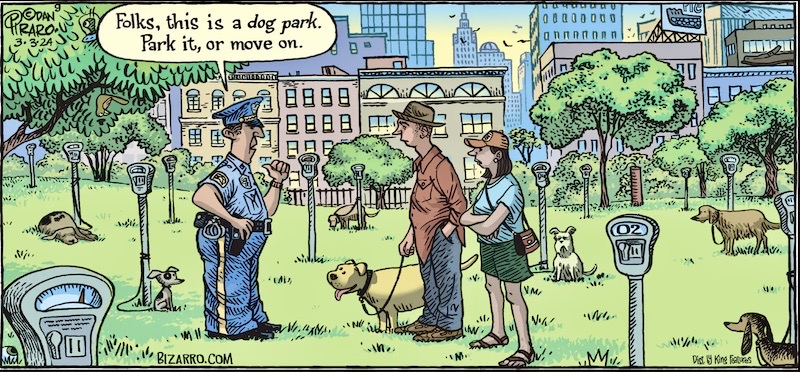
In today’s Bizarro, a dog park, with parking meters, where you can park your pooch by the hour:

Surprise! The strip exploits a possible sense of the N+N compound dog park — roughly, ‘an area or building where dogs may be left temporarily, for a fee’, the canine analogue of (largely British) car park ‘an area or building where cars or other vehicles may be left temporarily; a parking lot or parking garage’ (NOAD) — that you probably had never imagined.

Instead, you expected the everyday sense of dog park, ‘a park for dogs to exercise and play off-leash in a controlled environment under the supervision of their owners’ (Wikipedia) — a Use compound with the general meaning ‘park for dogs (to use)’, but coming with a sociocultural context that in practice conveys something considerably more specific.

Now, more details on everyday dog parks, and Bizarro dog parks too.

(more…)

It’s a mystery

March 2, 2024

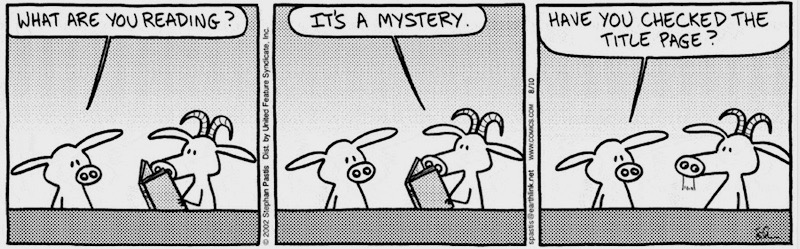
Very much a MQoS Not Dead Yet posting, as I’m barely functioning after one of those stunning drops in air pressure. Hanging around on my desktop for just just an occasion, this mystery-pun Pearls Before Swine cartoon from 2002 featuring Pig and Goat:


Pig, who has the personality of a trusting (but sometimes ignorant) child, assumes Goat doesn’t know the title of the book he’s reading — so does everything but point to the front of the book, to show that title.

Goat’s reply in panel 2, It’s a mystery, is ambiguous. Notably because mystery is ambiguous in this sentence. But so is it. And these two ambiguities are linked, by virtue of an ambiguity as to the construction they’re in. Now I’m going to cut a lot of corners in my discussion, because I’m barely able to get this posting done

(more…)

Baby foods

February 29, 2024

🐅 🐅 🐅  three tigers for ultimate February; for Leap Day, the US is having wild weather (four days of cold rain predicted here on the SF peninsula, where the first flowering fruit trees are already in bloom)

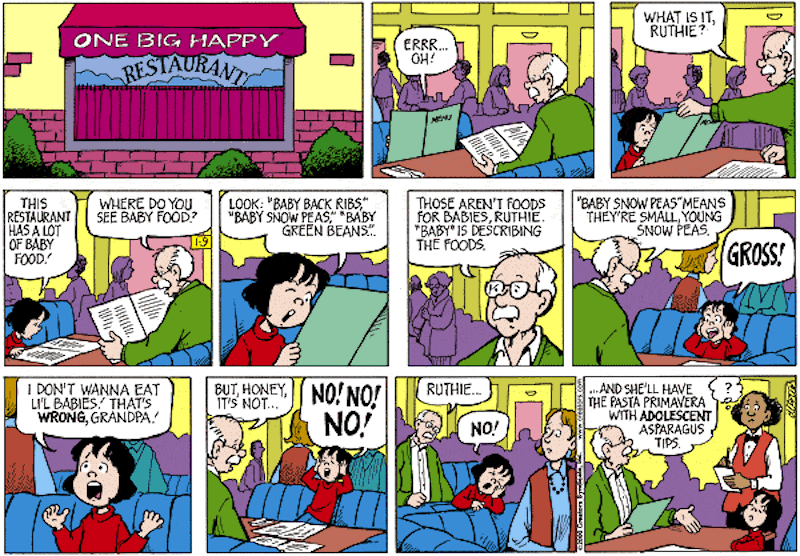
An old One Big Happy strip that turned up in my comics feed recently. The linguistic point is a familiar one on this blog, the enormous potential for ambiguity in N + N compounds in English:


(#1) baby back ribs, baby snow peas, baby green beans, with N1 baby ‘young, immature; small, insignificant (in comparison with others of its type)’ (the sense on the menu) versus baby food, baby carriage, baby book, with N1 baby ‘intended for (use by) a baby’ (the sense Ruthie understands)

The contrast is between two semantic interpretations of the relationship between the modifier N1 and the head N2 in these N1 + N2 compounds.

On the one hand, baby food ‘food for a baby’ is what I’ve called a Use compound; Use compounds (‘N2 for (use by/on/in) N1’) are very common, and sometimes present a pesky ambiguity with also very common Source compounds (‘N2 made from N1’) — some contrasts: Use compound saddle oil ‘oil for (use on) saddles’ vs. Source compound mink oil ‘oil made from minks’ (ugh, but true); Use compound snow tire ‘tire for (use in) snow’ vs. Source compound snowman ‘(simulacrum of a) man made of snow’. The snow examples come from my 1/25/23 posting “Snow tires” on Use vs. Source compounds, taking off from

a classic Don Martin Mad magazine cartoon for the winter season, illustrating the utility and flexibility of N + N compounds in English — and also their enormous potential for ambiguity, which has to be resolved in context

… [with] four examples of N1 + N2 compounds in English, all four highly conventionalized  to very culture-specific referents. In these conventionalized uses, two (snow tiresnowshoe) are use compounds …, two (snowmansnowball) are source compounds … But N + N combinations are potentially ambiguous in  multiple ways; this lack of clarity is the price you pay for the great brevity of these combinations (which lack any indications of the semantic relationship between the two elements).

So: [in the cartoon] we get snow tire and snowshoe understood as source compounds …: ‘(simulacrum of a) tire made of snow’, ‘(simulacrum of a) shoe made of snow’.

On the other hand, baby back ribs ‘back ribs (of pork) that are smaller than the usual (spareribs)’ is what I will now label an Attributive compound, in which some characteristic that’s metaphorically associated with N1 is attributed to N2. Only a few Ns have been conventionalized for use in Attributive compounds: baby for attributing relative smallness (in baby back ribs) or immaturity (in baby peas); giant and monster ‘gigantic, huge’ for attributing (relative) great size (in giant marigold and monster truck); killer ‘exceptional, impressive’ for attributing excellence (in killer abs and killer idea). Since only a few Ns have been conventionalized in this way, Attributive compounds are not very common. But there’s another compound type that’s fairly common and superficially resembles Attributives: what I’ll call the Predicative type, conveying ‘N2 that’s a N1’: baby prodigy ‘baby who’s a prodigy’, killer clown ‘clown that’s a killer’, cowboy poet ‘poet who’s a cowboy’. (The compound killer clown is then ambiguous as between Attributive and Predicative: someone who’s really good as a clown vs. a clown that kills.)

(more…)

You’ve been seeing other fish

February 1, 2024

🐇 🐇 🐇 trois lapins to inaugurate the little month of February (which stretches this year to 29 days), beginning unfortunately in these parts in cold rains that will last for a week, and (this morning) in low air pressure that makes my joints so painful that I can barely get this posting typed and has depressed my vital signs (blood pressure, pulse rate, body temperature) so much that I’m light-headed, unsteady on my feet, and muzzy-minded (the upside is that low air pressure inevitably goes on to rise, so that if I can hang on a while things will get better)

But I’m not dead yet, and (for reasons I don’t understand) I’m not at all depressed — low air pressure often causes me to break into weeping in despair at the slightest provocation, and the unbroken gloom of these days would test anyone — just pissed off at being so incapacitated.

My morning has been cheered by today’s Rhymes With Orange comic strip (involving a talking pet fish and its keeper), which plays in a surprising way with two of the many verb senses of see:

Minimal lexicographic facts about the senses of see involved in this strip, from NOAD:

verb see: 1 [a] perceive with the eyes; discern visually … 4 [a] meet (someone one knows) socially or by chance … [c] meet regularly as a boyfriend or girlfriend

On hearing “You’ve been seeing other fish”, most people would understand it to be conveying sense 4c (for reasons I’ll explore below); what’s funny is that the strip sets things up — via three pieces of evidence that the keeper has just been to an aquarium, a place people go to to watch fish — so that we will take the fish to be using the unexpected sense 1a: surprise!

(more…)

Morning names: kelp and skulk

January 15, 2024

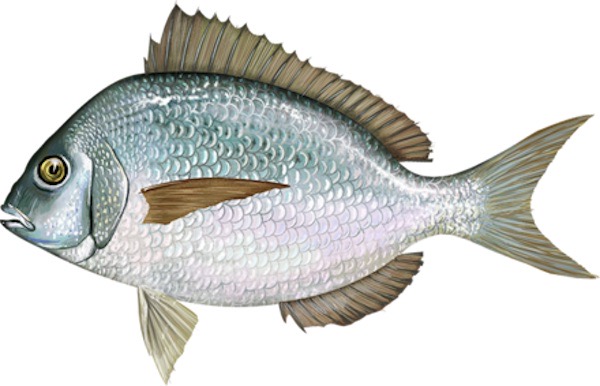
Immediately, I thought: Kelp and Skulk, Attorneys at Law, famously slimy and devious. But what came into my head on awakening was just the noun kelp, for the algae; and the verb skulk, roughly ‘lurk’. Suspiciously similar to one another phonologically. If you combine them, you get the name of a common fish, the scup. And each of them spins off a huge range of phonologically similar and possibly thematically related words.

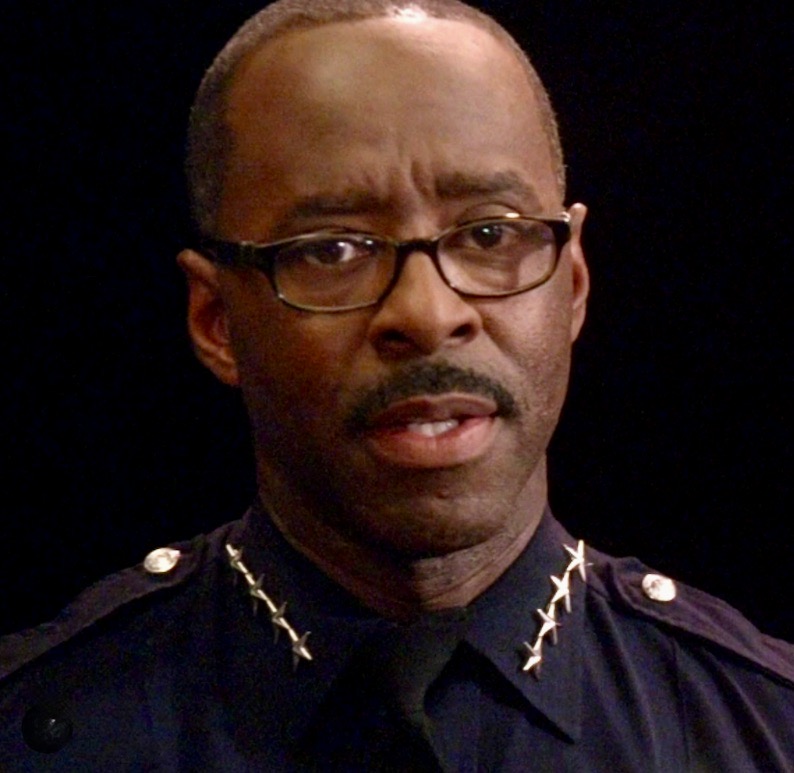
I did have an idea of how kelp and skulk got into my head — through a proper name that’s phonologically similar to both of my morning names: the surname Delk. The last name of a character on the American tv show The Closer, which I’d watched two episodes of last night: Thomas “Tommy” Delk, a fictional Chief of the Los Angeles Police Department (beautifully portrayed by Courtney B. Vance).

Scup the fish and Delk the cop:


(#1) Stenotomus chrysops, a porgy; and (#2) Tommy Delk, a chief

(more…)

Randy elves, coming in Latin, and a Korean feast

December 26, 2023

(The randy elves of 12/22/23 are engaged in 3-way man-on-man sex, described here by its makers in street language, so this part of the program is unsuitable for kids and the sexually modest (IF THAT’S YOU: DO NOT READ); the rest of it is about a variety of seasonal customs, some of them off-beat but none requiring policing (PLEASE READ AND ENJOY))

In my title: highlights of the first day of the three-day run-up to Christmas 2023.

Each day provides two occasions to celebrate:

— 12/22/23: CAYF (the gay porn movie Cum All Ye Faithful) climax day, with that Christmas-elf 3-way sex as the centerpiece of the final scene in the movie and the title of the movie distantly connected to the Christmas carol in Latin, Adeste Fideles; and Festoonus (celebrated at my house with that Korean feast)

— 12/23/23: Last day of Saturnalia; and Festivus

— 12/24/23: Fourth Sunday of Advent; and Christmas Eve (finally, two well-known holidays — though how Christmas Eve is celebrated varies enormously)

Notes on the first two days, on which fall four occasions of minor rank (at least in the modern world).

(more…)

Kissing the proverbial you know what

December 20, 2023

From the Raw Story site, “‘The stain is on you’: Ex-RNC chair slams GOP for silence on [GP]’s call for blood purity” by Matthew Chapman on 12/18/23 (in this story [GP] refers to (Helmet) Grabpussy), beginning:

The Republican Party at large owns former President [GP]’s increasing descent into fascistic and racist rhetoric, former GOP chair Michael Steele told MSNBC’s Katie Phang [sitting in for the host of “The Beat With Ari Melber”] on Monday.

This comes as [GP] stated at a rally that immigrants are “poisoning the blood of our country,” language that has clear roots in Nazi Germany — and Sen. Lindsey Graham (R-SC) defended it furiously when cornered by reporters.

“Michael, it is not just [GP] that’s doing the bad thing, it’s the enablers that are doing the bad thing,” said Phang. “We all know why they are kissing the proverbial you know what. And, when you have somebody like Marc Short [Republican operative, chief of staff to Vice President Mike Pence] saying ‘I doubt that [GP] has read Mein Kampf,’ I don’t disagree with him, I don’t think he has the capacity to read, but it is not the point. These people enable [GP] to be able to say this with zero consequence.”

In the crucial quote, boldfaced above, Phang was choosing between two idioms, both of the form kiss + object, both expressing submission to someone: the elevated idiom (with the C[ount] Sg object noun ring):

kiss someone’s ring or: kiss the ring

and the vulgar slang idiom (with the M[ass] Sg object noun ass):

kiss someone’s ass or: kiss ass

In any case, Phang chose to indicate that she was using a formulaic expression, via the formula-signaling adjective proverbial modifying the head noun of the object. She said kiss the proverbial X and not kiss proverbial X, and that would seem to indicate that she was using the elevated idiom (with ring), which comes with a definite article, and not the vulgar idiom (with ass), which is anarthrous: kiss the ringkiss the proverbial ring; kiss asskiss proverbial ass.

But we can feel pretty sure that she was aiming for the vulgar idiom, because she also used a scheme for avoiding taboo words (like ass ‘buttocks’ or ‘anus’): the filler you know what replacing the taboo item (I’m not going to kiss (his) you know what, He told me to stick it up my you know what).

The result is that at first glance she just looks confused, mixing features of the two competitors for a submission idiom. But it turns out that the syntax of formula-signaling proverbial is more complex than I had thought, and she was saying exactly what she intended.

(more…)

A visual sense-shifting pun joke

December 8, 2023

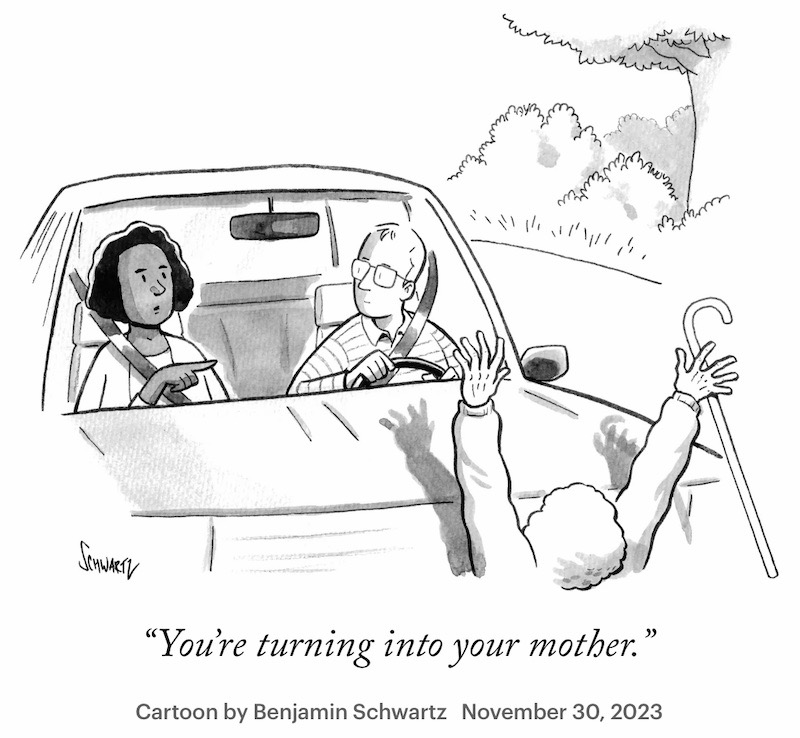
By Benjamin Schwartz in the 12/11/23 print issue of the New Yorker:

On first looking at the cartoon, we go to the faces, because faces are so socially important to human beings. There are two: a woman, speaking; and her male companion, the driver of the car they are in, his face turned to listen to her. She is voicing an observation (usually a complaint)  that is conventionally and stereotypically taken be to common in intimate couples in our society, that the addressee is turning into — becoming, in significant ways — one of their own parents.

In any case, what we perceive at first is the passenger telling the driver: You’re turning into your mother, with inchoative turn into ‘become’.

But then we take in the rest of the drawing, where we see — surprise! — an old woman, up against the hood of the car, her hands up in the air, her cane flying into the air; the car has run into her. The passenger is in fact observing to the driver that he’s driving into the old woman, using one of the senses of motional turn into, with a complement referring to the end-point of the turn.

(more…)

Slutty T-Rex

November 30, 2023

🐅 🐅 tiger tiger for ultimate November, also St. Andrew’s Day (Scotland’s national day); meanwhile, I bring you two dinosaurs trading ideas about popularity and sluttiness

A pair of Ryan North’s Dinosaur Comics strips, coming in succession on 11/10 and 11/13, in which T-Rex rambles on to his buddy Utahraptor about a fairly well-known paradoxical-sounding phenomenon in social networks, the friendship paradox. Actually, it applies more generally, and I’ll talk you through the (apparent) paradox in the general case. Yes, I’ll get to the comics, and to the way T-Rex uses the adjective slutty, but first let’s talk about your lunch partners.

The symmetric-relation paradox. Brace yourself for some mathematician-talk, but don’t despair: I’ll work up a concrete example (about you and your lunch partners) along the way.

Consider a a set N (for example, the set of people in a social network) and a symmetric relation R between members of N; R might be being friends with, say, or having gone to grade school with or — my concrete example — having had lunch with. Then for any member m of N (like you, for definiteness), define m’s R:N-cohort to be the set of members of N that m bears R to (like, the set of all your lunch partners), and m’s R:N-index to be the size of m’s R:N-cohort (like, how many lunch partners you’d had). Then it can be shown that, on average, the R:N-indices of members of m’s R:N-cohort are greater than m’s R:N-index — like, on average, the number of lunch partners your lunch partners have had is greater than the number of lunch partners you have had. Yes, it sounds paradoxical. But it’s provably so.

Now, listen up: what the symmetric-relation paradox does not say is that (all) your lunch partners have more lunch partners than you do. That would be genuinely paradoxical. All it says is that the (arithmetic) mean of their lunch-partner figures is higher than yours, which is a great deal less thrilling (though it still has a whiff of the perverse about it). So let’s look at the special case, the friendship paradox, where N is a social network and R is the being friends with relation (which is where T-Rex starts in his Dinosaur Comics ramble, before he goes on to the having had sex with relation (parallel to the having had lunch with relation) and to sluttiness, having had many sexual (rather than lunch) partners.

(more…)