Immediately, I thought: Kelp and Skulk, Attorneys at Law, famously slimy and devious. But what came into my head on awakening was just the noun kelp, for the algae; and the verb skulk, roughly ‘lurk’. Suspiciously similar to one another phonologically. If you combine them, you get the name of a common fish, the scup. And each of them spins off a huge range of phonologically similar and possibly thematically related words.
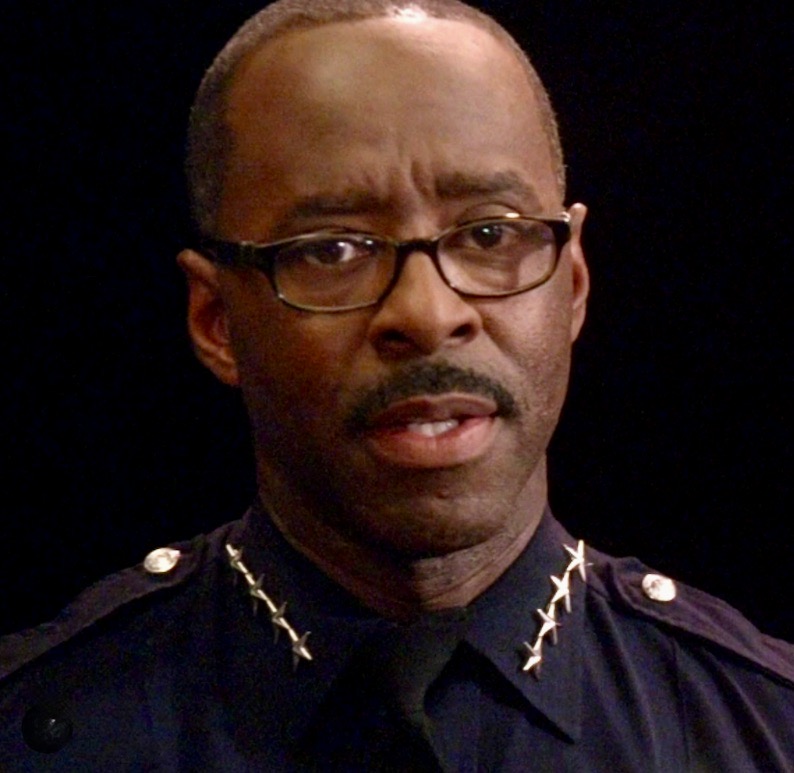
I did have an idea of how kelp and skulk got into my head — through a proper name that’s phonologically similar to both of my morning names: the surname Delk. The last name of a character on the American tv show The Closer, which I’d watched two episodes of last night: Thomas “Tommy” Delk, a fictional Chief of the Los Angeles Police Department (beautifully portrayed by Courtney B. Vance).
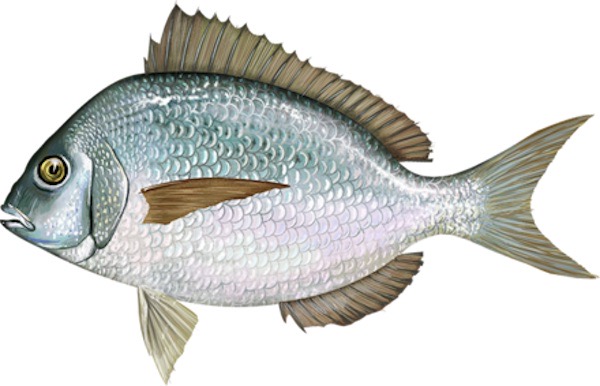
Scup the fish and Delk the cop:
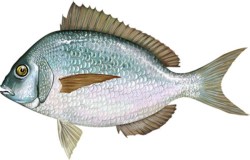
(#1) Stenotomus chrysops, a porgy; and (#2) Tommy Delk, a chief
The morning names. On the noun kelp, from NOAD:
a large brown seaweed [AZ: a type of algae, rather than a plant] that typically has a long, tough stalk with a broad frond divided into strips. Some kinds grow to a very large size and form underwater “forests” that support a large population of animals: a large bed of kelp | [count noun]: there are several kelps found in the lower zones. Family Laminariaceae, class Phaeophyceae, including the genera Laminaria (used in some areas as manure) and Macrocystis (harvested in the US as a source of algin). ORIGIN late Middle English: of unknown origin.
From my 11/2/15 posting “The New Yorker food issue”:
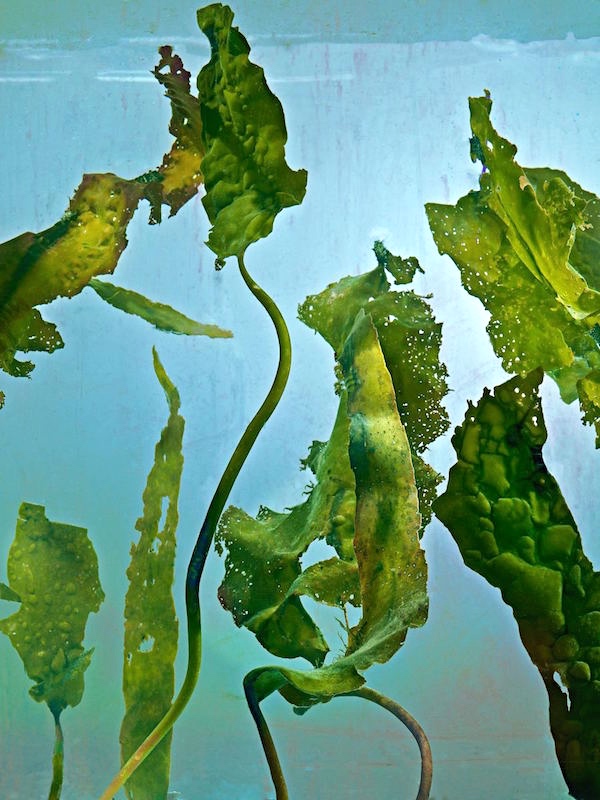
Dana Goodyear’s piece (“A New Leaf: Seaweed could be a miracle food — if we can figure out how to make it taste good”) follows Bren Smith and his kelp farm in the sea off Stony Creek CT. Kelp on the farm:
(#3)
Then on the verb skulk. From NOAD:
[no object] [a] keep out of sight, typically with a sinister or cowardly motive: don’t skulk outside the door like a spy! [b] [with adverbial of direction] move stealthily or furtively: he spent most of his time skulking about the corridors. [c] shirk one’s duties or responsibilities: we were accused of skulking. ORIGIN Middle English: of Scandinavian origin; compare wth Norwegan skulka ‘lurk’, and Danish skulka, Swedish skolka ‘shirk’.
(There are some nice illustrations of people skulking behind trees, but they all require licensing for use, so I will forgo the images here.)
About the fish and the cop. From NOAD on the fish:
noun scup: a common porgy … with faint dark vertical bars, occurring off the coasts of the northwest Atlantic. Stenotomus chrysops, family Sparidae.
With a passing note of linguistic interest in the Wikipedia entry:
Though the flesh is similar to that of more prestigious fish in the sea bream family …, the names scup and porgy are sometimes considered unattractive, leading to culinary names like orata Americana and Montauk sea bream.
And then a brief note from Wikipedia about Courtney Vance, who plays the cop Delk:
Courtney Bernard Vance (born March 12, 1960 [in Detroit MI]) is an American actor. He started his career on stage before moving to film and television. [AZ: He has an AB from Harvard, a MFA from Yale Drama School, and a lot of awards for his acting]
Word associations and their discontents. My idea is that kelp and skulk came to me though their phonological associations with the name Delk. Then kelp and skulk brought me scup, and I wondered where else they could take me, especially to words that might also have some thematic association with the trigger word. So, lists of some words that came quickly to me:
From kelp: whelk, clop, clot, burp, clap, crap, gorp, peck, self, shelf, shell, slick, shtick, plush, plaque
From skulk: slink, sculpt, pluck, lurk, shirk, skirt, shill, shir, schlep, suck, scum, skim, scrap, skunk, spunk
This was just idle mental rambling, leading maybe to some word play or some poetry, when I moved on to thinking about the syntax of the verb skulk and almost instantly ran aground because of interference from these associations, especially with lurk, shirk, and slink.
Ah, this was unfortunately familiar territory. From my Language Log posting of 6/1/05, “Scanting out”, about
the paralytic bafflement that afflicts many people when they try to say how they use some relatively infrequent expression
… Scanting out goes like this:
You’re asked how you use the word scant, and immediately you supply some instance of a scant MEASURE of SUBSTANCE, say a scant cup of sugar. You go on to observe that, though scant certainly appears to be an adjective, it can’t be used predicatively: *This cup of sugar is scant. Now you’ve got it boxed in, between a context in which it’s clearly acceptable and one in which it’s clearly unacceptable. But at this point things can get nasty, there in the middle.
If it’s an adjective, maybe it can be compared: ?This is an even scanter cup of sugar.. ?This is a more scant cup of sugar than I’ve ever seen. ?This is the scantest cup of sugar I’ve ever seen. Or otherwise modified: ?This is a really/pretty scant cup of coffee. Though it can’t occur in ordinary predicatives, maybe it can occur in fronted ones: ?Scant though the cup of sugar was, it was enough for the cake.
At this point, other expressions crowd into your consciousness and interfere with your judgments: scanty, skimpy, sparse, not quite a, nearly/almost a. One moment nearly everything seems not too bad, the next moment hardly anything seems fully ok. You have scanted out. The mechanism that allows you to make acceptability judgments has shorted out on scant, its circuits overloaded.
That’s the scanting-out experience.
About 10 seconds into thinking about the syntax of skulk, I scanted out, reeling from all those associations. ?They were skulking in a hole ?They skulked into the room ?They’re always skulking impudently. That sort of thing. Though I do feel pretty good about Delk and his slinky scup were skulking in the kelp.
Leave a Reply