Archive for the ‘Speech acts’ Category
July 26, 2020
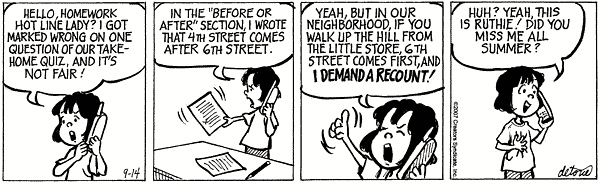
In the 9/14/19 One Big Happy, Ruthie wrestles with a workbook question, apparently something along the lines of “Does 4th Street come before 6th Street or after it?”:
 (#1)
There’s a lot packed in here. Crudely. the strip is about what before conveys, and that turns out to be dependent on the context. Ruthie takes before to refer to the ordering of a particular 4th and 6th Street in her own actual neighborhood, taking herself to provide the point of view for the spatial ordering (every spatial ordering via before rests on some point of view). But what’s the point of view of a workbook exercise? Who’s asking the question? For what purpose?
Now we’re out in the pragmatic weeds. Crucially, Ruthie has to understand that the workbook question is not an attempt to elicit useful information from her, but instead aims to get her to perform in a test of her sociocultural knowledge.
(more…)
Posted in Language and culture, Linguistics in the comics, Pragmatics, Semantics, Speech acts | 2 Comments »
April 5, 2020
Today’s Wayno/Piraro Bizarro combo is also a cartoon meme combo: Desert Island + Psychiatrist:

(#1) (If you’re puzzled by the odd symbols in the cartoon — Dan Piraro says there are 7 in this strip — see this Page.)
You notice the empty clinical couch, with its colorful pillow, because it’s the biggest thing in the drawing, and it’s right in the middle of it. You notice the psychiatrist, because he’s a human figure, of some size, with a significant face (our attention is drawn powerfully to faces).
Only then do you follow the therapist’s gaze and take in the little figure in the lower righthand corner: the tiny castaway under a miniature palm tree, on a desert island — charmingly presented as being in a colorful planter, so that it’s also one of the plants in routine office decor, matched by the ornamental foliage in the planter in the opposite corner.
We are both in a Desert Island cartoon and also in a Psychiatrist cartoon (where the therapist is doing shrink-talk), set in a stereotypical psychiatrist’s office (notably medical, down to the framed diplomas on the wall).
(more…)
Posted in Comic conventions, Linguistics in the comics, Pragmatics, Speech acts | Leave a Comment »
August 13, 2019
(Regularly skirting or confronting sexual matters, so perhaps not to everyone’s taste.)
Yesterday’s Wayno/Piraro Bizarro takes us back to the Garden of Eden:

(#1) (If you’re puzzled by the odd symbols in the cartoon — Dan Piraro says there are 4 in this strip — see this Page.)
The bit of formulaic language for this situation is a catchphrase, a slogan with near-proverbial status (YDK, for short):
YOU DON’T KNOW WHERE IT’S BEEN
The leaves are conventionally associated with modesty, through their having been used to cover the nakedness of Adam and Eve in the Garden — a use that then associates the leaves with the genitals, from which the psychological contamination spreads to the entire plant, including the fruits. You don’t know where that fig has been.
(more…)
Posted in Catchphrases, Culture, Formulaic language, Idioms, Language and the body, Language of sex, Linguistics in the comics, Music, Pragmatics, Proverbs, Slogans, Speech acts | Leave a Comment »
May 18, 2019
(OPAs, for short.) The contrast is to inconspicuously playful allusions, what I’ve called Easter egg quotations on this blog. With three OPAs from the 4/20/19 Economist, illustrating three levels of closeness between the content of the OPA and the topic of the article: no substantive relationship between the two (the Nock, Nock case), tangential relationship (the Sunset brouhaha case), and tight relationship (the defecate in the woods case).
The three cases also illustrate three degrees of paronomasia: the Nock, Nock case involves a (phonologically) perfect pun; the Sunset brouhaha case an imperfect pun; and the defecate in the woods case no pun at all, but whole-word substitutions.
I’ll start in the middle, with Sunset brouhaha. But first, some background. Which will incorporate flaming saganaki; be prepared.
(more…)
Posted in Acronyms, Allusion, Ambiguity, Idioms, Implicature, Jokes, Language and animals, Language and food, Language play, Metaphor, Metonymy, Movies and tv, Names, Pragmatics, Puns, Quotation, Sarcasm and irony, Semantics, Speech acts | 3 Comments »
January 1, 2019
Chip Dunham’s Overboard strip from December 28th:

(#1) Captain Crow and his dog Louie
An exercise in both syntax/semantics and semantics/pragmatics: on syntactic constructions and their semantics, and on the indirect conveying of meaning in context.
Above, what will become example (c) in the syntactic discussion:
(c) I don’t think I’ve told you today what a wonderful dog you are
which will lead to a related example, Sir Van Morrison’s song line in (d):
(d) Have I told you lately that I love you?
(more…)
Posted in Linguistics in the comics, Movies and tv, Politeness, Pragmatics, Relevance, Speech acts | Leave a Comment »
August 21, 2018
The text for the day is a dialogue posted on Facebook on the 19th by John Beavers (a guitarist who moonlights as a linguistics professor at the University of Texas, Austin), between John’s son Ezra and John’s wife / Ezra’s mother Janice Ta:

Ezra on his 3rd birthday (July 28th)
Ezra: Mommy, do “boy” and “toy” rhyme?
Janice: Yes, they do! You’re very good at rhyming. Do “boy” and “man” rhyme?
Ezra: No. You’re not very good at rhyming.
Ah, a significant ambiguity in the use of interrogative sentences: between information-seeking interrogatives (infoseek questions, I’ll call them), like Ezra’s do “boy” and “toy” rhyme?; and examination interrogatives (test questions, I’ll call them; they’re also known as quiz questions), like Janice’s do “boy” and “man” rhyme?
(more…)
Posted in Child language, Pragmatics, Speech acts | 2 Comments »
 (#1)