Archive for the ‘Speech acts’ Category

Indirect speech acts on the phone

March 13, 2024

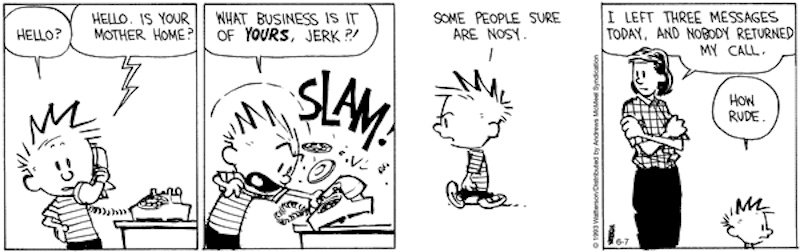
To cope with a day when I’m overwhelmed with e-mail to answer, an old Calvin and Hobbes strip salted away for just such days:


They exchange greeting hellos, and then the caller, detecting that the phone has been answered by a child, shifts to an indirect speech act designed to have the child get an adult — the caller specifically asks about their mother — to come to the phone: instead of (directly) asking Calvin to call his mother to the phone, they ask (politely) if his mother is home, assuming that Calvin will understand that they’re asking this because they assume she’s home and they want to talk to her, so they want him to turn the call over to her

The overall story here doesn’t depend on the phone being answered by a kid. It’s enough that the caller recognizes that the person answering the phone is not the one they want to talk to. In which case they could ask for them indirectly: Is Marcia home / in? (this being one big step of indirection beyond the conventionally indirect question May / Can I talk to Marcia?).

The crucial step in dealing with the yes-no question Is X home? is recognizing that because a literal understanding of it would be bizarre — why would some random caller need to know if X is home? — the caller must have some other motive in asking it. And on from there. But that’s where Calvin runs aground.

Well, that’s a lot for a little kid to work out in less than a second on the phone (and Calvin is not a patient or especially cooperative child). I actually remember being taught, explicitly, that if a phone caller, or someone at the door, asked if my mother was at home, that meant they wanted to talk to her, so I should get her. I imagine I could have worked this out eventually, but it might have taken some misfires for me to get the point.


Is the farmer busy or pretty?

November 25, 2023

An old One Big Happy strip, one in a long series in which Ruthie or her brother Joe is confronted with some type of test question (rather than an information-seeking question):


Ruthie is laboring at a workbook — a culture object that subjects a student to test questions, in this case a question requiring the student to demonstrate their understanding of the culturally appropriate grounds for publicly assessing the characteristics of other people: industriousness is an appropriate ground for assessing a farmer (because it’s relevant to his doing his job), while a conventionally attractive appearance is not

Even though she’s filling in questions in a workbook, Ruthie falls back on treating busy-or-pretty? as a question about her opinions, rather than her knowledge of cultural appropriateness. In fact, for all we can tell from the workbook picture, Farmer Brown might not be at all busy; he might be sitting upright in a stationary tractor, daydreaming about what’s for supper. But he could perfectly well be busy, while even if was drawn to look like a handsome film star, his looks would be culturally irrelevant to his job. (Subtle point: they would, however, be culturally relevant in general, since men judged to be conventionally good-looking have a social edge over other men in various contexts.)

Here, Ruthie personalizes her response by giving her opinions. In other OBH test-question strips she looks situations from her point of view or takes her own experiences as background for answering questions. But test questions demand a depersonalized stance — and then regularly plumb very fine points of sociocultural awareness. Fine points that for the most part aren’t treated in the workbooks, aren’t explicitly taught in schools. I’ll give one further example from an earlier posting of mine below.

(more…)

Why do you ask?

August 23, 2023

The One Big Happy strip that came up in my comics feed on 12/7/18 — the Ramona St. posting mill grinds slowly, very slowly — is all about pragmatics, in particular what we take to be the point of questions we’re asked. In the strip, Ruthie asks her father what you can do to stop hiccups. Her father doesn’t inquire into why she’s asking, but assumes that she’s not merely asking an information question (she might, after all, be researching the matter for a presentation at school), and it never occurs to him that she’s asking a quiz question (to which she already knows the answer, but is checking his paternal competence at everyday medical care, should the occasion arise). Instead, he assumes that she has a personal interest in the answer to the question — this turns out to be so — indeed, that she has the hiccups and wants to know how to stop them — that’s a good guess, and it’s close, but it’s wrong — so instead of answering Ruthie’s question, by describing an appropriate remedy, he leaps to supplying the remedy himself:


(#1) A well-intentioned action misfire that follows from the various (literal) meanings of questions; practical reasoning about which ones are likely to be relevant to the situation at hand; the calculation of meanings that can be indirectly conveyed given a literal meaning — most pressingly the calculation of Ruthie’s intentions in asking this particular question, so that her father can respond to those intentions; and then his short-circuiting his reaction to all of this by dispensing with a verbal reply and going right to the action it would recommend

Why is she asking? That’s the crucial point, where it would be easy to go wrong.

(more…)

Don’t ask! 2

May 25, 2023

A Peanuts strip, featuring Charlie Brown and Peppermint Patty:


(#1) But wait! Patty’s Don’t ask! is not a request for Charlie not to ask about her feelings (which would directly contradict her requesting Charlie to ask about her feelings); instead, it’s an exclamation (in Yiddish English) conveying Patty’s dismay at feeling really crappy

We have been through this use of Don’t ask! previously on this blog, in the aptly named posting of 1/31/21, “Don’t ask!”:

(more…)

Who am I kidding?

May 24, 2023

(Note: in this posting I’m going to be unrelentingly careful about the way I frame descriptions of linguistic phenomena (not falling back on the descriptive language of school grammar, which would be familiar to readers but which I believe to be fucked up beyond repair). So there will be a lot of technical talk here; please try to play along, but I don’t think there’s any way to do this right without re-thinking everything from the ground up.)

This is about a perfectly common expression — Who am I kidding? — that went past me in a flash on Facebook this morning but caused me (as a student of GUS — grammar, usage, and style / register) to reflect on the pronoun case in it. On the interrogative human pronoun, appearing here in what I’ll call its Form 1, who, rather than its Form 2, whom.

The pronoun in this expression is the direct object of the verb in the expression, KID, appearing in sentence-initial position (appearing “fronted”) in the WH-question construction of English. There’s nothing at all remarkable about this: in general, both forms of this pronoun are available as syntactic objects (of verbs or prepositions) in the language, differing only in their style / register (very roughly, formal whom vs informal who), with the special case of an object pronoun actually in combination with its governing preposition, which is  obligatorily in Form 2:

Who / Whom did you speak to? BUT *To who / ✓to whom did you speak?

So there’s nothing remarkable about Who am I kidding? It’s just informal.

What’s remarkable is the unacceptability of Whom am I kidding? The stylistic discord between the formality of object whom and the informality of the idiom WH-Pro am I kidding? is unresolvable. To put it another way, the choice of the Form 1 pronoun here is part of the idiom. Just like the choice of the PRP form of the verb KID, conveying progressive aspect: Who do I kid? lacks the idiomatic meaning.

(more…)

They do not act that way

March 6, 2023

From my comics backlog, a One Big Happy strip that turns on the distinction (in the philosophy of language) between descriptive statements (about what is)  and normative statements (about what should be) and shows Ruthie and Joe’s mother exploiting normative statements for her own parental ends — using one to convey injunction or prohibition: saying that this should be the case implicating that you should — or must — act to make it so.


Oh yes, there’s also the third-person reference to her addressees, framing an injunction on them specifically as a kind of normative universal — a manipulation of address terms that the kids simply fail to comprehend (in the last two panels of the strip)

Joe and Ruthie are in fact tearing through the grocery story like wild animals. Ellen Lombard, their mother, asserts that her children do not act like that, meaning this statement normatively. Conveying, in fact, that not only should her children not act like that, but that they must stop acting like that.

What question are you asking?

December 20, 2020

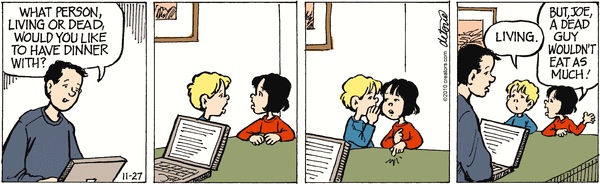
The 11/27 One Big Happy strip, which came up in my comics feed recently:

The father’s question, asking for a choice, appears to be an opinion-seeking question, of a sort that adults often exchange amongst one another to make pleasant small talk or as a kind of game. But note the father’s open laptop: the opinion-seeking question is being used here as a form of test question, in which the kids are supposed to display their knowledge of culturally significant people. And the kids are perfectly aware that the exercise is some kind of test.

There is, unfortunately, another variable here: the father’s question offers choices at two points: what person (that’s the question he’s intending to ask) and living or dead (which the father intends to be clarifying the range of persons that could be possible answers, but which the kids take to be the question at issue.

(more…)

No offense (intended)

October 15, 2020

From the American tv series Emergency! S7 E11 “The Convention” (from 7/3/79), a tv movie following the regular series. Two women end up serving as a paramedic team together — female paramedics were a new thing at the time, only grudgingly accepted, and they were normally paired with a male partner — so a male paramedic tells them the watch commander wouldn’t approve of the women teaming up. One of the women good-naturedly but pointedly snaps back at him:

(1a) How would you like a thick lip, to go with your thick head? No offense.

With the idiomatic tag No offense — a shorter version of No offense intended — literally meaning something like ‘I intend/mean you no offense by saying this’, but almost always conveying something more complex than that.

(more…)

The library hookers and booze joke

September 25, 2020

The joke, which was new to me and entertained me enormously:

(#1)

(more…)

Before or after?

July 26, 2020

In the 9/14/19 One Big Happy, Ruthie wrestles with a workbook question, apparently something along the lines of “Does 4th Street come before 6th Street or after it?”:

(#1)

There’s a lot packed in here. Crudely. the strip is about what before conveys, and that turns out to be dependent on the context. Ruthie takes before to refer to the ordering of a particular 4th and 6th Street in her own actual neighborhood, taking herself to provide the point of view for the spatial ordering (every spatial ordering via before rests on some point of view). But what’s the point of view of a workbook exercise? Who’s asking the question? For what purpose?

Now we’re out in the pragmatic weeds. Crucially, Ruthie has to understand that the workbook question is not an attempt to elicit useful information from her, but instead aims to get her to perform in a test of her sociocultural knowledge.

(more…)