Archive for the ‘Pragmatics’ Category

Context context context; and variation

September 26, 2015

Back in March, Luc Vartan Baronian posted on Facebook this semantics argument between his two children:

Daughter (4): I love my piggy bank.
Son (7): You mean your froggy bank?
Daughter: No! My piggy bank.
Son: But it’s a froggy, so it should be a froggy bank.
Daughter: No. It’s STILL a piggy bank.

Yesterday, Luc (recalling my immersion in penguiniana) sent this on to me, asking me if I had a penguin bank. My answer was fairly complex, though basically I spoke in favor of Luc’s daughter’s position.

(more…)

Participles of immediacy

September 21, 2015

Yesterday’s Doonesbury:

Not necessarily participles (PSP, PRP) of urgency, really, but something more like immediacy, conveying a sense of reporting on ongoing events, events that are happening right now. Hot news, on the scene.

Cotoneaster

August 20, 2015

Yesterday (while working on my “Plant families” posting, on the rose family) I came across the Wikipedia page for the agreeable plant Cotoneaster, which sent me on a complex journey through pronunciation and etymology, botanical taxonomy, English morphology, lexical semantics, and the pragmatics of expressions of resemblance.

(more…)

A hypothetical question?

August 9, 2015

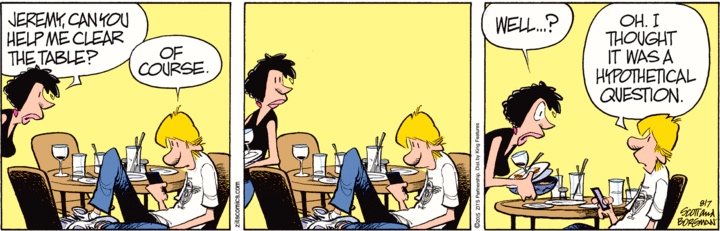
The Zits from the 7th:

Jeremy is given to responding to what people say in perfectly literal terms, not taking account of their reasons for framing things the way they do. He’s deliberately no good at Gricean relevance — a tactic that, by his lights, allows him to do nothing at all in situations where people (in particular, his mother) are trying to get him to do something.

As here. Jeremy’s mother asks him a question about his ability, a standard form of indirect request, framed this way out of politeness, so as to avoid issuing a direct command. But Jeremy takes her to be literally asking about his ability, a question asked only in case it might turn out that she wants his help in clearing the table.

(more…)

Semantic specialization and extension

August 2, 2015

First case: An NPR announcer warns the audience,

(1) Spoiler alert!

Second case: a site for tourists in Ghent, Belgium (linked to in a comment on my recent posting on the city), that tells us,

(2) Ghent is divided into two quarters: the historic centre and the artistic quarter

(more…)

The unflappable waitress

July 23, 2015

Today’s Bizarro:

Hun / hon.

The informal clipped form hon (for honey) as a term of address is stereotypically used, along with other pet names like the full honey, sweetie, dear(ie), and doll, by waitresses to their customers, in addition to the use of these as terms of endearment to genuine intimates. Many customers find the usage disrespectful and insulting, expressing intimacy in a situation where they see that deference to authority is called for.

(If you’re puzzled by the odd symbols in the cartoon — Don Piraro says there are 4 in this strip — see this Page.)

30 twats in a field

July 19, 2015

Passed along by Mike Pope, this supremely annoying video clip in which a man poses what sounds like a question riddle to a woman, who can’t interpret the question, and the man, chuckling offensively, just goes on repeating the question. But if she didn’t get the trick early on, she’ll be stuck indefinitely in her incomprehension — and by the time her tormentor finally provides hints that might let her see the trick, there’s no hope she’ll get out of the processing hole she’s in.

I would label the man as an asshole or a total dick, but since the speakers are British, I prefer to call him a first-class twat.

But check it out for yourself:

(more…)

“beat a urine”

July 17, 2015

At first glance this looks like word salad, and things aren’t helped much if I tell you that it’s a VP, that it’s attested, and that it wasn’t an inadvertent error. Context, we need context.

(more…)

Ominous questions

July 12, 2015

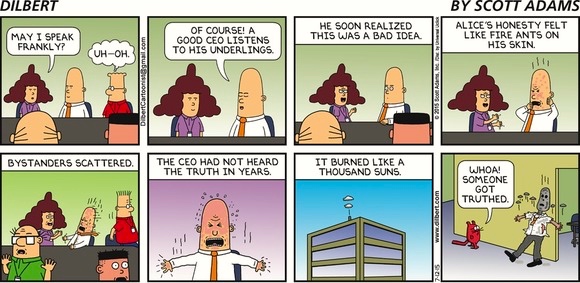
Today’s Dilbert:

“May I speak frankly?” is one of those seriously ominous questions: the person who asks it is ready to unload some very unpleasant frank opinions, as above. Even worse, it’s very difficult to say “No” to this question — because it doesn’t really function like a yes-no question, but at best serves to ask for permission to speak, and even then presumes that the permission will be granted, so that its effect is to announce that you’re going to speak.

(more…)

Disruptive conversation

July 8, 2015

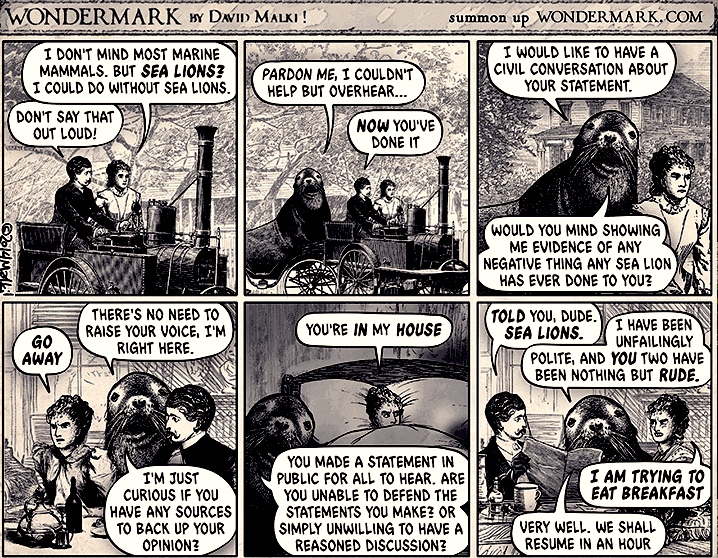
From Wondermark on 9/9/14:

(#1)

From blogger Tegiminis (“Game critic, writer, big gay robot” in Seattle WA) on the site Simplikation (“Heaps of words on games, culture, and media in general”) on 11/20/14: “Why Sealioning Is Bad”:

Chances are you’ve seen this comic by David Malki if you frequent Twitter at all these days. It even coined a new verb – “sealioning” – to describe the act of jumping into a discussion with demands for evidence and answers to questions.

But why is it an awful thing to do? Why do people react so negatively to a request for evidence? Surely a reasoned, rational person would acquiesce to such a statement!

Well, no.

(more…)