Archive for the ‘Pragmatics’ Category

y/y?

July 8, 2015

From the Mental Floss site yesterday, “Why Have People Started Asking Questions by Adding ‘Y/Y’?” by Gretchen McCulloch:

This is the best new way of asking questions, y/y? Some examples from around the internet show how this method of appending a y/y to the end of statements is starting to be used.

So I should wear my matching shirt at some point, y/y?
So, Ramsay is the new Joffrey but 1000x worse, y/y?
#knitting friends. We should all make these for next winter, y/y?
I have a million of these flower dresses and I need another one y/y?
the weirdest hat he’s ever worn, y/y?

This is strictly an orthographic feature; y/y? isn’t an abbreviation for spoken yes or yes?, as McCulloch points out. Instead, it’s a very compact way of converting a (written) statement to a question seeking agreement with that statement.
(more…)

Talking wine

June 6, 2015

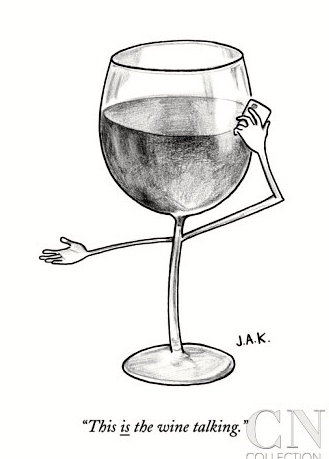
A cartoon in the latest (June 8th/15th) New Yorker by Jason Adam Katzenstein:

(#1)

It’s the wine talking is used to confess something you might not have said if you hadn’t drunk some wine. But it’s a formulaic expression, so it can be deployed in other ways, for instance to introduce talk about wine.

In the cartoon, the wine is literally talking.

(more…)

The nuptial trough

June 5, 2015

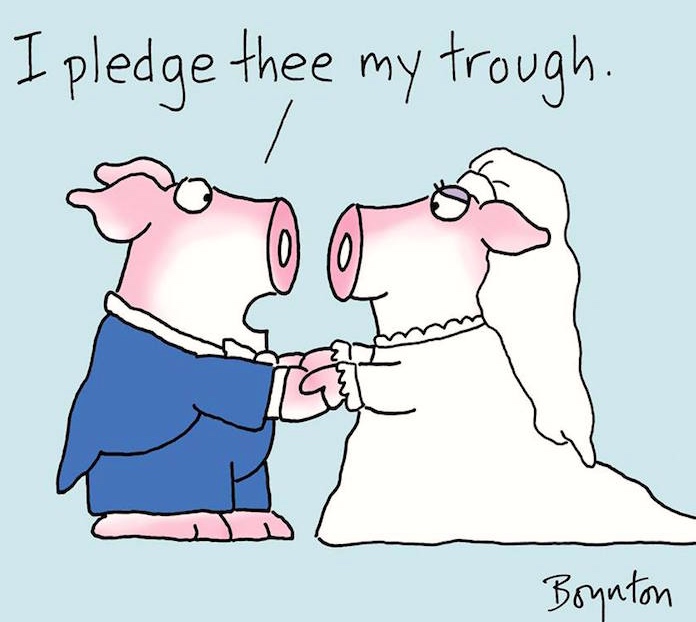
A cartoon by Sandra Boynton to celebrate June, the month of weddings:

Marriage for pigs: troth vs. trough. /θ/ vs. /f/ for many people, differing only in point of articulation.

(more…)

The hunted 95 per cent?

June 4, 2015

Let’s start with:

(1) Hunted for its horns, 95 percent of the population disappeared

This looks like a classic “dangling modifier”. We have a SPAR hunted for its horns (a Subjectless Predicative Adjunct Requiring a referent for the missing subject), but the adjunct doesn’t obey the Subject Rule (doesn’t pick up its referent from the subject of the main clause: (1) doesn’t in fact tell us that 95 percent of the population was hunted for its horns). (On the concepts and terminology, see the material in the Page on “Dangler postings”, especially the “as a SPAR” posting.)

But even without context, (1) is easily understood: 95 percent of the population is a metonymic stand-in for a population of X, and it’s X that was hunted for its horns. But that takes some interpretive work. However, when more discourse context is provided, this work is no longer needed, and I’d expect that readers wouldn’t even notice that (1) is technically a dangling modifier.

(more…)

Sideways denial

May 24, 2015

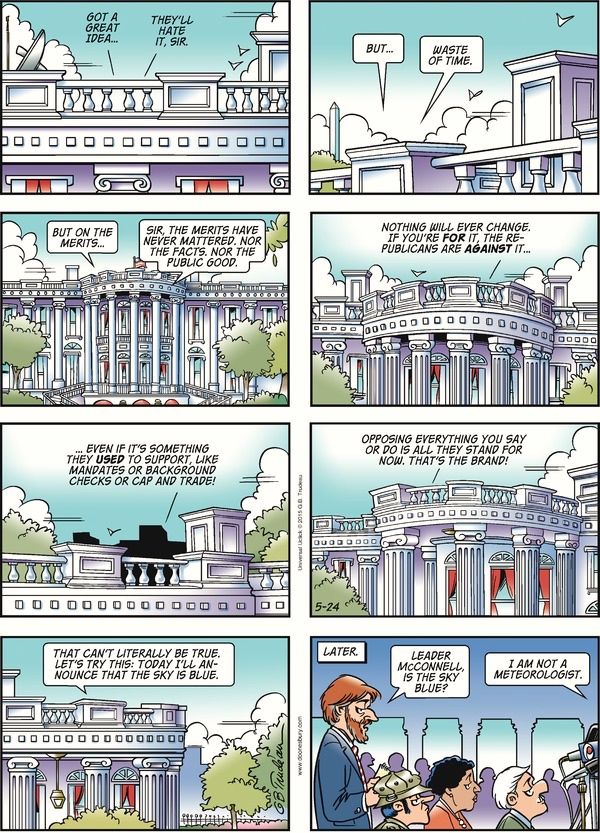
Today’s Doonesbury, in which Barack Obama toys with the Majority Leader of the U.S. Senate, Mitch McConnell

Much as McConnell would like to deny that the sky is blue, that’s too much for him to assert directly, so he says that he’s not qualified to answer the question, in effect issuing a sideways denial.

The strategy is familiar from the positions politicians take on climate denial.

(more…)

Or what?

May 22, 2015

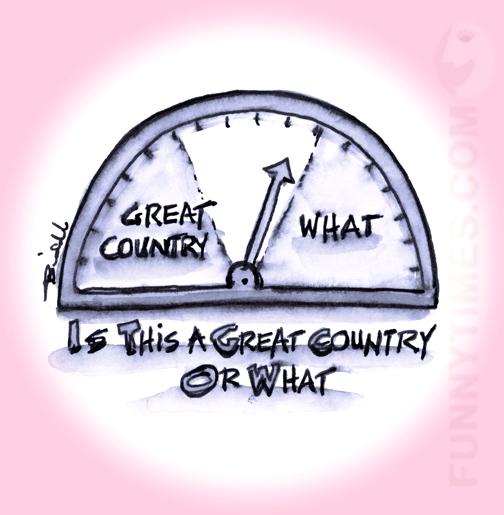
A Meg Biddle cartoon in the June 2015 Funny Times:

(#1)

Yes-no questions with the tag or what? are regularly used to emphatically assert the truth of the questioned proposition. So

Is this a great country, or what?

has the effect of proclaiming that this is indeed a great country. But the question has at least one other reading, merely asking for an alternative answer to Is this a great country?, and that’s the reading Biddle is playing with in the cartoon.

(more…)

Today’s dangler

May 16, 2015

Heard in a tv commercial for life insurance:

There’s no medical exam required. And by answering a few simple questions, your coverage can start immediately.

The boldfaced material has a classic “dangling modifier”, a non-default SPAR: by answering a few questions is a subjectless predicational adjunct to the main clause, and its interpretation requires that a referent be found for the missing subject, but that referent is not the default one, the referent of the subject (your coverage) in the main clause; instead it’s the referent of the possessive determiner (your) within this subject. Despite this, the sentence is easily understood (as something like ‘if/when you answer a few simple questions, your coverage will start immediately’); it may count as a “dangler”, but it’s harmless.

In my collection of many hundreds of danglers, there are only a few like this one (with a coding that begins SUB(by)-PRP), but there is a set of somewhat similar cases that I’ve looked at under the heading of “by-Topicalization”.

(more…)

Devious undermining

May 15, 2015

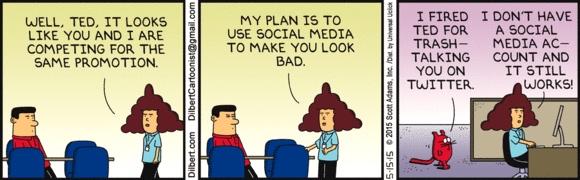
Today’s Dilbert, with Alice neatly knifing Ted in the back:

Alice plants the idea in Ted’s head of using social media to make someone look bad, thus tempting him to use the tactic on her. Big pragmatic win for Alice, especially since she has no social media accounts of her own and will look blameless.

From disaster to great spectacle

May 3, 2015

The news for yesterday, from Inside Edition:

Saturday is scheduled to be the biggest day ever in sports history with “The Fight of the Century,” [Floyd Mayweather, Jr. vs. Manny Pacquiao] Kentucky Derby, the NBA and NHL playoffs, and the final day of the NFL Draft.

The New York Post is calling it “Sportsmaggedon.”

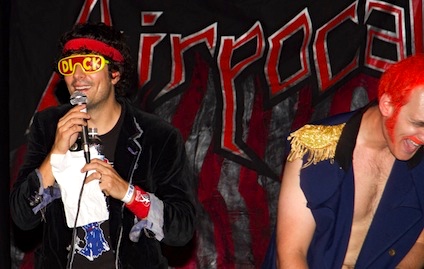
— using the libfix –maggedon, usually naming disasters, but here referring approvingly to a great spectacle. The disaster libfix –pocalypse has sometimes gone the same route: in my “The news for libfixes” of 1/14/13, there’s a rave for “Airpocalypse: America’s premier Air Band!”

(#1)

In both cases, a semantic component of great size or significance is preserved, but the affective polarity of the word is reversed: bad becomes good.

(more…)

Point of view

May 2, 2015

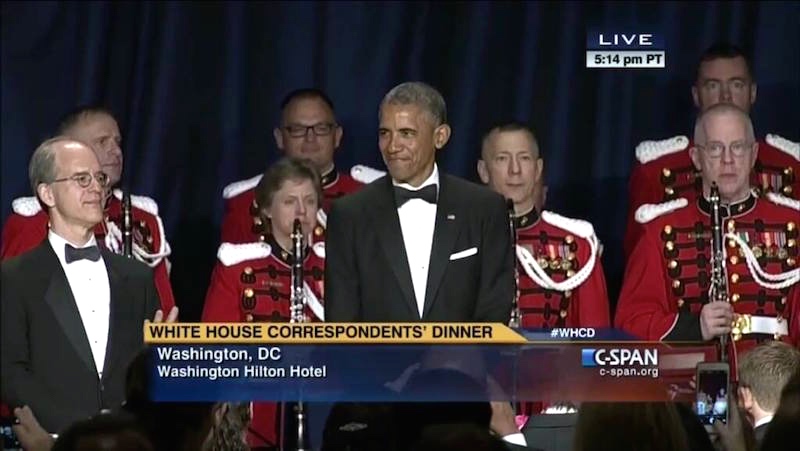
A photo sent by a friend, with a note referring to “the man in the uniform behind the left shoulder” of Barack Obama:

There are two men in uniform right behind Obama; how are we to interpret “left shoulder” here? From Obama’s point of view (in which case the man in question is to the right of Obama in the photo)? Or from our point of view, looking at the photo?

The potential ambiguity can be avoided by saying “to the right/left of Obama in the photo”, but (as it turns out) my friend has a principled usage here.

(more…)