Archive for the ‘Poetry’ Category

Dylan by Smith

January 11, 2025

I guess because of the success of the 2024 movie A Complete Unknown (about Bob Dylan’s early career), the video of the crowning piece of the Dylan Nobel Prize ceremony popped up on Facebook recently: Patti Smith performing Dylan’s “A Hard Rain’s A-Gonna Fall” as part of her accepting the 2016 Nobel Prize in Literature on Dylan’s behalf. I post this because the performance is heart-breakingly wonderful (like many viewers, I was moved to tears), and because I want to celebrate Patti Smith, honor Bob Dylan and his remarkable poetry, and take delight in the fact that they’re still shining (well, we’re a generation — Dylan a bit younger than me and a bit older than my guy Jacques, Smith 6 years younger than me, but still 78, not a kid any more).

I’ll start at the pinnacle — Patti in Stockholm — and then fill in some bits of the background.

(more…)

The axolotl poem

January 6, 2025

1/6 it’s Epiphany and 2001 Insurrection Day, and there’s fresh news from the salamander hotline, a follow-up to my writing yesterday, in the posting “That’s a lotta axolotl”:

I have known about axolotls since the 1950s, when Mad magazine was responsible for potrzebie as a non sequitur nonsense word, ferschlugginer as a sort of all-purpose modifier of negative affect, … and axolotl as a nonsense reference.

Which elicited this comment from Robert Coren:

As you may not be surprised to learn, my thoughts also went to Mad magazine as soon as I saw the word. I particularly remember fragments of a parody of Wordsworth’s Daffodils

I omit RC’s recollections, which are indeed fragmentary, after the first two lines (memory is a fickle thing); but the parody / burlesque (which I’d forgotten about) manages to be both clever (maintaining the form of the Wordsworth — 6-line verses of iambic tetrameter, with rhyme pattern ABABCC — and catching its spirit) and crude, just as a Mad parody ought to be.

(Rhymes for axolotl are not plentiful: the Mad parody uses bottle, twice, rejecting glottal, throttle, and wattle, and also AmE waddle, twaddle, toddle, swaddle, coddle, and model.)

(more…)

The sun chronicles

November 23, 2024

🏈 🏈 today’s the Big Game in these parts — Stanford vs. UC Berkeley, 12:30 (PT), blessedly at Berkeley; the rain has given way to overcast skies, with occasional sunny breaks

From sun to sun, art to art: it starts with a Ukrainian sculpture of Icarus (who recklessly flew too close to the sun, defying the gods, and so plunged to his death); moves through a Russian painting of Icarus with his father Daedalus (who warns his son not to fly too high or too low); from there to van Dyck’s earlier painting of this same scene; which leads to a van Dyck self-portrait with a sunflower, a Helianthus that’s turned to him as to the sun itself: perhaps the painter as an incarnation of the sun god Apollo.

(more…)

Baritone Bennington attacks the Ode to Joy

November 13, 2024

From Benita Bendon Campbell back on 11/1, a joyous diversion from painful times (“Something funny, we need something funny”): Rowan Atkinson playing “distinguished British baritone” Robert Bennington singing the Ode to Joy … until things go awry and he has to improvise a German text to Beethoven’s soaring tune. You can watch the YouTube video here.

And now, much more detail, from the Classic FM site (“the most relaxing music”), “The time Rowan Atkinson ‘forgot’ the words to Beethoven’s Ninth Symphony in hilarious skit” by Maddy Shaw Roberts on 5/11/21:


The Ode’s progress (picture: YouTube)

(more…)

Hunky Halloween Hamlet

October 15, 2024

From Tim Evanson, on Facebook this morning, his image for 16 days to Halloween:


(#1) Hunky Halloween Hamlet, let’s call him Hunklet, contemplating Peter Pumpkin (who really should have a grinning face carved in him) instead of Yorick’s grinning skull

The Shakespearean context (written as connected text rather than as poetic lines):


(#2) “Here hung those lips that I have kissed” — so Hamlet cries in iambs dread

(though I note that #1 could be read as God — or Zeus / Jupiter — surveying the Earth; everybody sing: “He’s got the whole world in His hands”)

(more…)

Volcanic verse

September 10, 2024

Well, silliness provoked by my getting, yesterday, this excellent fortune cookie fortune:

You will be awarded
some great honor

Which I was then able to combine with a postcard from Ann Burlingham (sent on 3/4/24), showing, of course, a volcano — Frederic Church’s 1862 painting of Cotopaxi in Ecuador — adding the requisite woolly mammoths (on a US postage stamp), flanking the fortune, to complete the composition:

For which I have supplied some verse, filched from Longfellow’s The Song of Hiawatha (1855), with its famously jogging trochaic tetrameter:

(more…)

Diamonds, dildos, and in Seattle, clams

August 27, 2024

Acres, folks, acres. Diamonds and dildos got covered in my 8/26 posting “Acres of dildos”. Then from Wendy Thrash on Facebook the next day, more acres that I probably should have talked about in the first place. WT wrote:

Sorry, but as an old Seattleite this forces me to think of Acres of Clams

and referred to a Folk Music Blog posting, “The Songs of Ivar Haglund” by Jacqui Sandor on 5/28/19. I was just going to post WT’s note as a comment on my posting here, but then it occurred to me that “Acres of Clams” might not be familiar to everyone, and even if you know about the folk song (a text climaxing in acres of clams, set to an old Irish jig tune), the note might not have transported your imagination to Seattle, or, indeed, to Ivar Haglund. It might just have been baffling.

So now I will take you into a gigantic morass of the folk song world — in which, however, shines the canonical “Acres of Clams” text, which ends up being about Puget Sound (where Seattle is located), where clams abound, and where there’s a seafood restaurant founded by folksinger Ivar Haglund named Ivar’s Acres of Clams. You see, it does hang together. (And, despite the previous dildos, the clams in question are — surprise! — not lady-parts, but edible bivalves.)

The morass is a consequence of the fact that an extraordinary number of texts have been set to that same jig tune — possibly more than to any other folk tune — and then both the tune and all those texts have been popularly known by names that are phrases from the texts (you’ll see a small sampling of these names in a moment). Even the canonical clam text (from about 150 years ago) is so popular that virtually every folksinger who performs it alters the text to fit their own interests, passions, aims, and politics.

To set the stage, from the HistoryLink site:


(#1) From “Ivar Haglund opens Ivar’s Acres of Clams at Pier 54 in July 1946” by David Wilma on 6/19/00

(more…)

Bijlert, Leonardo, parody magnets, and the Priapic-Apollonian opposition

August 5, 2024

The July 26th opening ceremonies for the Paris Olympic games included a tableau — of drag queens posed as presiding over a banquet — that vaguely resembled Leonardo da Vinci’s Last Supper painting:


(#1) The Olympic drag pose


(#2) The Leonardo original

(more…)

Slouch Gravitsky’s ode to those people

July 17, 2024

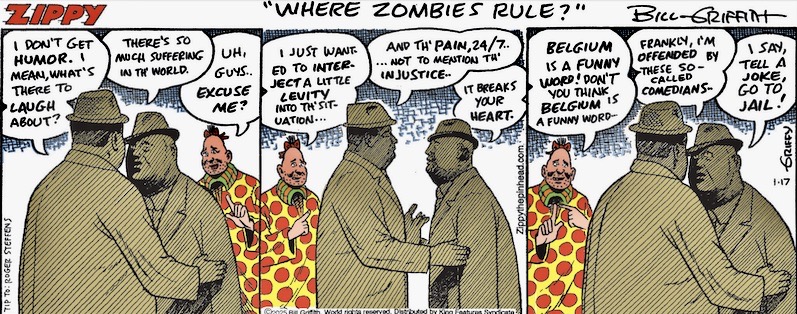
Today’s Zippy strip brings us a rambling poetic diatribe by Slouch Gravitsky, the Zipfigure of poet Charles Bukowsky in Bukowsky’s fictional alter ego, the (sometime) postal clerk Henry Chinaski — crude, aggrieved, cynical, alcoholic. And, oh yes, sharp-eyed.


This might be a burlesque of a specific Bukowski poem, but not one I’m familiar with; meanwhile, note the bottle of booze in the first and fourth panels (plus of course the cigarette) — plus Zippyesque dips into popular culture (Lawrence Welk, beef jerky, Taylor Swift)

(more…)

New preposition in town

July 1, 2024

Posted on the LINGTYP (Linguistic Typology) mailing list today, reproduced in this posting to illustrate one of the ways linguists play around with data and ideas as they try to figure out what’s going on on some specific case — looking for inspiration in (roughly) similar cases in other varieties of language.

If  that’s what you want to do, you want to go where the linguistic typologists hang out. On LT, from Wikipedia (very briefly):

Linguistic typology (or language typology) is a field of linguistics that studies and classifies languages according to their structural features to allow their comparison. Its aim is to describe and explain the structural diversity and the common properties of the world’s languages.

LTists have a society, the Association for Linguistic Typology (webpage here), which organizes meetings, publishes a journal, and sponsors that mailing list, for open discussion of typological matters. Like the one I brought up today:

(more…)