Today’s Rhymes With Orange:
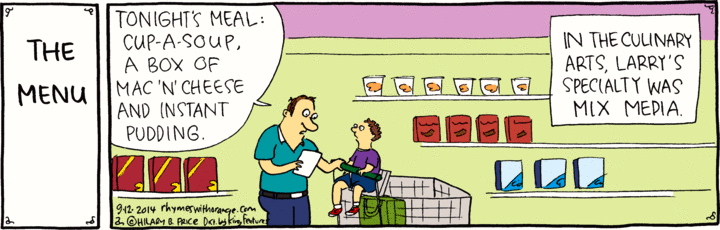
Instant food: just mix. And mix-n-match. But the linguistic point is mix media (for the expected mixed media) — an instance of lexicalized t/d deletion.
Today’s Rhymes With Orange:
Instant food: just mix. And mix-n-match. But the linguistic point is mix media (for the expected mixed media) — an instance of lexicalized t/d deletion.
Revisiting my posting “The accent in Polish”, with a cartoon in which a Mr. Waterski corrects a desk clerk’s pronunciation of his name. The correction comes in two parts:
(1) a statement of fact about this particular name: “The accent is on the second syllable”; and
(2) an appeal to a generalization: “like every other Polish surname”
Part (1) is a brute statement of fact and it’s largely inarguable: people’s names are to be pronounced as they say they are (so long as this pronunciation is consistent with the phonology of the target language). If your family name is Taliaferro and you’re a Virginian who pronounces the name like Tolliver, then that’s the pronunciation (but you can’t insist that in English it’s pronounced [ˌtaʎʎaˈfɛrro], as in Italian).
Part (2), however, makes a claim about Polish — that the accent in Polish surnames is on the second syllable — and that generalization can be tested against the evidence. In fact, it is incorrect, and simultaneously (in a sense) insufficiently general.
Today’s Rhymes With Orange:

Ah, Watérski.
I did spend some time trying to find out if Waterski was an attested Polish name, but the enormous number of sites on waterskiing frustrated my search.
It started fairly simply, with a BBC radio news report from Iraq (heard from I don’t know which source; BBC news comes to me from several places, including BBC3 more or less directly): a bulletin from the Assyrian city of Nineveh, which the news reader pronounced as
(1) /ˈnajn@vˌe/
instead of what I expected to be
(2) /ˈnɪn@və/
(where @ in the middle syllable represents a neutral unaccented vowel, ɪ or ə — usually transcribed ɪ, as in Wikipedia, though I sometimes hear ə).
I was, in fact, so astounded by the /aj/ in the first syllable of (1) that I failed to take notes on its source; I’d never heard anything but /ɪ/ in this syllable, and /aj/ is not even remotely like the vowel in the Assyrian pronunciation of the place name. Where would it come from?
(Mostly, but not entirely, about men’s underwear.)
On Facebook, a link passed on by Matthew Melmon to a June 13th posting on the Metro (U.K.) website, “Amazing news! Now you too can own this delightful swimming ‘sock’ “, showing a lateral flash thong on the ITV2 reality tv show TOWIE (The Only Way Is Essex):
 (#1)
(#1)
A remarkable garment indeed: how does it stay up? And who wears something like this in public (outside of outrageous precincts like TOWIE)?
An abstract for a talk by Erez Levon (Queen Mary, University of London) this coming Friday (1:30-3) at Stanford. I won’t be able to be there, but obviously the topic is of great interest to me.
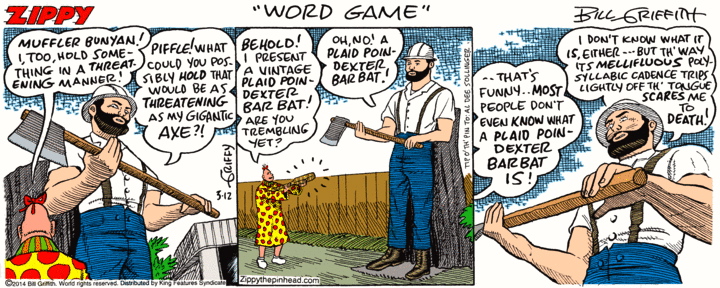
In today’s Zippy, we return to the Poindexter bar bat; see “The Poindexter bar bat, or barbat”, here, with extended discussion, including material from the Zippy archives and an analysis of bar bat. From that posting:
Poindexter bar bats: Poindexter is just one of those names that entertain Bill Griffith because of the sound; but what about bar bat? Like many things in Zippy, this is surely meant to be absurd but suggestive.
 (#1)
(#1)
Now we have the extended plaid Poindexter bar bat, which Muffler Bunyan enjoys because of its sound. A little festival of bilabial plosives ( /p p b b/ ), and tetrameter, the dominant English folk meter.
Today seems to be pun day. Passed on by Barbara Need on Facebook, this Bizarro from 2009:

Groan: phero- vs. pharaoh. These are homonyms for some speakers, near-homonyms for others (who have have [æ] in pharaoh and a higher vowel, [ɛ] or [e], in phero-).
In the Stanford freshman seminar on language in the comics, the topic of rising intonation at the end of intonational units came, with the predictable impression from some (by no means all) of the students that it was associated with asking questions. And then I was pointed to a piece by artist Taylor Mali, “Speak with conviction”, complaining about “invisible quesion marks”. There’s a deep but understandable confusion here.