Archive for the ‘Phonology’ Category

Fixing things

November 22, 2012

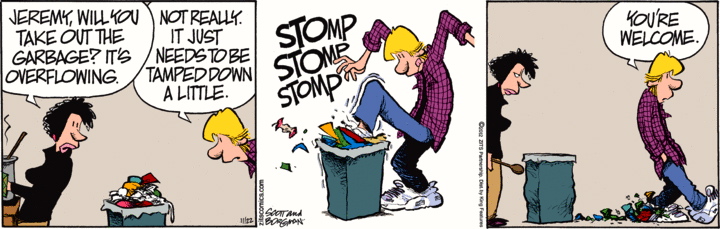
This morning’s Zits, in which Jeremy responds to his mother’s call for help:

Note the facial gestures, and the subversion of the mother’s request, in which Jeremy does not in fact take out the garbage, but does what strikes him as less work — though it makes a major mess.

(more…)

Brief mention: more impastas

October 31, 2012

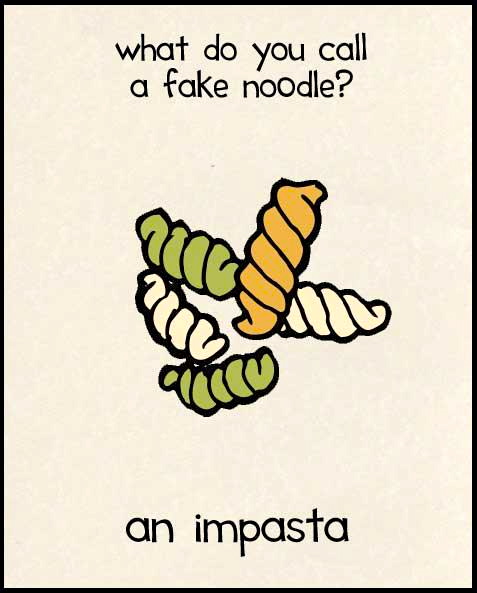
Following up on the Flying Spaghetti Monster and impastas (here), here’s another take on the same pun, done in rotini:

(From Bob Mugele’s Facebook site, passed on by Avery Andrews and Tony Aristar.)


Pronouncing names

October 15, 2012

In the NYT on Saturday, a front-page piece (“Missouree? Missouruh? To Be Politic, Say Both”, by Sarah Wheaton) about the pronunciation of names, with a political connection.

(more…)

Today’s dreadful pun

October 7, 2012

Today’s Bizarro:

Grotesque, but then the strip is called Bizarro.

(more…)

More Canadian raising

September 15, 2012

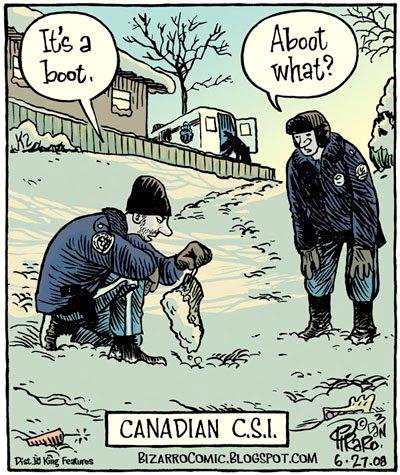
Passed on by Bert Vaux on Facebook, this Bizarro from 2008:

For a similar cartoon reflection on Canadian raising, see the Rhymes With Orange strip in my “Laundromat dialectology” posting. Bert went on to complain about the common American perception that Canadian raising results in something like aboot (rather than aboat):

For the life of me I can’t figure out how Americans came up with the idea that Canadians say [u:] for [aw]. Scots I could see (coo, etc.), but not Canadians.

The stereotype might in fact have been carried over from American perceptions of Scots English.


Laundromat dialectology

September 13, 2012

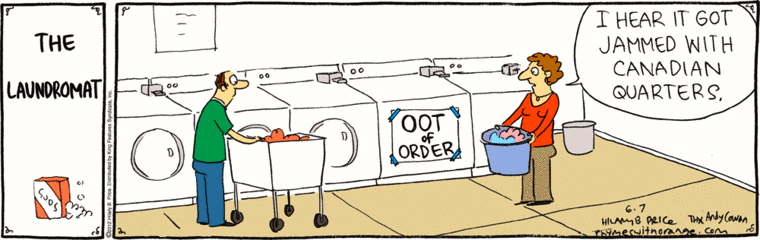
Via Emily Menon Bender on Facebook, this 6/7/12 Rhymes with Orange cartoon:

The dialectal feature illustrated here is known as “Canadian raising”; it’s a stereotype of Canadian speech.

(more…)

Regions

September 2, 2012

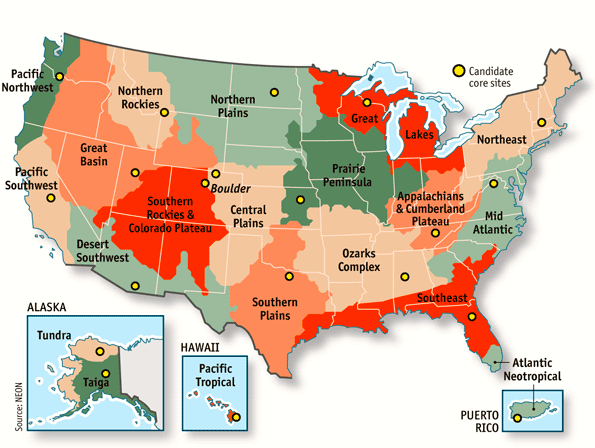
In the August 25th Economist, a piece “NEON Light: A 30-year plan to study America’s ecology is about to begin”. Highlights from Boulder CO:

… a group of American ecologists, led by David Schimel, … plan to shake up terrestrial ecology, and introduce it to the scale and sweep of Big Science, by establishing NEON, the National Ecological Observatory Network.

… NEON’s researchers have divided America into 20 domains …, each of which is dominated by a particular type of ecosystem. Each domain will have three sets of sensors within it. One set will be based in a core site — a place where conditions are undisturbed and likely to remain so — that will be monitored for at least 30 years. The other two sets will move around, staying in one place for three to five years before being transplanted elsewhere. These “relocatable” sites will allow comparisons to be made within a domain.

Here’s the map of ecosystem domains:

This is a categorization of places or locations, along with labels for each category. And of course it pays no heed to state boundaries.

There are a great many ways of dividing the U.S. into regions, each way having its own purpose or function.

(more…)

Garden-variety mishearing

August 22, 2012

Mishearings often arise though interference from things you have on your mind, either as habitual predispositions (to hear your own name, for instance, or vocabulary related to your interests) or your attention at the moment. In the latter vein, a story from yesterday, in the middle of my writing several postings on plants and gardens.

At Gordon Biersch (the restaurant), a server was running through some specials for the people at the next table. I heard Joaquin offer “lobster and shrimp compost”. Clearly absurd, though garden-related. I was, however, familiar with the menu, so I recognized the dish as “lobster and shrimp tacos” (quite nice, by the way).

Tacos and compost are reasonably closely related phonologically: both two syllables, with accent on the first. First syllable: /ta/ (neither Joaquin nor I is a /tæko/ speaker) vs. /kam/ (voiceless stop onsets, /t/ vs. /k/, nucleus /a/ vs. /am/ (with the latter commonly realized as [ã], nasalized [a]). Second syllable: /koz/ vs. /post/ (voiceless stop onsets, /k/ vs. /p/, nucleus /oz/ vs. /ost/, with alveolar fricatives /z/ vs. /s/ and a /t/ that is deletable in word-final clusters).


Dick Crazy

July 18, 2012

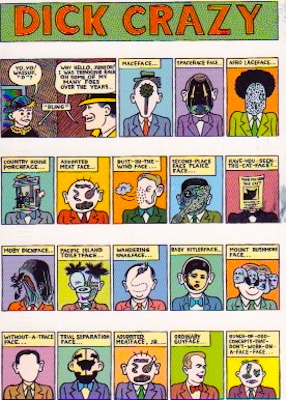
From my friend Max yesterday, a postcard version of artwork by Michael Kupperman for The Believer:

It starts with a series of rhyming compounds — Maceface, Spacerace Face, Afro Laceface — and then branches out into merely preposterous compounds (with images to go along with them), like Moby Dickface and Mount Rushmore Face.

And then there’s Dick Crazy, an imperfect pun on Dick Tracy.

(more…)

Voiced S

July 8, 2012

This morning on Weekend Edition Sunday, NPR reporter Mike Pesca, talking about strikeouts and curveballs, introduced the Higgs boson as a metaphor and ran it into the ground. All through this, he gave boson the accent pattern primary accent + unaccented, rather than the standard pattern primary accent + secondary accent. Along with the accent difference went the voicing of the medial fricative (spelled S); he had a medial /z/ every time, instead of the standard /s/:

standard /bósàn/, Pesca /bózǝn/

Presumably, for Pesca the word boson had become so familiar that the final syllable was deaccented, as in outsider-pronunciations of Oregon with /àn/ vs. Oregonian pronunciations with /ǝn/. And then the medial fricative got voiced, as in reason, raisin, besom, and some other words spelled with medial S. But there is a strong competing pattern, with /s/ (rather than /z/) for words that have unaccented final syllables and are spelled with medial S: mason, bosun (a minimal contrast to Pesca’s boson), basin, bison, and so on. (I’ve chosen words with tense vowels in the first syllable, to avoid the issue of spellings with medial S vs. SS.)

There are histories for each of these words, but it’s clear that synchronically the voicing isn’t determined automatically by phonological context. So I’m not sure what led to Pesca’s choice of /z/.