Archive for the ‘Inflection’ Category

Suck my suffix!

December 6, 2025

(thoroughly raunchy Christmas porn, in verse of sorts; not for kids or the sexually modest)

Inspired by the appearance of gay porn actor Dean Young partnered with Joey Mills in Joey’s Surf Vacation (yesterday on this blog), I pulled out DY’s photos from the Christmas sextravaganza Cum All Ye Faithful (in which he’s a very naughty elf), and whipped out a few lines of raunchy verse (with a linguistic subtext for the academically inclined):

(more…)

Today’s bilingual jest

June 8, 2025

E-mail today from Luis Casillas to me and Luc Baronian (it’s a Stanford connection), with his header:

Apparently English “n’t” is trulyn’t an inflectional affix after all

(intending to convey ‘truly not an inflectional affix after all’) and then the comment:

Seen on Twitter:


(#1) deranged grammar advice on-line

(more…)

virtual walk-throughing

April 7, 2025

This morning my attention was caught by a Comcast Business tv commercial offering virtual walk-throughing — the PRP of the verb + particle idiom walk though, as in You can walk through the sample office, here in its gerundive use. The standard form (virtual) walking through has the PRP inflection on the head of the verb + particle combination, the verb, which is the first element in the combination, so is internal to it.

It’s been a while since I noted a general tendency for idiomatic verb + particle (V+Prt) to get its inflection on the second element, at the end — to externalize the inflection, as here. I’ll go back to an earlier posting of mine, then add some notes on things that might facilitate externalization of inflection in V+Prt Vs.

(more…)

Adpositions and case inflections, from 1988

January 20, 2025

There was this paper of mine (“Jottings on Adpositions, Case Inflections, Government, and Agreement”), originally from 1988 but not properly published until 1992 (in The Joy of Grammar: A festschrift in Honor of James D. McCawley), that I wanted to quote from in an on-line discussion a week ago, only to discover that after the great dispersal of almost all my books and files some years back, I had no trace left of the thing, no copy of any kind (this sort of thing keeps happening to me). I couldn’t find a way to get a copy on-line, but in a stroke of luck it turned that Benjamins was selling off its remaining stock of the paperback edition of Joy at a price I could actually afford, so I bought their last copy and had it mailed to me next day delivery. This morning I created jpegs of all 15 pages (369 through 384); the quotation I need is on the first page, but now I can add this posting of all 15 pages to the little set of publications of mine available on-line.

(more…)

striking language

October 19, 2024

From Ellen Kaisse in e-mail to me on 10/4 (yes, the blog mill grinds very very slowly on Ramona St.): a nice ambiguity from the Seattle Times, in the first sentence of the story:
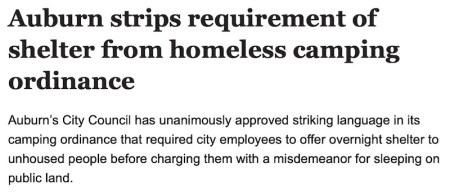

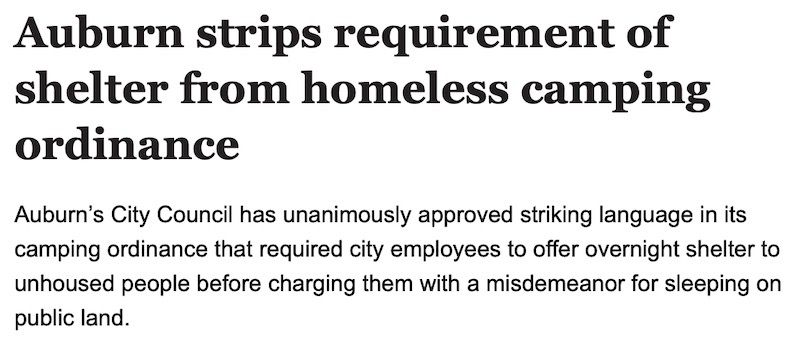
[what EK wrote, with some bracketed amendments by me:] I read striking as an adjective meaning ‘notable’ and modifying language rather than the intended reading where striking is [the nominalization of] a verb with language as its direct object [AZ: the nominalization (together with language and a very long relative clause modifying language) is itself the direct object of the verb approved]. It was only the headline that alerted me that my first reading was the opposite of what was actually approved.

Now if you ask an ordinary person what’s gong on with that sentence, they’ll tell you that it’s ambiguous, and they’ll provide some attempt at a paraphrase (as a sufficient account of the ambiguity), but they’ll simplify things somewhat by disregarding that long relative cause and, in effect, localizing the source of the ambiguity in the expression striking language, telling you that in the Auburn City Council sentence this expression means two different things, ‘notable language’ or ‘removing language’ (from something), and maybe they’ll go on to localize the source even further in the word striking, saying that striking in striking language can mean either ‘notable’ or ‘removing’ (from something).

Ask a linguist, like Ellen or me, and even our briefest answer will go immediately to localizing the ambiguity in specific words that are the crux of the matter. We’ll identify the lexical items involved and supply some relevant properties of the words — what syntactic category they belong to (EK refers explicitly to adjective (Adj) and verb (V) and implicitly to noun (N)); perhaps what derivational and inflectional categories they belong to (implicit in our references to nominalization). And then, especially, we’ll tell you something about the syntactic constructions in which the words are related to one another (we’ll refer to modifying / attributive adjectives, to verbs with direct objects, and so on). Our very brief comments are laden with allusions to the structure of English — its morphology and syntax — as well as to its lexicon.

The linguists’ view is that the lexicon, morphology, and syntax of the language work together in such a way that a stretch of phonological material can convey two different meanings; when we confront an ambiguous expression, we see it not as a brute fact (as if people somehow memorize how phonological substance and semantics are paired with one another, expression by expression), but as the consequence of the system of the language. Surprise! There are two ways you can end up with striking language, two ways the expression can be analyzed. (There are, in fact, more than two; but there are at least the two EK told us about.)

Now I’m going to wade hip-deep into the system of English involved in striking language (and some similar expressions). Not to tell you everything, but to tell you just enough to show you that the system is both big and complex. Therefore, challenging. And therefore, wonderful to figure out. Contemplating stuff like this makes me happy.

(more…)

Mango(e)s and papayas, anything your heart desires

September 18, 2024

From the Economist‘s 8/24/24 issue, under the characteristically jokey head Beneath the (ap)peal, the informative subhead

South Asia’s long love affair with mangoes

(yes, about the appeal of the fruits in South Asia, incorporating –peal as a pun on peel ‘outer covering of a fruit or vegetable’)

Which stopped me in my tracks, because I would have written mangos rather than mangoes. It turns out that there’s real variation on this point; both mangos and mangoes are well attested (and have occurred in postings on this blog, though all the instances of mangoes are in quoted material, not from my hand). And, entertainingly, published lyrics for the song titled “Mangos” (made famous by Rosemary Clooney) come in two different versions, from different sources: one with mangos, one with mangoes.

(more…)

Obscure plurals of octopus (and rhinoceros)

November 21, 2023

A brief, somewhat goofy spin-off from my 11/18 posting “The visiopun”, about plurals of the English noun octopus, which entertained mostly octopi (borrowing the Latin plural, but giving it an English spelling-pronunciation /áktǝpàj/) and octopuses (with the default plural suffix for English nouns), but also entertaining octopodes (borrowed from Classical Greek, so learnèd and obscure). The posting inspired a Facebook exchange today, starting with:

— Gadi Niram: I love the [four-syllable] plural octopodes, but it’s really not suited to most communication.

To which I replied:

— AZ >  GN (amplifying on GN’s reservations): It has the primary accent on the second syllable: òctópodes, like àntípodes. … At first I was hoping for óctopòdes or òctopódes, cleaving more closely to the accent pattern of óctopùs. But reality is weirder than that.

(more…)

The visiopun

November 18, 2023

… visiopun being my coinage referring to a punning word presented visually — not actually said or printed, but alluded to by some striking image, usually with some lead-on hinting at the pun. An extremely simple, utterly flat-footed example of my own devising:

What do you call a US infantryman from World War I?

(#1)

The image is of a small male figure made of dough, so the punning word is doughboy. (Yes, the Pillsbury Doughboy. I simplified things by using an existing image.)

Now to a complex visiopun passed on to me on Facebook today by Emily Menon Bender (the source is cited in the image):

(#2)

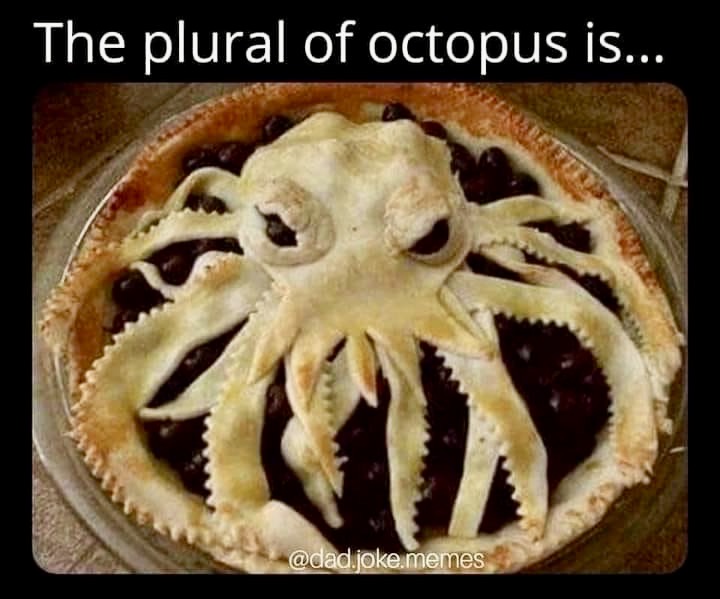
The image is of a pie in the shape of an octopus, so the punning word is octopie (/áktǝpàj/ in my AmE variety), a play on octopi, one of the plural forms of octopus. Cute.

(more…)

Explorations in abessive clothing

February 21, 2023

(about bodies, mostly men’s, and the exposure of parts of those bodies, either by complete absence of an item of clothing, or by the absence of part of such an item; there will be plenty of male buttocks on view, and there will be discussion of men’s bodies, sometimes in street language — so not to everyone’s taste)

About items of clothing or parts of such items that are missing, lacking, absent.  (I’ll explain the adjective abessive in a moment; it does some of the work of the English derivational suffix –less or the preposition without, but is of wider applicability.) Two topics in this area are standing preoccupations of this blog: (re: absent items of clothing) male shirtlessness; and (re: absent parts of items of clothing) the assless / bottomless / backless nature of jockstraps.

The actual entry point to this posting came on Facebook on 5/9/19, when John Dorrance asked about the first use of assless chaps and Season Devereux  responded ,”Aren’t all chaps assless though?” To which I replied:

Yes indeed. The assless in assless chaps is an appositive, rather than restrictive, modifier — used to remind the hearer that chaps do in fact lack an ass, or to emphasize this fact in context — cf. appositive ‘chaps, which are assless’ vs. restrictive ‘chaps that are assless’, which is pleonastic.

It will take a little while to work up to chaps as abessive clothing: in this case, an item of clothing that lacks one of its parts (they’re assless) — in fact lacks two, since they’re also crotchless (chaps are essentially outerwear leggings of leather, held up by a belt).

Exploring abessive clothing quickly can take us far afield, and I’m not sure at this point how far I’m willing to go, so I’ll just dig in and see what happens. Come walk with me.

(more…)

Fiberglass football

November 14, 2021

The Zippy strip of 11/8, in which our Pinhead confronts the hulking fiberglass figure of Football Man (looming in front of the Moreland Tire Co., whose products Football Man is presumably exalting:


(#1) Whatever Moreland products Football Man is hawking, he’s also exalting football as quintessentially American — so if Zippy is no fan of the game, he’s no American either — and as a (dark) metaphor for life (next up in the game of life: brain damage)

Having spent 29 years as a college professor in Columbus OH, I have a lot to say about football, very little of it pleasant, but this is probably not the time to air my grievances.

So put that aside, and ask the questions that almost every Zippy strip provokes: who are these guys? what is this place?

(more…)