Archive for the ‘Back formation’ Category

Short shot #58: sunseed

February 17, 2011

Reported by Victor Steinbok on ADS-L: sunseed for sunflower seed, as here:

Argentina is a leading exporter of sunflower oil, and it is seen producing 2.8 million tonnes of sunseeds this season. The birds have a taste for sunseeds and also pick on corn kernels from the cobs, often ruining them.

(Steinbok adds that the story is about damage to sunflower and other crops from flocks of hungry parrots and pigeons.)

Searching on {“sunseed”} pulls up lots of references to Sunseed Farm in Ann Arbor MI (which sells all sorts of things other than sunflower seeds) and some for the Sun Seed Co. (which sells a variety of seeds), but also a few for “black oil sun seed”, that is, black oil sunflower seed.

(Searches pull up some other stuff, for example sunroot and sunchoke, alternative names for the Jerusalem artichoke, also known as earth apple and topinambour. The Jerusalem artichoke is a species (Helianthus tuberosus) of sunflower grown for its edible tubers; Jerusalem in the name is often taken to be a folk-etymologization of Italian girasole ‘turn-sun’.)

Now, how to get from sunflower seed to sunseed (or sun seed)? It could be a matter of truncation, a telescoping of sunflower seed. Or a simple truncation of sunflower. Or it could be the result of a reanalysis in which flower is taken to refer only to the flowers, in which case sun is understood as naming the plant, so that it can then be used, in a kind of back-formation, as an element in a compound with seed.

Brevity is part of the story in any case. And any of these routes would allow free-standing sun to refer to the sunflower plant, as here:

I love sunflowers and plan on growing a lot again this year, but I’ll be pulling any volunteers in the main beds, and the suns will have their own area. Also the residue will go into the long term compost piles that I just heap and let sit for years in the woods.

Just thought I’d pass this on in case any body else plants suns in their beds with other stuff.

BTW, some people commented that they always grow suns with their other stuff and haven’t noticed anything detrimental. [The reference is to the reputed growth-suppressing effects of all parts of the sunflower plant.]

 

Data points: back-formation 11/28/10

November 28, 2010

In the Pope and prostitute news (some Language Log discussion here), occurrences of the simple back-formed verb contracept (based on contraception/contraceptive) unearthed by Paul Frank and discussed on ADS-L:

“As Sacred Heart Major Seminary professor Janet Smith put it in The Catholic World Report, ‘We must note that what is intrinsically wrong in a homosexual sexual act in which a condom is used is not the moral wrong of contraception but the homosexual act itself. In the case of homosexual sexual activity, a condom does not act as a contraceptive; it is not possible for homosexuals to contracept since their sexual activity has no procreative power that can be thwarted.’ There’s a logic here, but it’s the loopy follow-the-dots logic that led an Egyptian imam to declare that a woman can work in the same office as men who are not her relatives, as long as she breastfeeds them first.” (The Nation, December 13, 2010)

“But some theologians argue that the condom was not being used to contracept but rather to lower the risk of spreading AIDS.” (Philadelphia Enquirer, November 28, 2010)

Frank noted that contracept isn’t in the OED (it isn’t in NOAD2 or AHD4 either); that he found 6,040 raw ghits; and that One Look Dictionary says that it’s in the Random House Dictionary. David Barnhart found over 100 articles with contracepted in the Nexis database.

Larry Horn added the more complex back-formation contraceive (with a reconstructed stem -ceive), for which Barnhart found about 10 Nexis hits.

Another Blunt Card

November 25, 2010

Another gay-related Blunt Card, this time with the back-formed verb gay marry:

With a bonus, the playful division of the compound pronoun myself into its possessive modifier (my) and nominal head (self) parts, with an intervening adjective modifier (hot) of the head. Some such divisions of reflexives with intervening modification are pretty common: my former self, my future self, my true self, my better self, your sorry self, etc., many of them serving as alternatives to also somewhat awkward nominals with an adjective plus an ordinary pronoun (the former me, the true me, etc.).


Data points: verbing, back-formation 9/12/10

September 12, 2010

For the moment I’ve lost the particular citation that set this note off, with the noun catwalk converted to a verb, but others are easy to find — and lead to some other uses of catwalk (and dogwalk).

(more…)

Dating by cliché

August 23, 2010

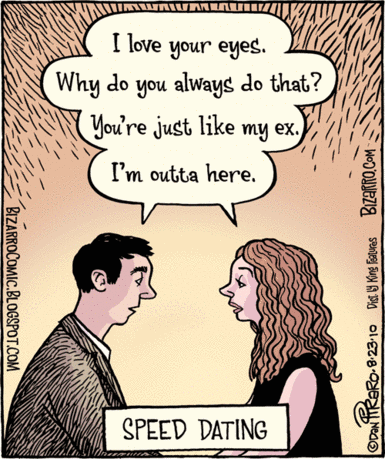
Today’s Bizarro:

Dan Piraro has chosen to have all four clichés attributed to both parties in the event. Maybe we’re supposed to see the exchange as alternating between the man and the woman, or maybe we can mix and match.

[Bonus observation: the synthetic compound speed-dating (however punctuated) has of course given rise to a two-part back-formed verb speed-date. Lots of hits for to speed-date and speed-dated, both intransitive and transitive.]

travel-write

May 1, 2010

Caught on KQED April 30, an opinion piece by travel writer Jules Older, speaking for himself and his collaborator wife, on travel-writing about Arizona, the Sonoran desert in particular, in light of the Arizona state legislature passing a law require that suspected undocumented aliens be able to prove that they are in the state legally:

We wouldn’t travel write about South Africa. We won’t travel write about Burma. And now we won’t help entice visitors to Arizona.

Many googleable examples of “to travel write”, for instance:

Attend V!VA’s Travel Writing Boot Camps
Learn to Travel Write. Get Published. Get Paid. (link)

Everyone is a local somewhere. You need not travel across the world to travel write. (link)

(plus many for the website Travel-Write.com).

An ordinary two-part back-formed verb, based on the synthetic compounds travel writing/travel writer, but clearly a useful one, and one I hadn’t been aware of before.

(I don’t try to catalogue all the back-formations that come my way, but even slapdash collection has netted me, so far, 172 examples of two-part back-formed verbs. An inventory of postings on 2-p b-f verbs, through 6/13/09, is here; since then I’ve posted about name-check, feel-cop, Eve-tease, and shirt-lift.)

Acronym fun

February 12, 2010

Since it deals with all sorts of military programs, organizations, and devices,”The Soft-Kill Solution: New frontiers in pain compliance” by Ando Arike, in the latest (March 2010) Harper’s Magazine, has plenty of acronyms, most of them new to me.

One of the names, however, was perfectly familiar to me, though I hadn’t appreciated it was an acronym: Taser (its registered name), often lower-cased to taser. The T and S come from Tom Swift, the hero of a popular American series of adventure novels for boys; Taser inventor John Cover was a great fan of the Tom Swift books. The E and R stand for Electric Rifle, Cover’s designation for a fictitious weapon along the lines of Cover’s actual invention. A middle initial A (not, apparently, in the Tom Swift books) then fills out a name parallel to the acronym laser.

This somewhat labored invention is then sometimes said to stand for “Thomas A. Swift Electric Rifle”. But the OED says “Tom Swift’s electric rifle”, probably because the inventor-hero was referred to in the books as Tom Swift, not Thomas A. Swift.

Once we had the noun taser (first OED cite 1972), then along came the verbing taser (first cite 1976) and a verb tase (first cite 1991), which is either a shortening of the verb taser or a back-formation from the noun taser.

informate

January 23, 2010

A simple back-formed verb in Bizarro:

The cartoon helpfully supplies the source of the verb, the noun information.

(more…)

booklift

December 23, 2009

In my posting on the shoplifting of books, I used booklifting as a portmanteau of shoplifting and book. I’m not the first person to use the word booklifting for theft. Here’s another occurrence:

The vendors couldn’t keep an eye on each of us as we stormed down the bookstore aisles like schoolgirls on a fun fair. It was an ordinary stealing foray. We were good. Synchronised booklifting, we’d invented the art. (link)

It’s not clear that such examples have portmanteaus. Booklifting could just be a synthetic compound based on the verb lift ‘steal’ (a slang use attested since the 16th century); after all, shoplifting is itself such a compound (attested since the late 17th century, with a backformed verb to shoplift developed later). And there are examples that look pretty clearly like synthetic compounds (not directly involving shoplifting):

A student in Kenya has turned to the BBC to help investigate the problem of continued theft of books from the country’s libraries. Ruben Gitahi asked BBC World Service’s Outlook programme to look into the practice of “booklifting” – which he said was becoming “rampant” in the country’s cities. (link)

And also examples of booklifting ‘raising books into the air’:

So today I took took 200+ books, and moved them off of shelves, and replaced them with (probably over) 200 more and then brought 150 of the former to Goodwill. I get my muscles from booklifting thank you very much. (link)

Back to booklifting ‘stealing books’. Predictably, I suppose, a back-formed verb to booklift has developed:

Have you ever booklifted? (link)

(This is a badly scanned text, but this part of it seems clear, and it’s about stealing books from a library.)

Meanwhile, there are various uses of a noun booklift: for a device for lifting books, for a device for holding copy up, and for shipping books to institutions in need.

And in investigating lift ‘steal’, I came across the slang verb boost with a similar sense (OED2: ‘To steal, esp. to shoplift; to rob’; originally U.S., and attested from the early 20th century).

Short shot #27: to queen-wave

December 11, 2009

Chris Ambidge writes to tell me about an early Xmas present he got from a friend:

It’s a 20cm tall mannikin of The Queen: with usual hairdo, peach coloured dress & coat, sensible shoes, smile, white gloves, handbag & (of course) pearls. But wait — there’s much more. Her handbag is a solar cell, so put her someplace bright & it works — to cause her up-held hand to queen-wave.

Ah, the back-formed verb to queen-wave, based on the synthetic compound queen-waving ‘waving (one’s hand) like the Queen’. An entertaining survey of years of Queen-waving (from the Onion News Network) can be seen here.