Archive for the ‘Linguistics in the comics’ Category
March 3, 2019
From various friends on Facebook who know that I’m interested in meta-comics, this 4/21/17 Imbattable strip by Pascal Jousselin, in an English translation:

(#1) Imbattable (‘Unbeatable’) is a bandit superhero in a yellow and black costume
Among Imbattable’s superpowers is his ability to break the walls of the cartoon’s panels and freely move between them. With the result that temporarily, in the fourth panel, the cat is in two places at once — a phenomenon that unsettles both the cat and the old lady.
(more…)
Posted in Comic conventions, Formulaic language, French, Idioms, Linguistics in the comics, Truncation | 1 Comment »
February 27, 2019
A series of three Calvin and Hobbes strips (re-run on the 25th, 26th, and 27th) in which Calvin undertakes to eat four boxes of Chocolate Frosted Sugar Bombs to get a gee-whiz official beanie. A return to cartoonist Bill Watterson’s attacks on sugary breakfast cereals and the way they are marketed to children, especially through the stratagem of describing them as part of a healthful breakfast (in #2 below):
(more…)
Posted in Language and food, Language in advertising, Linguistics in the comics | 1 Comment »
February 27, 2019
Today’s Zits, featuring teenage boys goofing off, but in a specific way:
 (#1)
(#1)
Thereby presenting an exercise in cartoon understanding that’s a snap if you’re plugged into American pop culture of the past century, but is something of a challenge otherwise.
(more…)
Posted in Books, Idioms, Linguistics in the comics, Masculinity, Movies and tv, Music, Phonetics, Understanding comics | Leave a Comment »
February 26, 2019
From linguist Avery Andrews on Facebook:

(#1) Avery: “My first reading of this was ‘Cthulhu Towers’, indicating that whatever the top-down constraints on my linguistic processing may be, real world plausibility has at best a delayed effect”
To judge from my own misreadings — some of them reported on in the Page on this blog with misreading postings — real-world plausibility has virtually no role in initial misreadings; we tend to notice these misreadings, in fact, because they are so bizarre.
On the other hand, they sometimes clearly reflect material currently or persistently on the hearer’s mind — if you’ve been thinking about cooking some pasta for dinner, Italian pasta names are likely to insert themselves into your peceptions; if you’re a gardener, plant names will come readily to mind, even if they’re preposterous; and of course it’s common to see sexual vocabulary where none was intended — but often they look like the welling-up of material from some deep chthonic place in memory, inexplicably in the context.
(more…)
Posted in Books, Context, Fiction, Linguistics in the comics, Memory, Misreadings, Pragmatics, Processing | Leave a Comment »
February 25, 2019
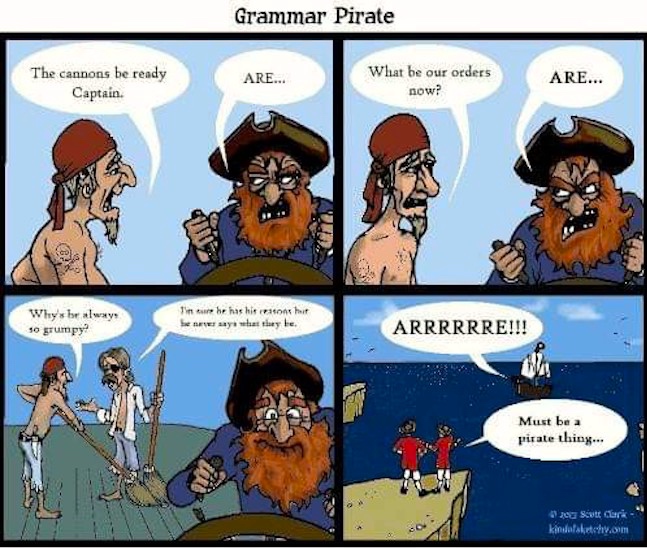
The title of this cartoon, which turned up yesterday in FB’s Our Bastard Language group:
 (#1)
(#1)
The captain is both a pirate and (as it turns out, once you figure out what the man intends to say) a grammar nazi, bent on correcting his crew’s inferior (as he sees it) English — hence the portmanteau grammar pirate. So the cartoon is, primarily, about (stereotypical) pirate talk (which will take us to the West Country of England), but also about peeving.
(more…)
Posted in Books, Holidays, Linguistics in the comics, Movies and tv, Peeving, Pop culture, Portmanteaus, Snowclonelet composites | Leave a Comment »
February 22, 2019
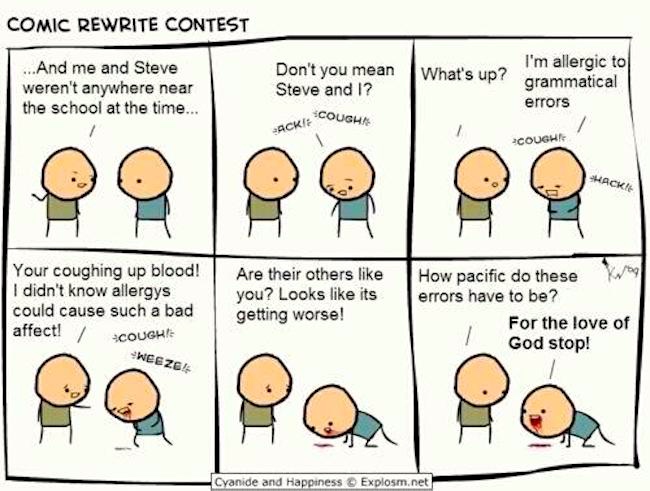
Revived on Facebook recently, this 2/20/12 Cyanide and Happiness cartoon by Jay A.:
 (#1)
(#1)
The first three panels are routine (but annoying): Character 1 produces an example of AccConjSubj (the non-standard Accusative Conjoined Subject me and Steve) and Character 2 reacts with hysterical peeving, becoming physically sick from experiencing the AccConjSubj.
But then we discover that we’re not in anything like the real world, where someone speaks and someone else hears what they say, but instead in the Land of Supertitles, where someone produces a banner with writing on it and someone else reads it. That has to be what’s going on — since otherwise how could Chr2 know how Chr1 was spelling what they said? YOUR instead of YOU’RE, ALLERGYS insead of ALLERGIES, AFFECT instead of EFFECT, THEIR instead of THEY’RE, ITS instead of IT’S — they’re all homophones, so how could Chr2 know that Chr1 was spelling them wrong? UNLESS CHR2 COULD READ WHAT CHR1 WAS SAYING.
(more…)
Posted in Idioms, Linguistics in the comics, Peeving, Phonetics, Pronoun case, Sociolinguistics, Syntax, Usage attitudes | 3 Comments »
February 21, 2019
A few days ago, this full-page magazine display made the rounds of Facebook:

(#1) Deriding the “Libtard Agenda” while imitating the Johnson Smith Co.’s ads for novelty items in the back pages of comic books and other publications aimed at children
The first copies I saw didn’t identify the creator or the publication the page came from, and there was some question whether it was (as George V. Reilly, invoking Poe’s Law, put it) “a right-wing parody of progressive views, or a left-wing parody of right-wing opinions of progressive views”. Parody, certainly, but from what viewpoint?
So in its form it’s a parody of a genre of advertising hucksterism. And then in its specific content it’s a parody of a style of political talk (either mocking what’s framed as a preoccuption with kale, gun control, facts, and the like, or mocking those who engage in such mockery).
Much has now become clear. To start with, the copy of the page in #1 identifies the creator as Mary Trainor, and that provides enough context to eventually sort things out.
(more…)
Posted in Clipping, Compounds, Gender and sexuality, Language and poitics, Language in advertising, Language play, Libfixes, Linguistics in the comics, Movies and tv, Parody, Penguins, Taboo language and slurs | Leave a Comment »
February 20, 2019
(This posting will go lots of places, some of which — a Greek military re-enactors’ group in Melbourne — you’ll find astonishing, but there’s no denying that, as the title suggests, it’s penis-dense. Without actually depicting them — those images are in my posting this morning on AZBlogX, “Gay Heart Throbs” — but still. However, without penises strewn along the road every few feet, there’s no getting to the fun stuff (like allusions to Miss Anne Elk and to Sonnets from the Portuguese). So use your judgment.)
Phallophilia I: self-regard. A recent Daily Jocks ad (for Kasper Military shorts from the Helsinki Athletica company) showing a hunky model gazing fixedly down at his bulging crotch, with a title and a caption supplied by me:

(#1) On contemplating his penis
Could I just say here for one moment that
I have a new theory about the penis?
Yes, well you may well ask, what is my theory.
And well you may. Yes my word you may well
Ask what it is, this theory of mine.
Well, this theory that I have — which is mine —
This theory which belongs to me is as follows.
Ahem. Ahem. This is how it goes.
Ahem. The next thing that I am about to say
Is my theory. Ahem. Ready?
My theory is along the following lines.
All penises are round at one end,
Tubular in the middle, and then
Anchored in hair at the far end.
That is the theory that I have
And which is mine, and
What it is too.
— excerpts from an interview with noted penis scholar Gay H. Throbs, DPhS. (Doctor of Phallological Science)
On the nose, GHT!
(more…)
Posted in Captions, Gay porn, Gaze, Gender and sexuality, Language in advertising, Linguistics in the comics, Movies and tv, Names, Parody, Phallicity, Poetry, Pseudonyms, Resources, Signs and symbols, Underwear | Leave a Comment »