Archive for the ‘Linguistics in the comics’ Category

Allentown riff

November 22, 2011

Today’s Zippy has our Pinhead riffing on Billy Joel’s song “Allentown”:

Another contribution to the Zippy song-burlesque oeuvre, following on “Somewhere Over My Poncho” (“Somewhere Over the Rainbow”), “My Funny Serpentine” (“My Funny Valentine”), and “Everything Works Out for Me” (“Everything Happens to Me”). This one diverges pretty far from the original, but the model is unmistakable from the first line.

(more…)

The mother-in-law solution

November 20, 2011

The Mark Parisi Off the Mark cartoon that was posted here originally has been removed because it violated copyright. Here’s a description of its content:

Main image: White-haired woman, gagged and feet bound, in a large skillet on a stove, while a younger woman holds the skillet and sprinkles salt (or pepper) on the older woman. Voice balloon coming from the left:

Mmmm! Honey, that smells just like my mother’s cooking!

You don’t see a lot of ambiguities turning on possessive ‘s (my mother’s cooking ‘my mother’s cookery’) vs. reduced-auxiliary ‘s (my mother’s cooking ‘my mother is cooking’ — itself ambiguous between my mother referring to the person doing the cooking and to the thing being cooked). In this case, it’s crucial that like is also ambiguous, between a preposition (combining with an NP object and meaning, roughly, ‘resembling’) and a subordinator (combining with a clause and meaning, roughly, ‘as if’).

That gives three principal readings for that smells just like my mother’s cooking:

(a) ‘that smells just the way my mother’s cooking smells’

(b) ‘that smells just as if my mother is cooking something’

(c) ‘that smells just as if my mother is being cooked’

The speaker intended reading (a) (or, just possibly, reading (b)), but reading (c) corresponds to what’s happening in the cartoon: the addressee is cooking her mother-in-law. With apparent relish.

 

Accents

November 18, 2011

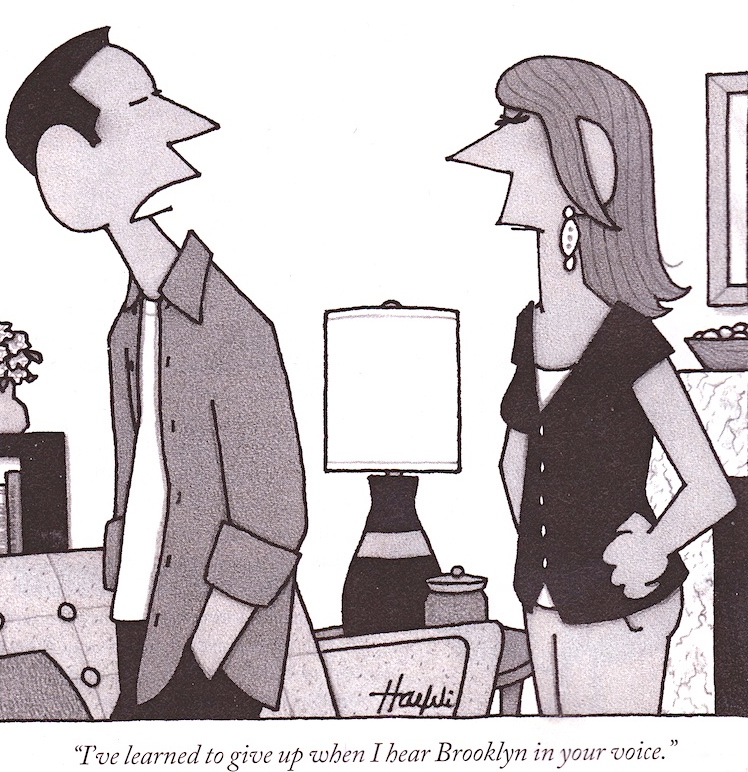
Haefeli cartoon in the latest New Yorker (November 21st):

The power of accents. Everybody knows, at some level, that our speech styles vary according to social context — who we’re talking to, about what, for what purposes — but most of us tend to assume that this variation is under conscious control, that people “put on” accents for some purpose, though linguists point out again and again that this degree of control is essentially impossible, that almost all of this style shifting has to be unconscious. But other people are often sensitive to these shifts, though again almost entirely at an unconscious level.

In the cartoon, the “Brooklyn” in her voice is surely not something she’s projecting willingly, but he’s aware of it and interprets it consciously. But not necessarily accurately — though it makes a wry joke.

X is the real Y

November 16, 2011

From the web comic A Softer World (#737, 11/9/11):

In a comment:

(heartbreak is the real chlamydia)

This looks like a new snowclone-like figure X is the real Y, where X and Y denote things that are not normally compared, like emotions and diseases. (Contrast this with the ubiquitous snowclone X is the new Y, where X and Y denote things from the same semantic domain, like two colors or two ages.)

(more…)

Taking notes

November 15, 2011

Today’s Zippy, with penheads:

As a devoted data collector, I certainly appreciate panel 2. With apologies to Edward Gorey:

GenX so

November 14, 2011

Today’s Zits has Jeremy using intensifier so modifying a verb: one type of what I’ve called GenX so (named that for its spread in people from Generation X):

The stereotypical associations of GenX so are to young white women (in the U.S.), no doubt because of its prominence in the movies Heathers (1988) and Clueless (1994). Studies of actual usage (though admittedly small in scale) suggest that the actual association with women, while apparently real, is smaller than the stereotype would suggest; and as the GenXers have aged, they seem to have carried this usage with them, and it’s spread to many people not in GenX (like me). For some assessment of these factors, see the 2007 paper by Douglas Kenter, Eric Lee, and Rowyn McDonald (written for me in an undergraduate seminar on linguistic innovations), available here.

(more…)

The rumor mill

November 11, 2011

Today’s Zippy:

The metaphorical idiom rumor mill literalized, with tidbits, hearsay, and buzz made concrete.

Repurposing beef

November 10, 2011

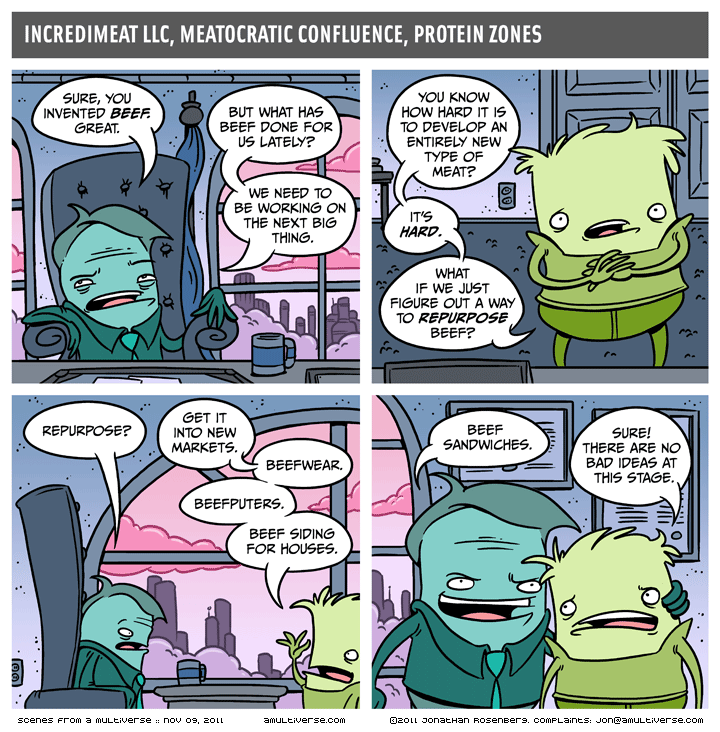
Today’s Scenes From a Multiverse:

(I especially like the idea that beef sandwiches would be a repurposing of the meat.)

(more…)

Big words

November 9, 2011

Today’s Bizarro:

So: big in size as printed, all-caps; or long (and “fancy”) — the latter being the ordinary sense of big word.

(more…)

Disco

November 7, 2011

Today’s Bizarro, with a very distant pun:

As with other distant imperfect puns, this one works only because of all the heavily determining context, ” ___ Savings Time”, which allows disco and daylight to count as equivalent even though they share nothing significant beyond the initial /d/ and their disyllabicity.

(more…)