Archive for the ‘Linguistics in the comics’ Category

Dilbert 2: engineers and knowledge workers

April 22, 2012

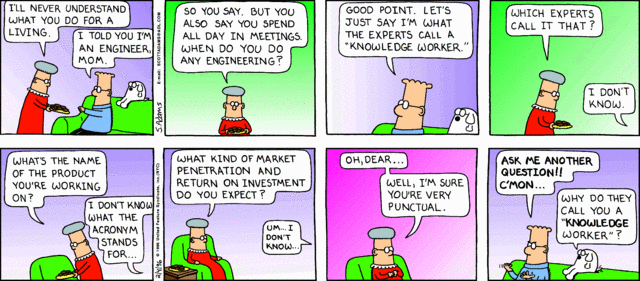
Another Dilbert strip (from 2/4/96), this time with our office hero confronted by his mother (as he often is):

After one evasion and three “I don’t know”s, Dilbert’s claim to knowledge (as in knowledge worker) is severely damaged. Of course, that’s a specialized sense of knowledge.

It’s especially telling that Dilbert doesn’t know what the acronym for the project he’s working on stands for. Probably few people on the project do.

Dilbert 1: managerspeak

April 22, 2012

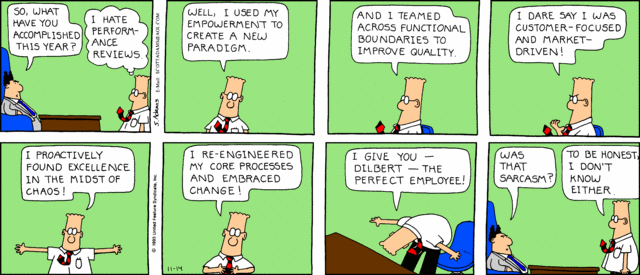
The first of two old Dilberts I’ve recently come across. This one (from 11/14/93) about Dilbert’s response to the annual performance review:

Dilbert wields managerspeak like a pro here, and takes a bow for his, um, performance. As far as I can see, none of the managerspeak is necessary, and much of it is merely ornamental.

In the last panel, Dilbert responds, not directly to the question his boss asks (which is a straightforward yes-no question), but to a presupposition of the question, which is that the boss doesn’t know whether Dilbert’s performance was sarcastic in intent.

Peanuts vs. the grammar nazis

April 20, 2012

Via several friends on Facebook, this image from Bob Lucas’s wall photos:

On the snowclonelet X nazi, with special reference to grammar nazi, see here and here.

And note that the Peanuts takeoff is about spelling rather than grammar — that is, it’s about garmmra.


Gender-appropriate playthings

April 19, 2012

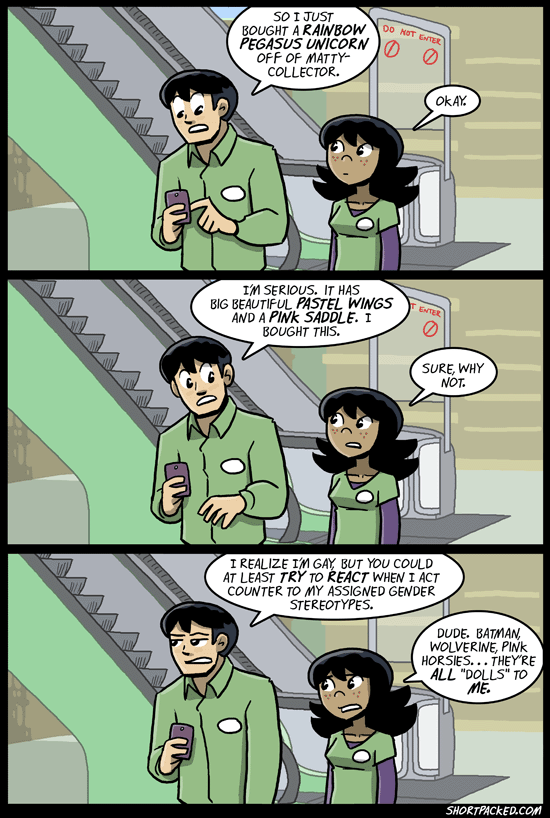
Via Jack Hamilton on Facebook, this cartoon from Shortpacked! by Dave Willis:

Previous postings on this blog: “Dolls and action figures” (on the distinction between the two types of playthings), here, and “Dubious bromanteau” (on brony, bro + pony, as in My Little Pony), here.

On the strip:

Shortpacked! is a webcomic by David Willis set in a toy store. It is part of the Blank Label Comics family. After putting an end to his successful webcomic It’s Walky!, Willis decided to turn Shortpacked!, his autobiographical comic, into a new title. The strip is based in the same universe as It’s Walky! and Roomies!, and features two side characters from the previous comic, Robin and Mike. It is more R-rated than most comic strips that appear in mainstream newspapers, using profanity and sexual innuendos not found in those newspapers. The primary inspiration behind Shortpacked was Willis’ own experiences working retail at Toys “R” Us. (link)

The body language of dogs

April 18, 2012

Lili Chin’s “Doggie Language”:

Or maybe I should say the “body communication” of dogs.

More Lili Chin dogs here; a fair tolerance for cuteness is required.

(Hat tip to Robin Queen, via Facebook.)

huge-quiffed schlemiel

April 18, 2012

In Sunday’s NYT Book Review, a piece by Douglas Wolk (“Dreams of Youth: Lynda Barry’s ‘Blabber Blabber Blabber’ and More”) with the delicious expression “huge-quiffed schlemiel” in it, in a review of a retrospective of Dutch artist Joost Swarte‘s cartoons.

(more…)

Cartoon matters

April 15, 2012

Late on Thursday, a notification that Elizabeth Traugott and I  have been provided a summer intern for our project on “Linguistics in the Comics”; I posted our proposal here last month. Buoyed by this news, I talked enthusiastically about the project with the staff at Three Seasons, where I was having dinner. That got me into giving examples of cartoons illustrating some of the topics we are exploring (language play of various kinds, social dialects, errors, new and spreading usages; the conventions of the comics; the narrative structure of comics).

I happen to have brought the most recent issue (April 16th) of The New Yorker with me, so our conversation turned to the excellent cartoons in the magazine, and how varied they are, in both content and visual style. I noted the range of content and tone, from social commentary at one end to gag cartoons at the other, bringing up Bob Mankoff (the cartoon editor of the magazine) as one of the cartoonists who specializes in gags. I then looked at the issue and found that the second cartoon in it was by Mankoff:

The cartoon depends on all sorts of background knowledge: what scythes are, how Death, the Grim Reaper, is conventionally represented, etc. And, crucially, the story of Trayvon Martin in his black hoodie. This last factor makes the cartoon highly topical — but also likely to lose much of its punch as years go by and the story of Martin and Zimmerman recedes into history.

Rejection

April 14, 2012

On Facebook, Serene Vannoy has reminded her readers of this 1981 Peanuts cartoon, featuring Snoopy as an aspiring writer:

This cartoon is a favorite on writers’ websites, for obvious reasons: every writer has been rejected, usually many times (goodness knows I have), and it hurts. So it’s entertaining to see Snoopy’s childlike assumption that his intentions and desires should rule and his bafflement that other people don’t recognize this.

(more…)

Body language

April 10, 2012

Today’s Zippy has some very specific gestures:

This is one step beyond the gestures in this Zippy strip from last year, in which body language mostly communicates feelings. Here, a single gesture conveys an entire specific text. That is, Zippy’s “body language” seems to be non-compositional — like a codebook, rather than an actual language.

fugues

April 10, 2012

Today’s Bizarro, with a pun on fugue:

(with an accompanying pun on minor). There’s a musical and a medical sense of fugue; from NOAD2:

Music a contrapuntal composition in which a short melody or phrase (the subject) is introduced by one part and successively taken up by others and developed by interweaving the parts.

Psychiatry a state or period of loss of awareness of one’s identity, often coupled with flight from one’s usual environment, associated with certain forms of hysteria and epilepsy.

Remarkably, these two words share an etymology, going back to Latin fuga ‘flight’, related to the verb fugere ‘to flee’ — with metaphorical extensions of flee in two different directions, in two different domains. (Because of the common etymology, the two words are listed in dictionaries in a single entry, though the relationship between the two will not be obvious to any ordinary speaker of the language.)

In tandem with this ambiguity, there’s a parallel ambiguity in minor: a musical sense, referring to a scale or to an interval within that scale; and an older general sense, meaning ‘lesser in importance, seriousness, or significance’. The first is a metaphorical development from the second, and both are contrasted with major. So: a minor fugue, a contrapuntal composition in a minor key or a psychiatric condition of lesser importance.

(Bonus: the Latin fug- ‘flee’ root crops up in other English words: fugitive, refuge, refugee, and the rarer fugacious ‘passing away quickly, evanescent’.)