A Wondermark cartoon (of 2/3/14), passed on by Roey Gafter:
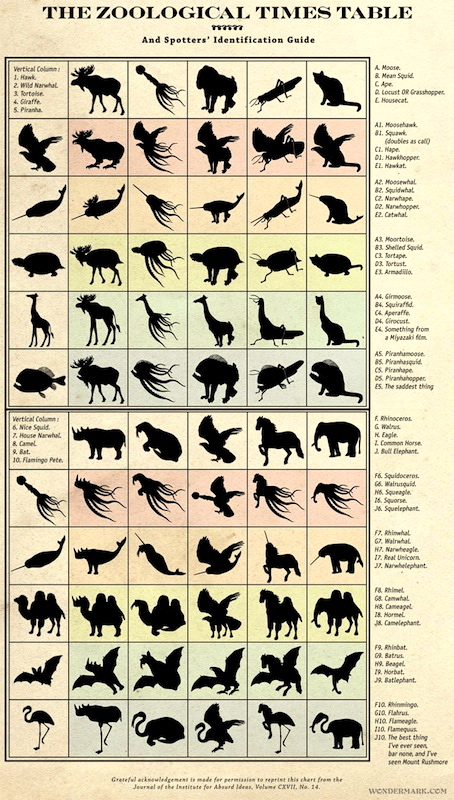
Zoological crosses, with inventive names.
A Wondermark cartoon (of 2/3/14), passed on by Roey Gafter:
Zoological crosses, with inventive names.
A Roz Chast cartoon:
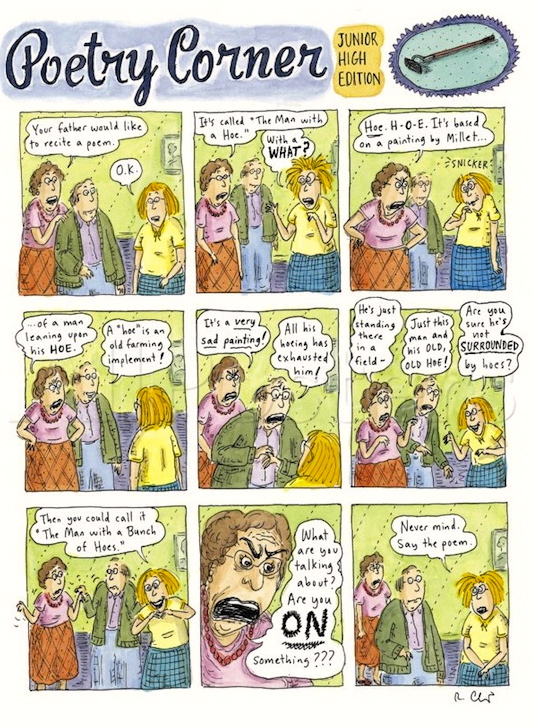
Generational differences. Slang. An inadvertent pun.
(Original lead from Jonathan Lighter on ADS-L. This image via Ben Zimmer.)
Today’s Rhymes With Orange:
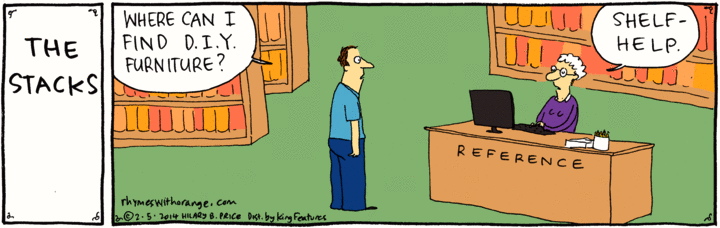
Cute pun. As an exercise, consider what you need to know just to understand this (let alone understanding why it’s funny), about English expressions and sociocultural conventions.
This figure of speech — sometimes characterized as “bait and switch” — came up in conversation with Don Steiny on Sunday. It seems not to have been discussed on this blog or Language Log.
The Stanford freshman seminar 63N (The Language of Comics) has tended to focus on the genres that are the focus of my postings on the comics — what you might characterize as traditional or mainstream print comics. Manga, graphic novels, animation of all sorts, etc. come up, but the focus in class and assignments is primarily on three types of traditional print comics: single-panel cartoons (sometimes called gag cartoons), three- or four-panel cartoons, and comic books (which continue over at least a few pages). (Student projects have been more adventurous.)
From Norma Mendoza-Denton, this Washington Post story of 12/31/13, “The trial balloon: O teachers, after a banner year for graphic novels, don’t ban these books”, by Michael Cavna.
A list of excellent graphic novels of 2013, set off by an anecdote about a grade-schooler who was reading a memoir when a teacher asked accusingly what it was. Then:
“It’s a graphic novel,” came the girl’s reply. Such works, the girl was told, were unacceptable for classroom “reading time,” let alone for a book report. The teacher’s sharp ruling boiled down to a four-word excuse for banishment: “Graphic. Novels. Aren’t. Books.”
Sigh.
Today’s Bizarro:

So Batman, like a good bat, orders insects, while Robin orders the worm: the early bird gets the worm. Proverbs rule.
Yesterday’s Bizarro, in a truncated version:
 (#1)
(#1)
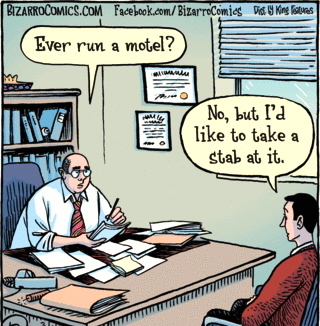
This is funny as it stands, but it takes a considerable amount of pop-cultural knowledge to comprehend. The keys are the reference to motels and to stabbing: Psycho.
A recent xkcd:
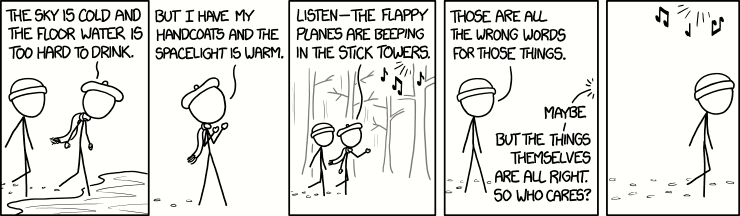
I was about to post on this one, but Mark Liberman got to it first, yesterday, under the title “A stick tower by any other name”, where he wrote:
Mouseover title: “Stay warm, little flappers, and find lots of plant eggs!”
An amusing reminder of a serious issue: most compounds and phrasal collocations are used in ways that are consistent with their compositional meaning, but not entirely predictable from it. “Solar cell” doesn’t mean “tanning bed”; “drainage basin” doesn’t mean “mop bucket”; “forest canopy” doesn’t mean “camping tent”; etc.
The frequent failure of perfect compositional semantics in composite expressions (both N + N and Adj + N) is a persistent theme on this blog.

