Archive for the ‘Linguistics in the comics’ Category

For St. Patrick’s

March 17, 2016

Passed on by Horton Copperpot, this day-appropriate Bizarro cartoon from back in 2012 (which I thought I’d posted, but apparently not):

(If you’re puzzled by the odd symbols in the cartoon — Dan Piraro says there are 2 in this strip — see this Page.)

St.Patrick famously (but fabulously) drove the snakes from Ireland, thus leaving the snake-haired Medusa bald (as above) and without her powers. Bad history for a blind date.
(more…)

Two Thursday cartoons

March 17, 2016

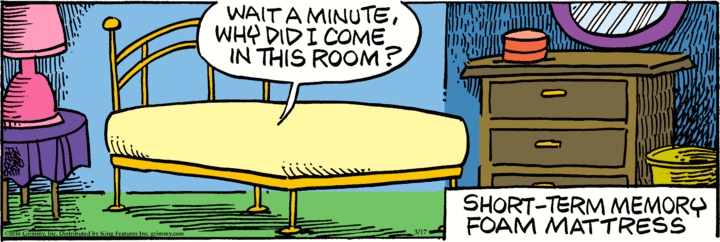
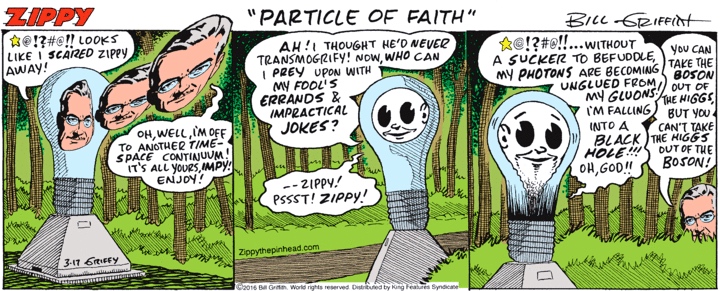
From my King Features feed today, two cartoons of linguistic interest: a Mother Goose and Grimm with a POP (phrasal overlap portmanteau) and a Zippy that happens to use a playful verb with, it turns out, a long history:

(#1)

(#2)

(more…)

Your money’s no good here

March 16, 2016

Today’s Bizarro, exploiting an ambiguity in pragmatics, use in discourse contexts:

(#1)

(If you’re puzzled by the odd symbols in the cartoon — Dan Piraro says there are 3 in this strip — see this Page.)

Your money’s no good here has a use as a pragmatic idiom, conventionally conveying that at this moment it’s of no use in the context because the services or goods it’s being offered for are being supplied for free, are complimentary, are “on the house”. But in the cartoon, the bartender is speaking literally, saying that the customer’s money is no good here because it’s not in fact legal tender.

(more…)

Cowboy POP

March 13, 2016

Today’s Rhymes With Orange:

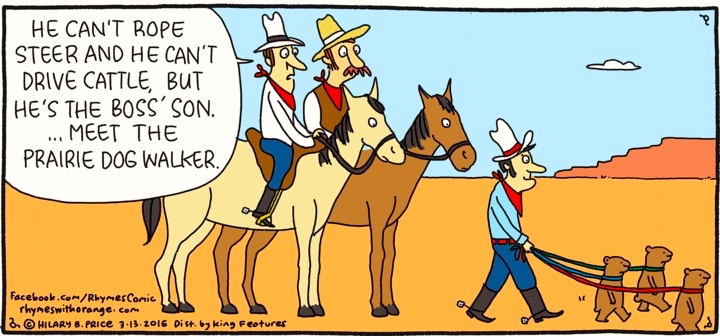
It’s been a while since we had a POP (phrasal overlap portmanteau), but here’s a cute one (Hilary Price is fond of them): prairie dog + dog walker = prairie dog walker, which is what the fellow in the cartoon is — definitely a niche occupation, not much in demand.

(more…)

Mayan comics and alliterative music

March 12, 2016

Recent e-mail from my old friend Larry Schourup with two very different offerings of interest: a piece about Mayan counterparts to modern comics, and a response to my 2/23/16 posting (on “Who is Silvia?”), which had a Schubert setting of Shakespeare, very alliterative, with a (Kurt) Moll performance of Mozart (from The Marriage of Figaro), also alliterative.

(more…)

Spoiled children

March 12, 2016

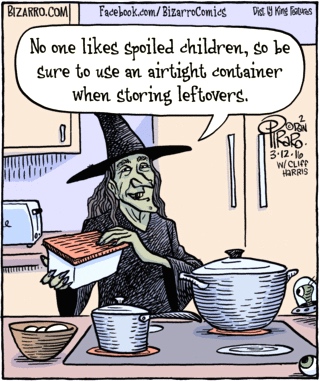
Today’s Bizarro, turning on an ambiguity in spoiled:

(#1)

(If you’re puzzled by the odd symbols in the cartoon — Dan Piraro says there are 2 in this strip — see this Page.)

(more…)

Sweet nothings: candy, cereal, advertising

March 12, 2016

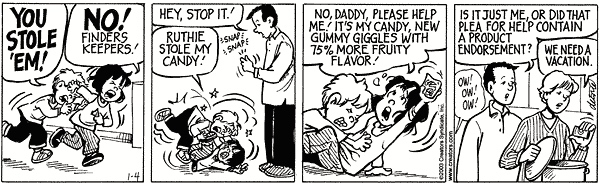
A One Big Happy strip from 1/4/16:

(#1)

Ruthie gets this information from tv advertising, no doubt.

That’s candy. Then there’s cereal, marketed to both kids and adults. From “Selling Sweet Nothings: Science Shows Food Marketing’s Effects on Children’s Minds — and Appetites” by Mariko Hewer, in Observer (Association for Psychological Science) 27.10.14-18 (December 2014), beginning:

In the 1960s and ’70s, the prime time to advertise food to children was on Saturday mornings, when they perched themselves in front of the TV to watch cartoons. Today, with kids’ programming available almost continuously, children are bombarded with daily doses of food-related advertising. According to a 2013 study by Lisa M. Powell, as cited by the Robert Wood Johnson Foundation, “In 2011, children ages 2 to 11 saw about a dozen television ads each day for products typically high in saturated fat, sugar, or sodium.”

(more…)

Drawings plus text, telling stories, for kids

March 11, 2016

There’s no fully comfortable label for cartoons, comics, and graphic novels — drawings plus text that together tell stories — taken together, but here are two more of these things meant for kids (in two different age ranges): the various Big Nate materials by Lincoln Pierce (daily comics, comic collections, longer stories in comic form, animated cartoons, etc.), aimed at readers 8 to 12, with a male central character; and the graphic novel In Real Life, by Cory Doctorow & Jen Wang, aimed at readers 12 to 18, with a female central character.

(more…)

Three from the New Yorker

March 11, 2016

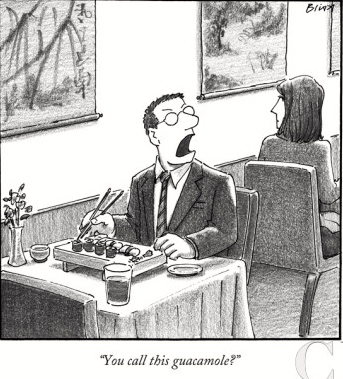
Two from the 2/29/16 issue, one from the 3/7/16 issue, all having to do with language, but in different ways. Michael Maslin (who’s appeared here twice before) on the 29th, with the opposite of giddyup:

(#1)

(A horse in a tree! How can that be?)

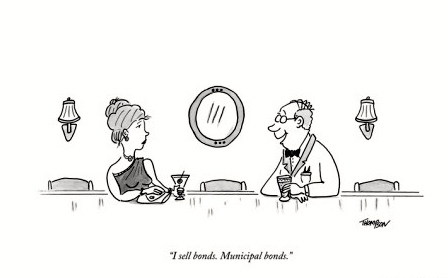
David Thompson (new on this blog) on the 29th:

(#2)

— a cartoon you very much need to be tuned into popular culture to understand.

And Harry Bliss (who already has a Page here) on the 7th:

(#3)

— not a question at all, but a loud complaint (in a sushi restaurant) by a customer who seems to have expected guacamole.

(more…)

Ruthie v. idioms

March 10, 2016

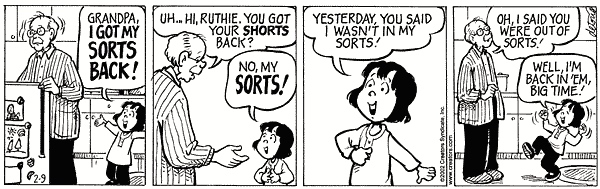
Yesterday’s One Big Happy has Ruthie coping with idiomaticity:

The whole idiom here is (be) out of sorts (with two somewhat different senses), and Ruthie understands something of its meaning as a whole, but she’s also trying to understand it as to some extent compositional, with the parts out of and a noun sorts (whatever that refers to). There are several possible senses for out of; the one Ruthie’s fixed on is an opposite of in (but there’s at least one other sense she might have gone for).

(more…)