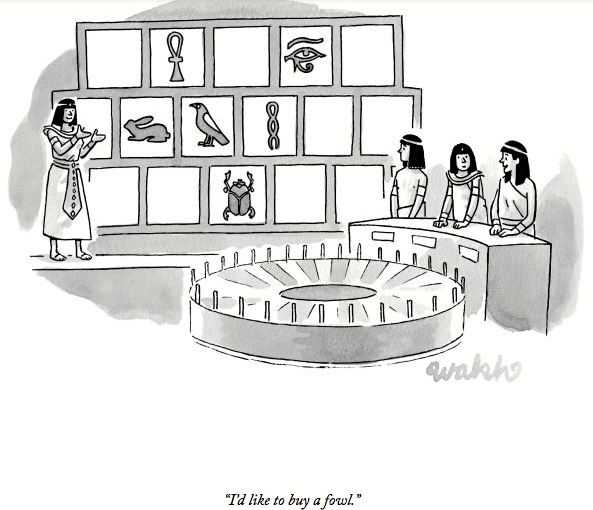
Via Elizabeth Daingerfield Zwicky, this Evolution of Woman cartoon from the Tainted Lips Tumblr account of a young woman named Tupa:

The drawing plays on the widespread use of flowers (as vaginal symbols) to represent women. Think Georgia O’Keeffe.
Via Elizabeth Daingerfield Zwicky, this Evolution of Woman cartoon from the Tainted Lips Tumblr account of a young woman named Tupa:
The drawing plays on the widespread use of flowers (as vaginal symbols) to represent women. Think Georgia O’Keeffe.
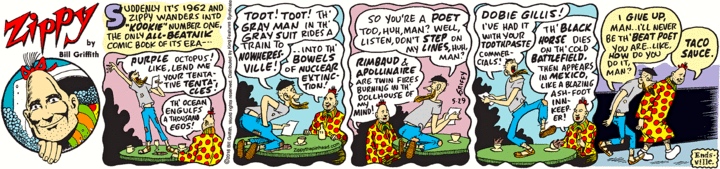
Today’s Zippy goes back to 1962 and Kookie comic book #1:
 (#1)
(#1)
— meanwhile, engaging in a battle of beatnik poetry with the character Bongo from Kookie.
(Another in a long line of Zippy strips on beatnik customs, including invented beatnik poetry.)
(Mostly about art, rather than language.)
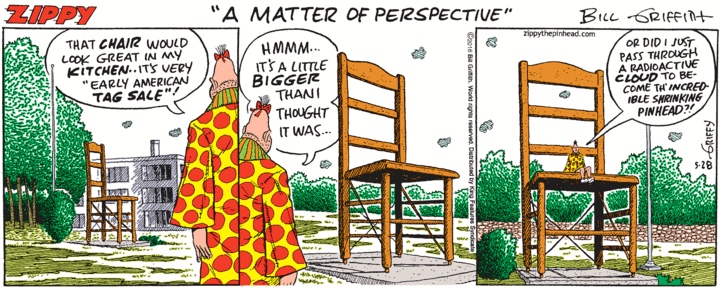
Today’s Zippy:
 (#1)
(#1)
Giant chairs are something of a theme in public art. The one in the cartoon is no doubt (given Bill Griffith’s proclivities) a real one, but I haven’t located it. However, there are plenty of others around; here, Geneva, Switzerland; Washington DC; Hampstead Heath in London; Dartmoor, Devon; and Denver CO.
On the Comics Kingdom blog on Tuesday, for National Escargot Day (May 24th), ten cartoons on snails, all of them new to this blog. Some turn on the snail cartoon meme (having to do with slowness), many have to do with the slowness of postal services (snail mail, in the rhyming retronym), the rest deal with other gastropodal matters.
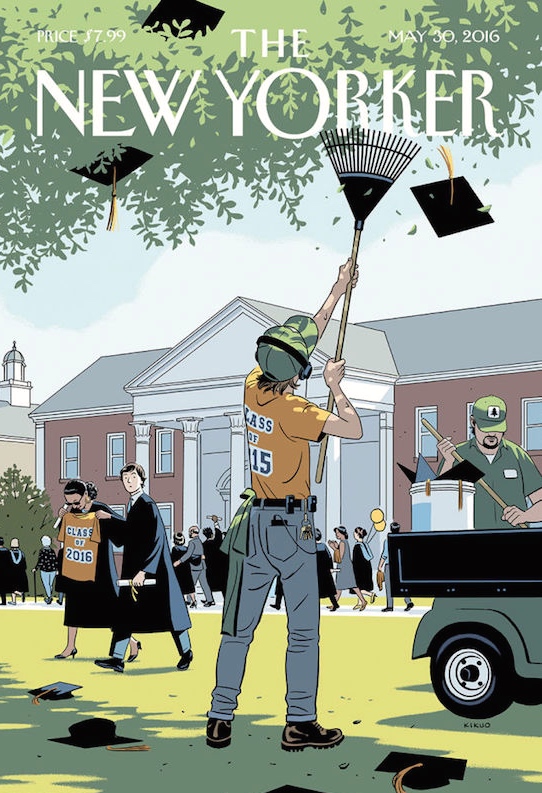
The cover of the May 30th New Yorker, “Commencement”:
 (#1)
(#1)
A standard exercise on this blog: what do you have to know to understand what’s going on in this drawing? To see why it might be funny? (It could, of course, just be an affectionate portrait of an event of the season, not meant to be funny.)
Like Thurber, Sendak, Briggs, and some others I’ve written about, another cartoonist / illustrator not generally accounted to be a Real Artist (perhaps at best a “graphic artist” like Bechdel) — especially since his work is funny, and meant to be. But he was a delight, the clear standout in the specialized field of cartoonists / illustrators / humorists who focus on the world of music. The occasion is my unearthing my copy of The Hoffnung Symphony Orchestra (originally published in 1955, reprinted in 1984), with its enormously enjoyable combination of hilarious exaggerated drawings of symphony musicians at work and preposterous invented instruments. A third vein of humor comes in some other books of his, especially Musical Chairs of 1958, with its hybrid concoctions of animal plus instrument (a cat playing on its whiskers as a violin, for example).
Seven examples follow. I had to exercise severe forbearance to keep from swamping you with Hoffnungiana.
James Thurber drew stuff, all the time. Some of this stuff was published as single-panel cartoons in the New Yorker (indeed, went a long way towards defining the New Yorker style in cartooning). Other stuff served as illustrations to his writing. In at least one case — The Last Flower, which I’ll look at below — the text and illustrations are fused, in the fashion of a graphic novel.
All of this you can appreciate in a single volume, Thurber: Writings & Drawings (1996), from the estimable Library of America (contents selected by Garrison Keillor), which has the complete My Life and Hard Times (1933), The Last Flower (1939), and The 13 Clocks (1950) — for an appreciation of this last book on this blog, see my 7/29/13 posting — and substantial selections from most of the rest of his output, from Is Sex Necessary? (White & Thurber, 1929) to The Years with Ross (1958).
… in the comics. Specifically in today’s revival of a Calvin and Hobbes strip:
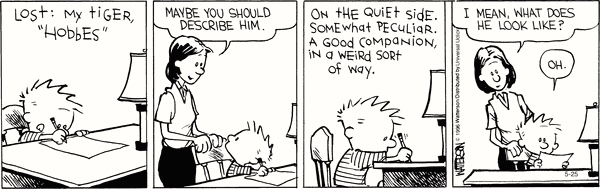
Just what sort of description is called for? It depends on the context.
Some men go on the down-low, but Zippy goes on the Hi-Lo. Yesterday’s strip is set in the diner of this name in Minneapolis MN:
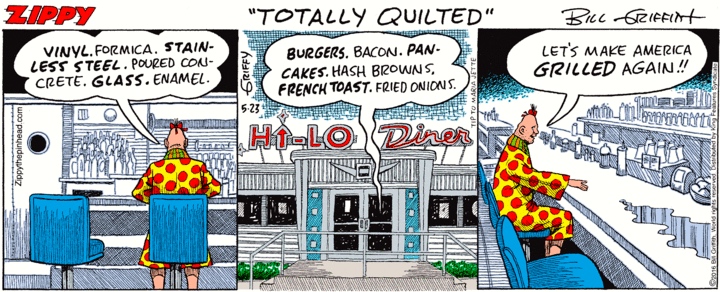 (#1)
(#1)
Seen here in a recent photo:
 (#2)
(#2)