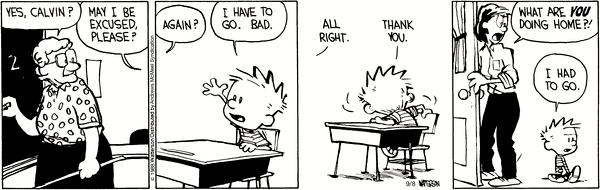
In the 7/30 strip, on the ambiguity of the word letter; in the 7/31 strip, a play on the name of the letter Y:
Archive for the ‘Linguistics in the comics’ Category
Ruthie faces literal ambiguity
August 28, 2018But is it a cartoon?
August 25, 2018From the Pun Based Humor Facebook page (ultimate source not identified):
A photograph (composed and posed for humorous effect), but if you drew this scene, it would straightforwardly be a (captionless) cartoon, so why shouldn’t this count as a cartoon too? Not your prototypical cartoon, but a cartoon nevertheless.
An analogy would be to the art work of Pierre et Gilles: photographs elaborately composed and posed for artistic effect (often humorous effect as well), and meant as a photographic equivalent of a fantasy painting or drawing.
Meanwhile, there’s the matter of cartoon understanding: the young man, the box of breakfast cereal (Kix brand), and the highway route sign (for US Route 66) are the three elements focused on in the photograph, but what’s funny about that? Is it relevant that the route is historic, or that it’s a loop, or that the young man’s belt end is dangling (something to do with loops, maybe)? Or maybe stuff in the background is subtly significant. Or the setting, on a town street, at an intersection with a crosswalk.
Fantasy originalism
August 25, 2018volumptuous
August 22, 2018That’s the portmanteau in yesterday’s Luann strip:
voluminous + voluptuous, probably with a bit of sumptuous mixed in — but certainly ample heft combined with sensuousness. Not a waif, and not any typical fashion model.
More bedevilment
August 21, 2018Today’s Bizarro/Wayno collab:

(#1) (If you’re puzzled by the odd symbols in the cartoon — Dan Piraro says there are 4 in this strip — see this Page.)
The disaster to be averted:
Humpty Dumpty sat on a wall / Humpty Dumpty had a great fall
Meanwhile, HD is bedeviled. From NOAD:
verb bedevil: [a] (of something bad) cause great and continual trouble to: inconsistencies that bedevil modern English spelling. [b] (of a person) torment or harass: he bedeviled them with petty practical jokes.
Hazard signage
August 21, 2018A Tom Gauld New Scientist cartoon:
Gauld’s version starts with real hazard pictograms and then veers into the fanciful.
(Note: the DEPRESSING pictogram is a black cloud, not a version of the poop emoji.)
Another puzzle in cartoon understanding
August 19, 2018It appeared on Facebook today, with this note from Chris Hansen:

(#1) CH: From another list we have a cartoon that takes a heckuva lot of background knowledge to understand. Arnold may want to deconstruct it, if he hasn’t already. I don’t know the cartoonist.
Well, I certainly wanted to deconstruct it, but not without knowing who the artist was. Quickly, however, Chris himself, Brian Guerrero-Kane, and Roger Phillips all supplied that information — Leigh Rubin (who has a Page on this blog) — and led me to fuller versions of the cartoon, with a title that considerably aids understanding. But the stripped-down version in #1, though challenging, is soluble, so I’ll do that first.
The crystal ball of cartoon understanding
August 17, 2018Today’s Mother Goose and Grimm takes us through the murky realms of cartoon understanding:
At the surface level, the fortune teller offers a preposterous prediction about how Grimm will be reincarnated, and Grimm says he doesn’t believe in reincarnation. Entirely comprehensible (so long as you know about fortune tellers, and can recognize a stereotype of one — woman in gypsy costume with crystal ball — and so long as you know what reincarnation is), but not funny, unless you also know about Carnation brand evaporated milk (sweetened powdered milk that comes in cans). It’s a joke, son.
At the eggcorn’s edge
August 15, 2018Head in hands
August 14, 2018The Zippy from the 13th, in which the Pinhead mocks a piece of metal public art:
This is a Zippy, so you can be sure that there’s an actual piece of public art that looks like this (though it took quite some time to find it, and then I stumbled on it by accident — a happy accident, as it turns out, which got me to the work and the sculptor through a Dutch bronze duck.).
Then the figure in the sculpture has its head in its hands — a gesture with a variety of possible meanings, seen in other sculptures. Which of course were the ones I found when trying to identify the statue in #1.
And Bill Griffith has salted the strip with two textual references: “The Sculpted Word” (the title), and “Man in Search of …” (last panel).