Archive for the ‘Linguistics in the comics’ Category
September 28, 2018
A week ago, I posted about this cartoon:

(#1) from the 9/21 posting “A transtlantic exercise in cartoon understanding”
Most of the posting was about the content of the cartoon. But then there’s the question of its source — there’s an artist’s signature, but what is it? — and that’s turned out to be quite a mystery.
(more…)
Posted in Linguistics in the comics | 1 Comment »
September 27, 2018
A cartoonist and cartoon enthusiast who hasn’t appeared on this blog before.
The barest of brief Wikipedia information:
Mike Lynch [born January 18, 1962, in Iowa City IA] is a cartoonist whose work can be seen in Reader’s Digest, The Wall Street Journal, Playboy and other mass media markets.
Lynch maintains a substantial blog on cartoons, with material of his own and compilations of other cartoonists. For example, a 9/24 posting on gag cartoons, from Dick Buchanan; a 9/21 posting on women cartoonists of the New Yorker, from Liza Donnelly; a 9/20 posting on cartoonists drawing on the wall at the Overlook Lounge in NYC.
(more…)
Posted in Art, Books, Comic conventions, Formulaic expressions, Language play, Linguistics in the comics, Pop culture, Puns, Understanding comics, Words and things | Leave a Comment »
September 26, 2018
The One Big Happy from 8/30, in which Ruthie hopes for semantic transparency in morphology:

Ruthie’s reading from a book, so she can see the LAND in IRELAND (in pronunciation, it’s reduced to unaccented /lǝnd/ and might not be so easily identifiable). So she hopes the IRE part will be another word she knows that will make sense in combination with LAND in the way that the first elements in, say, ICELAND and WOODLAND do.
And her dad helpfully explains IRE.
Posted in Compositional semantics, Compounds, Linguistics in the comics, Morphology, Semantics | 1 Comment »
September 25, 2018
Today’s Bizarro/Wayno collaboration (entitled “Recurring Dream”) is, from the point of view of this blog, quite timely:

(#1) (If you’re puzzled by the odd symbols in the cartoon — Dan Piraro says there are 5 in this strip — see this Page.)
That’s a dog therapist ‘therapist for dogs’ (a Use N + N compound); see discussion in my 9/22 posting “therapist dog, dog therapist”. In this case, for a patient who’s had the canine equivalent of the common nightmare of being naked in public (especially in front of a class or while giving a speech).
(more…)
Posted in Comic conventions, Compounds, Linguistics in the comics, Morphology, Semantics, Sociocultural conventions | Leave a Comment »
September 22, 2018
Exercises in English N + N compounds (for use in another context), illustrated in cartoons exemplifying the Psychiatrist cartoon meme, with dogs either as patient or therapist (or both): therapist dog ‘dog that is a therapist’ (also ‘dog for therapists (to use, for example as companions)’, a sense I’ll disregard here); dog therapist either ‘therapist that is a dog’ (sense 1) or ‘therapist for dogs (taking dog as patients)’ (sense 2).
(more…)
Posted in Comic conventions, Compounds, Linguistics in the comics, Morphology, Semantics, Subsectivity | 1 Comment »
September 21, 2018
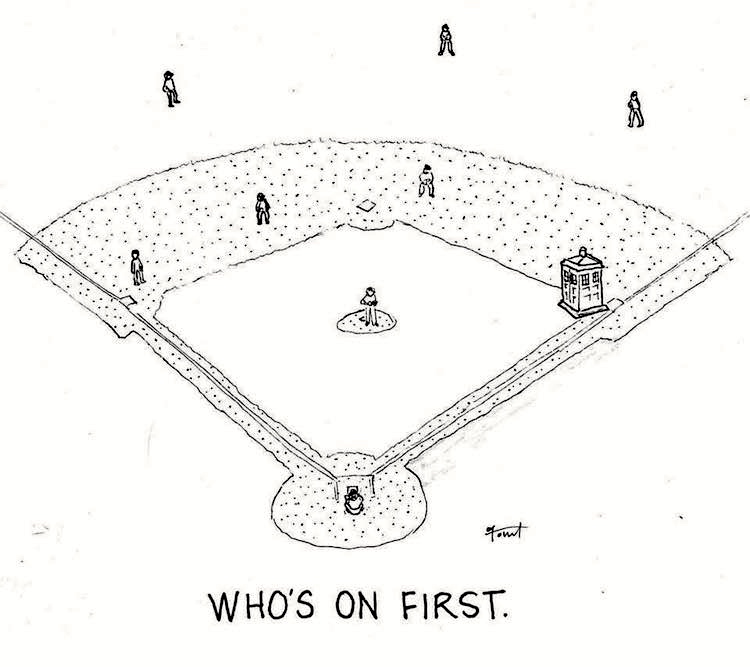
To fully appreciate this cartoon (passed on to me on Facebook), you need to have two pieces of pop-cultural knowledge, one originally American, one originally British (though it is the way of such things to cross the Atlantic culturally):
(#1)
You need, of course, to recognize — American cultural knowledge — that this is a baseball diamond, with a game in progress, and that there’s an object on first base. Then — further American cultural knowledge — you need to recognize the (note: declarative, not interrogative) sentence Who’s on first as the first move in one of the greatest America comedy routines ever. Then — British cultural knowledge — you need to recognize the thing on first base and connect it to the fact that Who’s on first, both of them elements from one of the most popular British tv shows ever.
(more…)
Posted in Humor, Language play, Linguistics in the comics, Movies and tv, Understanding comics | 1 Comment »
September 11, 2018
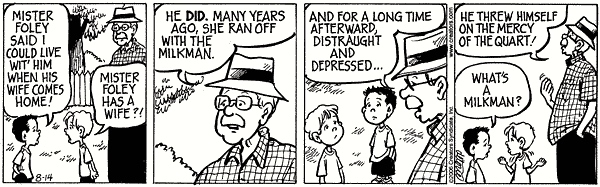
… and a bad grandpa pun, in the One Big Happy from 8/14:
 (#1)
(#1)
(The characters, left to right in the first and last panels: the neighbor boy James; the son of the OBH family, Ruthie’s older brother Joe; and Joe’s grandfather.)
Grandpa reproduces a bit of culture lore, about liaisons between housewives and milkmen. The boys are no doubt somewhat vague about what would be involved in a woman’s running off with the milkman. But, more pressingly, they don’t know what a milkman is: the N + N compound is scarcely transparent semantically, so unless you’ve actually had milkmen in your experience, tales of women and milkmen are just baffling.
(more…)
Posted in Gender and sexuality, Idioms, Language and the body, Language and the sexes, Linguistics in the comics, Sociocultural conventions, Understanding comics | Leave a Comment »
September 11, 2018
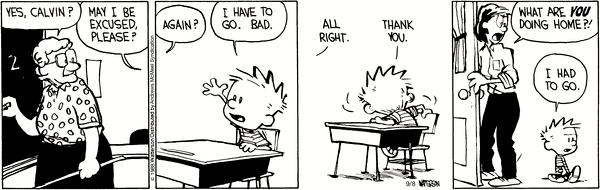
The catch phrase of writer and performer Merle Kessler’s alter ego Ian Shoales, just a bit short of the more vernacular I’m outta here. That’s motion go. Then there’s elimination go, and an ambiguity between the two, as exploited by Calvin in this (recently re-cycled) Calvin and Hobbes strip:
 (#1)
(#1)
(more…)
Posted in Ambiguity, Books, Euphemism, Language and the body, Linguistics in the comics, Movies and tv, Taboo language and slurs | 1 Comment »