Three candy bulletins from the last month: the news (which came to me from Scott Schwenter on Facebook, reporting exultantly from Pickerington OH) that Trix Fruity Shapes (from General Mills) are back on the shelves; today’s Wayno & Piraro Bizarro cartoon with cotton gin ‘gin(-flavored) cotton candy’; and the Sunday 10/28 NYT Magazine Candy Issue.
Archive for the ‘Linguistics in the comics’ Category
Sweet stuff
November 1, 2018Revisiting 20: X Places
November 1, 2018The Scenes From a Multiverse of 10/9, entitled #NOTALLPLACES:
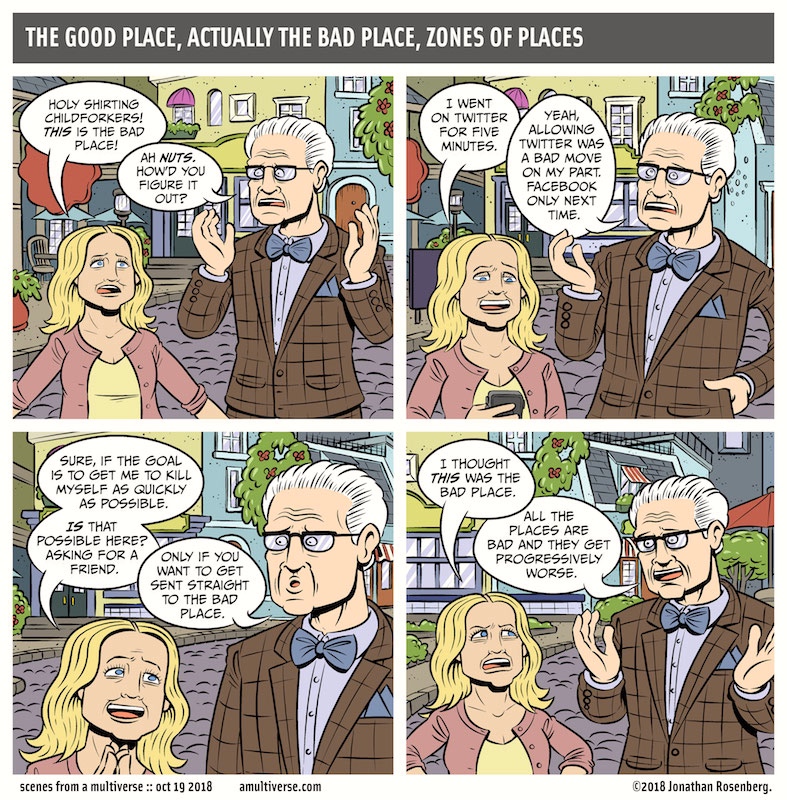
A riff on Michael Schur’s sitcom The Good Place, with Kristen Bell (as Eleanor, apparently sent wrongly to the place after her deathGood Plae modality is harsh.) and Ted Danson (as Michael, the designer of the place). Also a comment on social media (Twitter vs. Facebook). And of course on the nature of reality and our perceptions of it.
A reading
October 31, 2018Posted on Facebook, this Peter Steiner cartoon from 2016:
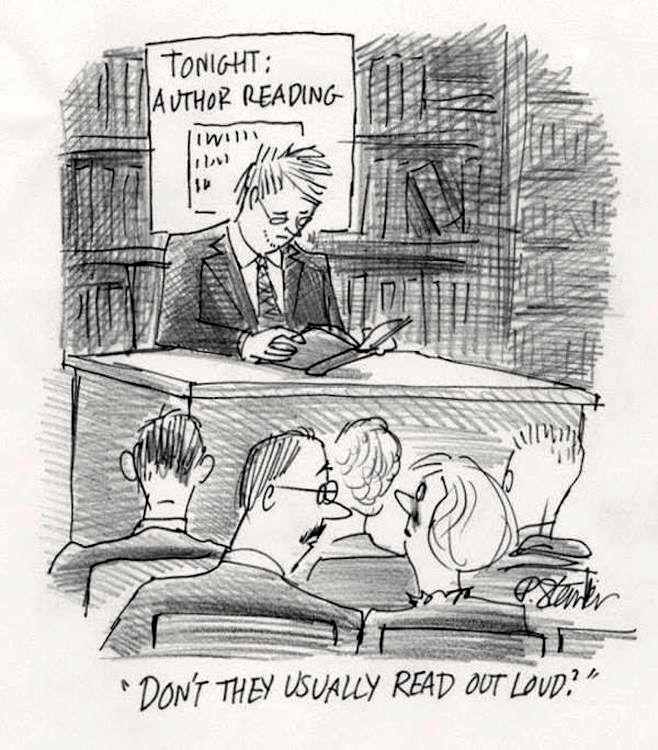
(#1) From a 1/28/16 posting on Steiner’s blog
The humor turns on an ambiguity of the verb read, and also on a specialization of the derived nominal reading to a very culture-specific event.
(Then some words on the artist, who now has a Page on this blog.)
Famous wolf on the Yellow Brick Road
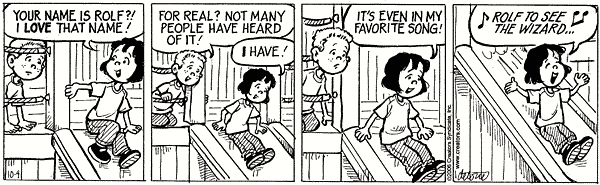
October 31, 2018In today’s comics feed, the One Big Happy from 10/4, in which Ruthie mondegreens:
 (#1)
(#1)
Yes: the song “We’re Off to See the Wizard”, from the 1939 movie of The Wizard of Oz, with we’re off (mis)heard as Rolf.
Another food holiday
October 28, 2018Today, Sandra Boynton tells us, is National Chocolate Day:

(#1) “October 28 is National Chocolate Day. Pace yourself.”
In the world of chocolate delights, there are many extreme pleasures. But extremism in the consumption of chocolate is no great vice, entirely pardonable. It can be bent to the service of other holidays, as it routinely is at Easter, Halloween, and Christmas.
Then there’s Death by Chocolate for the Day of the Dead…
The holidays of our lives
October 27, 2018(Near the end, there will be a hunky male model wearing nothing but a Halloween jockstrap. A warning in case you’d prefer to avoid a holiday men’s underwear discussion.)
Yesterday’s Zippy features a Dingburg-local idiomatic holiday:
 (#1)
(#1)
Of course, I immediately went to sources to discover what was celebrated on October 26th. Well, not only is October National Pumpkin Month, the 26th is the day specifically devoted to the fruit of Cucurbita pepo, this orange squash / gourd / melon / cucurbit: National Pumpkin Day. The day ushers in the Pumpkin Season, which is prefigured by a period in which pumpkin spice erupts as a ubiquitous descriptor of foods and much more (see my 10/20/17 posting “A processed food flavor”); which embraces a number of Halloween-specific cultural practices and symbols (jack-o-lanterns, dressing up in costumes, and trick-or-treating, plus witches and black cats as symbols — and orange and black as a decorative theme); and which is culinarily realized in pumpkin pie as a holiday food for Halloween, Thanksgiving, and Christmas.
So pumpkin pie can last you from mid-October to early January. Meanwhile, some riffs on the cartoon and some on edible pumpkiniana.
At duty on the moors
October 26, 2018 (#1)
(#1)
Ripped from our posts,
Dumped in this wasteland,
Together we rustCrankily, nastily
“Old fool’s gone all mottled”
“Her door don’t work”We hiss and huddle,
Waiting for a ring.Why don’t you
Ever call? Why?
Three exercises in cartoon understanding
October 24, 2018In this morning’s comics feed: a Zippy with the slogan “Kindness, Acceptance, Inclusion”; a Bizarro with a Discomfort Control mechanism; and a Rhymes With Orange about the facial recognition of a Mr. Banner. The first two can be understood at some level even if you don’t get the cultural references involved (though they’re much more entertaining if you do), but the third is probably just incomprehensible if you don’t recognize Mr. Banner.
Use skate in a sentence
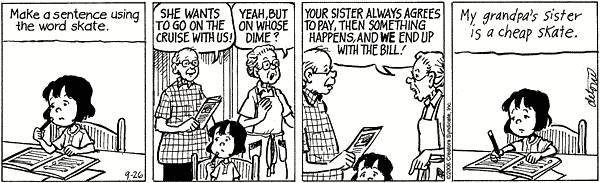
October 23, 2018The One Big Happy in today’s comics feed, from 9/26:
 (#1)
(#1)
Ruthie is faced with the task of demonstrating what a word means by using it in a sentence — a task often assigned to children as a test of their understanding of word meanings. But choosing effective example sentences is a challenging art for professional lexicographers, and children are not particularly good at it.
In this case, “the word skate” could be a verb (‘move on ice skates or roller skates in a gliding fashion’ (NOAD)) or any one of several nouns, but, on hearing about her tightwad great-aunt, Ruthie fixes instead on the otherwise opaque /sket/ portion of the compound cheapskate ‘tightwad, miser’ (which she analyzes as a composite nominal cheap skate).
The Tritoons gather by the river
October 21, 2018… diabolus in imaginē, at the tri-state corner (where NY, NJ, and PA are joined), in Milford PA, on Sunday 9/30, funny funny funny. Viewable on tape today. As announced today on Facebook by one of the Three Weird Brothers, Bob Eckstein, using this cartoon of his (from the 5/19/14 New Yorker) as a visual:
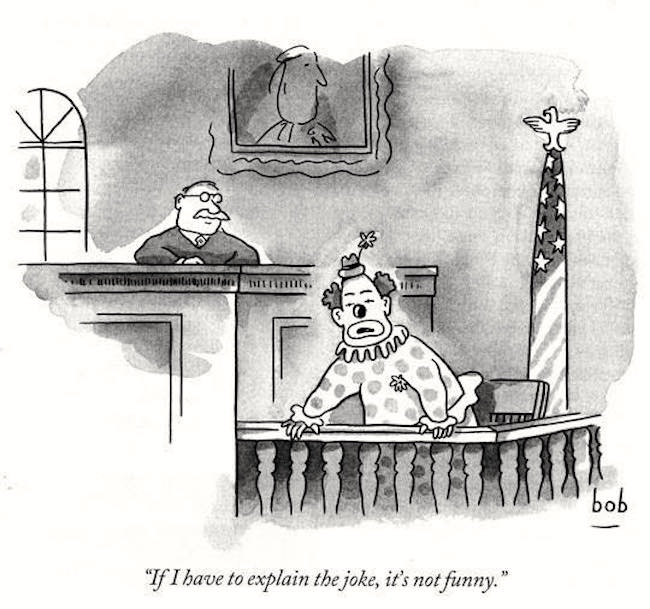 (#1)
(#1)
The Milford Readers and Writers Festival in Milford PA (#3 — the first one was in 2016). “New Yorker Cartoonists Talk About Funny!” with Bob Eckstein, Christopher Weyant, and David Borchart, moderated by Carol McManus (tape shown on CSPAN-2 today starting at 2:18 pm ET).