Archive for the ‘German’ Category

The poetic groundsow

February 2, 2025

Links from Wayles Browne (a regular visitor to this blog from far above Cayuga’s waters), attached to my Ancho Rabbit posting from yesterday, which I will now expand into a posting for Groundhog Day (2/2):

The BBC reports on Groundhog Day: it’s six more weeks of winter.

And of linguistic interest: a Pennsylvania Dutch poem about the groundhog and his, or rather her, day [the BBC report “How the Pennsylvania Dutch created Groundhog Day”; in PaDu, it’s die Grundsau ‘the groundsow’] (as read by Cornell’s old grad student Mark Louden).

(more…)

The Austria ostrich

November 15, 2024

Very briefly noted.

Passed on back on 11/9 by Michael Palmer on Facebook, this fine reworking of the map of Austria as an ostrich:


MP came across it on the Language Nerds Facebook site, but I don’t know who created the image in the first place

In English, Austria (a Latinization of the German name Österreich ‘eastern realm’) and ostrich (from a compound of the Latin avi- stem meaning ‘bird’ and the Greek struth– stem meaning ‘ostrich, big sparrow’) have only medial /str/ as clearly shared material, so are very distant puns, if they count as puns at all. Much the same is true of Spanish Austria and avestruz.  Things are even more distant in Italian (Austria and struzzo) and of course German (Österreich and Strauß).

But in French, as I pointed out on Facebook, by the accidents of phonological change, Latinized Austria > Autriche and the avi– + struth– compound > autruche, yielding a truly fine pun: Autriche is an autruche!

So Austria not only looks like an ostrich, in French it sounds like one too. This makes me happy.


Baritone Bennington attacks the Ode to Joy

November 13, 2024

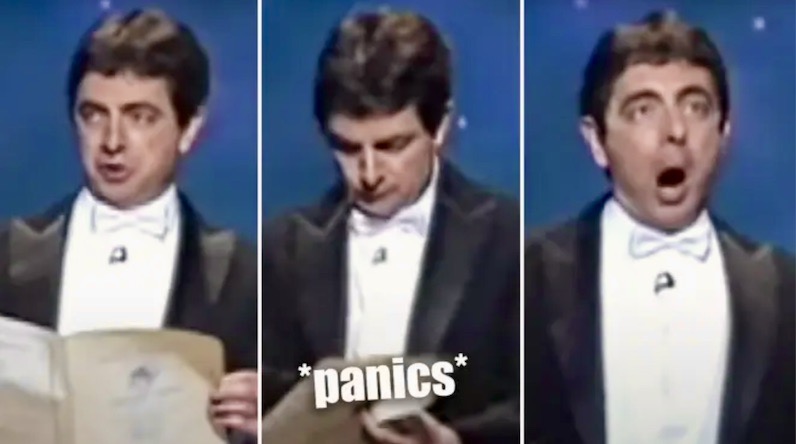
From Benita Bendon Campbell back on 11/1, a joyous diversion from painful times (“Something funny, we need something funny”): Rowan Atkinson playing “distinguished British baritone” Robert Bennington singing the Ode to Joy … until things go awry and he has to improvise a German text to Beethoven’s soaring tune. You can watch the YouTube video here.

And now, much more detail, from the Classic FM site (“the most relaxing music”), “The time Rowan Atkinson ‘forgot’ the words to Beethoven’s Ninth Symphony in hilarious skit” by Maddy Shaw Roberts on 5/11/21:


The Ode’s progress (picture: YouTube)

(more…)

Lament for Manfred

August 4, 2024

Ich weiß wohl, was soll es bedeutenDass ich so traurig bin

An anguish of old age is living immersed in death — of family, friends, loves, colleagues, mentors and models, students, people who have entertained, enriched, and illuminated you — while laboring just to get from day to day yourself. I have failed to memorialize many of the departed, I cannot cope any more, and I am ashamed of all of that. And now comes the death of Manfred Bierwisch, not exactly a surprise, since he was a full decade older than me, but then he was one of the few who should have been granted a life forever. And with a special role in my life.

Martin Haspelmath on Facebook this morning:

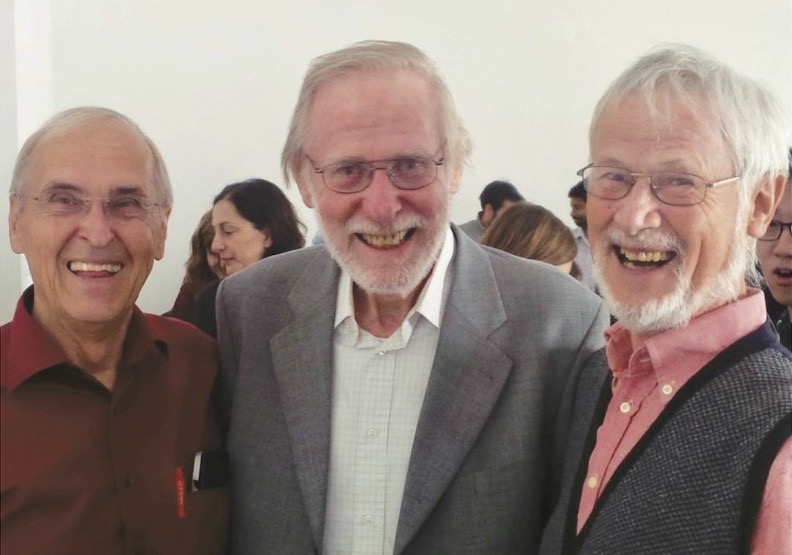
RIP Manfred Bierwisch (1930-2024, in the middle of the picture).


(MH:) The picture shows [MB] with his close friends Paul Kiparsky and Dieter Wunderlich (taken from Kiparsky’s 2023 memoir in the [Annual Review of Linguistics])

He was the GDR’s most prominent linguist, but he made no compromises with the regime. When some people were doing “Marxist linguistics” because it was good for their careers, he kept pursuing “structural linguistics”. Unlike some of his friends from the 1950s (e.g. Heinz Vater and Ewald Lang), he did not try to leave for the freer West Germany, but he stayed in the East. In 2005, he was awarded an honorary doctorate from Leipzig University, where he had studied in the 1950s (and where he was jailed for 10 months for possession of illegal writings).

(more…)

Perfecto Fancy-Boy

June 24, 2024

Perfecto Fancy-Boy, the Dingburg psychoanalyst, analyzes the appeal of Helmet Grabpussy in today’s Zippy the Pinhead strip:


(#1) Grabpussy’s real name is suppressed above, as too indecent to mention, even on this blog; but what grabbed me first in this strip was the name Perfecto Fancy-Boy for the psychoanalyst — a name that is most unlikely to have ever been given to any actual person, but is instead a pure creation of Zippy‘s cartoonist Bill Griffith

Zippy is a savorer of words and phrases. (He is also the playful lord of nonsensicality, call him Absurdo.) He has favorite names — Ashtabula, Estonia, Valvoline, Ding-Dongs, taco sauce, and more, treasured just for the way they sound, not for what they refer to; the Talking Heads album Stop Making Sense could have been named in his honor.

And he’s forever latching onto random expressions whose sound enchants him, so that he repeats them for pleasure, like mantras — what Griffy, the cartoon avatar of Bill Griffith, calls onomatomania. (There’s a Page on this blog about my postings on chants, cheers, mantras, and onomatomania.)

Then there’s Griffith’s choice of names for his characters — like Perfecto Fancy-Boy. No doubt intentionally crafted to some degree, but also to some degree pulled out of thin air, from Griffith’s subconscious, picked because they “sounded good”. I’m in no position to say which part is which, so here I’ll just unearth some possible ingredients in the name Perfecto Fancy-Boy, specifically in this name referring to a psychoanalyst.

(more…)

Ancestral investigations

March 26, 2024

In recent days, I’ve been exchanging e-mail with my (Université du Québec à Chicoutimi) linguistics colleague Luc Baronian about ethnic and linguistic history, with special reference to the Welsh (and the Welsh language, Cymraeg) in Pennsylvania and the Pennsylvania Dutch (and their language, Pennsilfaanisch Deitsch); and about tracing ancestral history. Three pieces of background here:

First, Luc is an Armenian-Canadian, the way I’m a Swiss-American. Luc is by recent paternal ancestry Armenian (as you can tell from his surname), by upbringing French Canadian; I am by recent paternal ancestry Swiss (as you can tell by my surname), by upbringing (and maternal ancestry) Pennsylvania Dutch (a descendant of primarily 18th-century immigrants to southeastern Pennsylvania, mostly from the Palatinate region of southern Germany).

Second, some years back, Luc — whose ancestry-search competence is vastly better than mine — helped me trace connections on my mother’s side and correct my misrecollections of several facts.

Third, Luc had gotten interested in the history of the Welsh language in Pennsylvania, which begins in colonial times, with late 17th-century negotiations over the Welsh Tract as a landmark event, and then apparently vanishes, leaving only place-names in its wake.

(more…)

More Hummels

March 25, 2024

On the heels of yesterday’s posting about the early 19th-century composer Johann Nepomuk Hummel, more people named Hummel (with the accented vowel rounded [U] (as in English put) in German or German-influenced English varieties, like Pennsylvania Dutch English; but unrounded [Ʌ] (as in English putt) in ordinary American English). The German landscape painter Carl Hummel. The fictional Kurt Hummel in the American tv series Glee. And the artist nun Maria Innocentia Hummel, whose paintings provided the original models for Hummel figurines, which is what this posting is mostly about.

(more…)

Dalla sua pace

December 6, 2023

Today (12/6: St. Nicholas Day, Finnish Independence Day, and Mozart’s death day) my morning name was the Italian phrase dalla sua pace ‘on his / her peace’. From a Mozart opera. The music playing on my Apple Music when I awoke was indeed from opera in Italian, Rossini’s Barber of Seville, so if the phrase had come from Mozart’s Marriage of Figaro — Figaro being the barber in question — the appearance of that phrase in my morning mind would have been easy to explain. Alas, Dalla sua pace (On her peace) is an aria from Mozart’s Don Giovanni, quite a different plot, entirely barber-free and Figaro-free.

It is, of course, possible that my unconscious mind is not as up on the details of opera in Italian as my conscious mind, so it made this distant operatic association. Or maybe I was just reviving an interest in the preposizioni articolate ‘articulated (i.e., articled / arthrous) prepositions’ of Italian, of which dalla — combining the versatile preposition da (expressing source ‘from’, location ‘at, on’, and goal ‘to’) with the fem.sg. definite article la — is a prime example; here it is in a display of the articled prepositions (versions of this chart are found on many sites):


Prepositions down on the left, definite articles across at the top

(Articled prepositions are found in many European languages, as in French du = de ‘of’ + le (masc.sg.) and German zur = zu ‘to, towards’ + der (dat.fem.sg.), with very different details in each language.)

But the aria from Don Giovanni, what of that?

(more…)

Der Vogelfänger bin ich ja

November 20, 2023

Or, in rhyming colloquial English:

I’m Papageno, that’s my name,
And catching birds, well, that’s my game!


Nathan Gunn as Papageno, clutching his magic bells

And he more or less literally animates the Mozart / Schikaneder (think: Sullivan / Gilbert, Rodgers / Hammerstein, McCartney / Lennon) opera Die Zauberflöte (The Magic Flute) — since he’s on the scene and in the action during most of the opera’s duration; and since he brings common, earthy, fallible, playful, humane depth to the work. The other characters are mostly otherworldly beings of one sort or another, or the presumed central human characters Tamino and Pamina (“a prince on a quest” and “a princess in distress”, according to the screen characterizations in the 2006 abridged video version of the fabulous 2004 Julie Taymor production at the Metropolitan Opera Company), who are earnest but rather cardboard idealizations of humanity (though they are humanized as much as possible in the Taymor production’s performances).

Zauberflöte is a fairy-tale opera with a familiar schematic story line, in which someone achieves a much-sought goal (love; entrance into the adult world; admission to some desirable association, band, or circle; whatever) by enduring probative tests, trials, or ordeals. T&P do that, but kids nevertheless seem to think — as I do — that the opera is about Papageno, who brought T&P together in the first place and then gets dragged along with them, serving as an unwilling hero in their ordeals but in the end failing to undergo the trials of fire and water (instead he gets his mate, Papagena). I doubt that any child seeing the video identifies with either T or P; but Papageno is a great kid, one of them: silly, error-prone, adorable, sometimes scared shitless, a sturdy friend, and a hell of a lot of fun.

It also has two prominent subtexts, which work together to support the theme of brotherhood that runs through the opera: Freemasonry and the Enlightenment ideal of the brotherhood of all humanity.   Many people will experience a performance of the opera without appreciating either element of its late-18th-century European intellectual and political context, and children will surely not get any of this (they will instead have their own understanding of what’s going on, and that’s fine; after all, there can be 17 ways of looking at a blackbird), but it’s especially relevant to the Taymor production because that production is richly overloaded with symbolism for both subtexts — which children will experience as the ways and forms of a strange but delightful imaginary world (imaginary worlds being a central element of childhood experience).

I write this after having watched the video again, twice, and of course seeing lots of things I hadn’t seen before, thereby complicating my intentions of reporting a lamentable memory lapse on my part. But I’ll press on.

(more…)

On the plot of Die Zauberflöte

November 19, 2023

(Side material for a posting in preparation about Julie Taymor’s Metropolitan Opera production of Mozart’s Die Zauberflöte)

Opera plots are notoriously packed with preposterous and incomprehensible details, but at least at first glance, The Magic Flute would win some sort of grand prize in the problematic plot department. But some of it makes sense when you understand it as a fairy-tale (so accommodating many of the fantastical elements) in which someone (the prince Tamino, with whom the opera opens) undertakes a quest and undergoes an ordeal to achieve some prize (admission into the wizard Sarastro’s (S’s) Brotherhood of the Sun); it’s also a love story, with Tamino (T) falling in love with the princess Pamina (P) — daughter of the otherworldly Queen of the Night (Q) — through seeing a portrait of her brought to him by his quest-companion (acquired in the early scenes of the opera), the bird-catcher Papageno (Pg); T&P become a couple, undergo the trials together, and so join S’s band.

Summing up this much, there are five central characters:

three ordinary mortals (in the order of their appearance): T, Pg, P (T&P become a couple; Pg picks up a mate along the way, instead of undergoing the trials)

two otherworldly mortals, S and Q

More of the details become comprehensible if you know that the opera is full of allusions to and symbols of Freemasonry; Mozart and his librettist Schikaneder were both active Masons, and they seem to have viewed Die Zauberflöte as their “Masonic opera”. The Taymor production is way overloaded with Masonic symbolism. But unless you’re a Mason or read analyses of the opera, you’ll miss all this.

But we’re still left with two sources of audience bewilderment: the nature of S and of Q, which appears to shift dramatically between the two acts of the opera; and a sixth character, Monostatos (M), a third otherworldly mortal character, who keeps cropping up in a creepy subplot that stretches through a considerable span within the opera. A Moor in the original, in the Taymor production M is white but bizarre, hawk-beaked and grotesquely fleshy (with a troupe of Turkish followers). But the question is what M’s intrusions are doing in the opera at all; they might just be Mozartean effusions of dark and dangerous Turkishness, with M replaying the character Osmin from Mozart’s earlier German Singspiel opera Die Entführung aus dem Serail (The Abduction from the Seraglio). A bit more below.

(more…)