In recent days, I’ve been exchanging e-mail with my (Université du Québec à Chicoutimi) linguistics colleague Luc Baronian about ethnic and linguistic history, with special reference to the Welsh (and the Welsh language, Cymraeg) in Pennsylvania and the Pennsylvania Dutch (and their language, Pennsilfaanisch Deitsch); and about tracing ancestral history. Three pieces of background here:
First, Luc is an Armenian-Canadian, the way I’m a Swiss-American. Luc is by recent paternal ancestry Armenian (as you can tell from his surname), by upbringing French Canadian; I am by recent paternal ancestry Swiss (as you can tell by my surname), by upbringing (and maternal ancestry) Pennsylvania Dutch (a descendant of primarily 18th-century immigrants to southeastern Pennsylvania, mostly from the Palatinate region of southern Germany).
Second, some years back, Luc — whose ancestry-search competence is vastly better than mine — helped me trace connections on my mother’s side and correct my misrecollections of several facts.
Third, Luc had gotten interested in the history of the Welsh language in Pennsylvania, which begins in colonial times, with late 17th-century negotiations over the Welsh Tract as a landmark event, and then apparently vanishes, leaving only place-names in its wake.
Previously on this blog. My 4/6/18 posting “Family matters”, which was about (among other things),
my maternal grandmother Susanna Hershey Rice, daughter of Reuben Long and Martha Hershey, and widow of Irwin Rice [Rice turned out to be, as I had supposed, a re-spelling of the German name Reiss];
my “uncle” Paul Fries, the brother of my uncle (by marriage) Herb Fries, my mother’s twin sister Marion’s first husband;
and the fragility of memory (since I had misremembered a number of the facts here)
All of these people were Pennsylvania Dutch; my grandmother spoke Pennsilfaanisch Deitsch as her first language, and picked up English as a second language in grade school. Her English was of the PDE (Pennsylvania Dutch English) variety, only a bit more Deitsch-infuenced than my parents’ (my childhood PDE was considerably less pronounced than my parents’, and then I shifted almost entirely to a variety of English spread from Philadelphia).
Nomenclatural note. Descendants of the Palatinate Germans in Pennsylvania — people like me — refer, in English, to themselves and their offshoot of Palatinate German as Pennsylvania Dutch, as I have done above. Because Dutch here means ‘German’ (and not ‘Netherlandish’), academic custom has been to use the label Pennsylvania German for the ethnicity and the language.
The Welsh tract. From Wikipedia:
The Welsh Tract, also called the Welsh Barony, was a portion of the Province of Pennsylvania, a British colony in North America (today a U.S. state), settled largely by Welsh-speaking Quakers in the late 17th century. The region is located to the west of Philadelphia. The original settlers, led by John Roberts, negotiated with William Penn in 1684 to constitute the Tract as a separate county whose local government would use the Welsh language. The Barony was never formally created, but the many Welsh settlers gave their communities Welsh names that survive today. A more successful attempt at setting up a Gwladfa (Welsh-speaking colony) occurred two centuries later, in the Chubut Province of Patagonia, Argentina.
History: In the late 17th century, there was significant Welsh immigration to Pennsylvania for religious and cultural reasons. In about 1681, a group of Welsh Quakers met with William Penn to secure a land grant to conduct their affairs in their language. The parties agreed on a tract covering 40,000 acres, to be constituted as a separate county whose people and government could conduct their affairs in Welsh.
… The Welsh Tract’s boundaries were established in 1687, but notwithstanding the prior agreement, by the 1690s the land had already been partitioned among different counties, despite appeals from the Welsh settlers, and the Tract never gained self-government.
… The area is now part of Montgomery, Chester, and Delaware counties. Many towns in the area still bear Welsh names. Some, such as North Wales, Lower Gwynedd, Upper Gwynedd, Lower Merion, Upper Merion, Narberth, Bala Cynwyd, Radnor, Malvern, Berwyn, and Haverford Township, are named after places in Wales.
What happened to Pennsylvania Welsh? An exchange between Luc and me (edited for this posting):
— LB: We had a conversation once about how linguists should discuss the second extinction of languages in North America after the Native languages. How German and French and other European languages were eliminated as community languages in several places.
I came across references regarding the Welsh Tract in Pennsylvania and how the Welsh Quakers were fairly numerous West of Philadelphia… do you happen to know how long their language was spoken? Can’t seem to find anything about it.
— AZ: There’s still place-name evidence of the Welsh presence. The townships in Berks county (county seat Reading) southeast (towards Philadelphia) of the one I grew up in (Spring, named for the physical feature) had Welsh names: Cumru, Brecknock, and Caernarvon (Cumru township, minutes away by car from Spring, had the borough of Shillington, where John Updike grew up; I grew up in the boroughs of West Lawn and Wyomissing Hills).
But there were no linguistic enclaves when I grew up (in the 1940s and 50s), nor any Welsh-influenced variety of English, nor any families who traced their ancestry back to the Wesh settlers; the place was awash with Pa. Dutchness, with plenty of linguistic enclaves, almost everyone with Pa. Dutch names, and a local linguistic variety, PDE, with a heavy substratum influence from the local variety of German.
So descendants of the Welsh either moved on west or were completely swamped by the English and the Germans.
LB: I’m surprised you’re unaware of Welsh family names growing up. Well maybe not in your area
AZ: Jones is far and away the most common Welsh surname in Wales, but I don’t think there was a single Jones in any of the schools I attended growing up, only a mile or so from Cumru Township. When I was a kid, I was baffled by the idea that Jones was a common name: Smith and Jones, as people said. Smith, yes; Schmidt, Jesus yes. Millers by the dozens (Miller being both English and Pa. Dutch). But Jones, no.
What happened to Pennsylvania Welsh? The question remains unresolved. If all the speakers got up as a group and moved away, they should have a recoverable history in their new location. So there should be records of the decline and death of Pennsylvania Welsh, somewhere; these developments take some time. Even if all the speakers of Pa. Welsh dispersed to a variety of different places, they would have done so in small groups, and those would have some linguistic history. Which is buried somewhere, probably in the 18th century.
One obvious place to look is the records of county historical societies in Montgomery, Chester, and Delaware counties, possibly the adjacent Berks and Bucks counties as well. Another, given the association of Pa. Welsh with the Quakers, would be in historical accounts of the Society of Friends.
Tracing my Pa. Dutch ancestry. Luc and I also returned to this topic:
— AZ: My Pa. Dutch grandmother and her family seem to have kept no records at all, but kept family genealogy in their heads, as common folk generally do. And that information evaporates.
— LB: Well the records now are very much available, I’m finding. Getting to 1776 isn’t that difficult.
What records? The source Luc is referring to turns out to be FamilySearch, originally The Genealogical Society of Utah (helping members of the LDS Church trace their ancestors), now a service that scans and codes gigantic numbers of publicly available records and makes the results freely available.
The crucial word here is codes; anyone who’s tried to extract reliable codable information from US census records, birth and death notices, and other available publicly records knows what a pain the process is: stuff is left out, the recorders are confused or make mistakes, the sources are confused or lie, the records are illegible, and so on. The work requires great care and judgment, side-checking of the material, puzzle-solving ability, and so on; it takes a lot of time. The LDS Church has its own reasons for caring about all this, but the point is that they care a lot, so they put a large staff to work enormous amounts of time to boil their raw material down to comprehensible data they can put some confidence in.
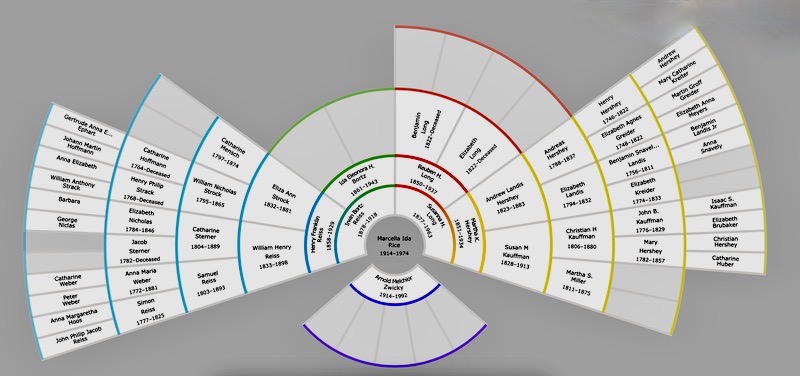
They have also devised effective ways of displaying their findings. In particular, the fan chart, like the one that they created (at Luc’s request) for tracing my mother’s ancestry back to the late 18th century:
generation -1 for my mother, Marcella Ida Rice (everyone — except her mother and me — called her Marty), her father Irwin Bortz Reiss (about whom I know almost nothing, since he died in the great flu pandemic, in 1918) and her mother Susanna Hershey Rice (my Grandmother Sue); then generation -2, parents for each of these; then all the way back to generation -5 in roughly Revolutionary times, plus some names for generation -6 (you’ll need to enlarge this image to make the details legible; my printout for reference is nearly 10 inches across)
Luc wrote:
It’s not complete and I didn’t take time to verify the sources, but on FamilySearch you apparently have relatives who have done a lot of work on your mom’s tree.
But it’s quite a lot more than I had before.
March 26, 2024 at 2:37 pm |
“Welsch” (“French”) was the name Germans gave to Waldensians, French-speaking Protestants from the Cottian Alps who fled to Germany in the late 17th/early 18th century. Since many Waldensians emigrated to Pennsylvania later in the 18th century–often disguised behind Germanized surnames–it is quite possible to be Pennsylvania Welsch without one’s ancestors ever having set foot in Wales.
March 26, 2024 at 3:50 pm |
😀 😀 😀