Archive for the ‘German’ Category
September 26, 2022
(Phallic preoccupations abound in this posting, sometimes in street language — I mean, look at the title above — so some readers may want to skip over it)
Passed on by a friend on Facebook yesterday, this German grocery-store snapshot plus a joking double-entendre intro in English (together making what appears to be a a fast-spreading meme):

(#1) Hähnchenschnitten Wiener Art ‘Viennese-style chicken cutlets’ from the (German) Vossko company, the name of the product including the German phrase Wiener Art ‘Viennese-style’ — that is, prepared like Wiener Schnitzel / Wienerschnitzel); meanwhile, the English-language intro alludes to wiener art, in the sense ‘penis art’, referring to artworks in which penises are significant elements (or, in an hugely extended sense, to any artworks in which human penises are visible) — the label wiener art involving the (mildly racy) AmE sexual slang term wiener ‘penis’
German Wiener Art ‘Viennese-style’ (a) leads to English Wiener art ‘Viennese art’ (b) and then to four AmE slang uses of wiener art: (c) ‘sausage / frankfurter art’; (d) ‘dachshund art’; (e) ‘penis art’; (f) ‘weenie art’. All will be illustrated below.
(more…)
Posted in Ambiguity, Art, Double entendres, German, Language and food, Language and the body, Metaphor, Metonymy, Parodies, Parody, Phallicity, Puns, Slang, Taboo language and slurs | Leave a Comment »
March 11, 2020
The news from gay Switzerland, in headline form: ‘Swinger [Swiss swing wrestler] outs himself as gay’. From the Outsports site: “Swiss wrestler Curdin Orlik comes out as gay, first out active male athlete in nation: The Swiss wrestler competes in an [un]usual version of the sport, but his coming out as gay is universal”, by Jim Buzinski on 3/10/20:

(#1) Orlik in ceremonial regalia, wearing a victor’s wreath and a jacket with edelweiss embroidered on the lapels
(more…)
Posted in Gender and sexuality, German, Homosexuality, Language and sports, Names, Switzerland and Swiss things | 3 Comments »
January 30, 2020
(Plenty of talk about male genitals. Not particularly salacious, but some might prefer to avoid this material.)
The term is osteopenia, which I briefly had hopes would combine the stems osteo– ‘bone’ and peni– ‘penis’ and so mean something like ‘hard penis, erection, boner’ (As I’ve noted elsewhere on this blog, I’m fond of penises. For some guys, it’s sports cars; for me, it’s penises.) . But alas, no. From NOAD:
noun osteopenia: reduced bone mass of lesser severity than osteoporosis. ORIGIN 1960s: from osteo– and Greek penia ‘poverty’.
(more…)
Posted in German, Language and medicine, Language and the body | Leave a Comment »
October 9, 2019
In the Swiss German-language daily Blick, a 10/6 story by Marc Iseli, “Neues Gastro-Konzept kommt nach Zürich: Migros bringt den Metzger zum Anfassen” (‘A new gastronomic concept comes to Zürich: Migros makes the butcher accessible’), about a new program — some combination of Retail, Gastronomie und Event — that is somehow supposed to bring the consumer closer to the producers of food (the butcher, the baker, the fisherman, the farmer), at least in the giant supermarket by the main railway station in Zürich:

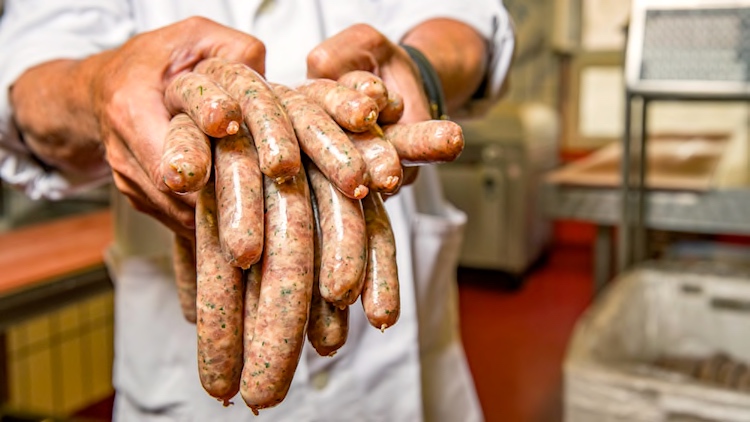
(#1) From the butcher’s hands to yours, in the new “Meet Food” (yes, with a name borrowed from English) program (note: I didn’t choose this photo; Blick did; I will, however, inventory it in my files under “Phallicity: The Wurst”, where it deserves some sort of vividness trophy)
The story is about this still not fully defined program, but its primary interest for me is that it comes from der Migros-Sprecher (‘the Migros spokesperson’) Gabriel Zwicky, who gets his name in the news quite a lot, Migros being a very big thing in Switzerland. Zwickys, we are everywhere.
(more…)
Posted in German, Language and food, Lexical semantics, Names, Phallicity, Switzerland and Swiss things, Zwickys | Leave a Comment »
July 24, 2019
In a recent comics feed, the 6/27 One Big Happy, with an exchange between Grandma Rose and the grotesquely smiling Avis
(#1)
In panel 1, the baggage of emotional baggage is a conventional metaphor, one no longer requiring the hearer to work out the effect of the figure and so now listed in dictionaries. But then Rose immediately brings it back from dormancy to life in a long riff of creative metaphor (in panels 2-4), composed on the spot and calling up a complex and vivid scene for the hearer.
We use the same term, metaphor, for both phenomena, and the mechanism is the same in both — but one is a historical phenomenon (whose figural character is usually out of the consciousness of speaker and hearer), while the other is a phenomenon of discourse production and comprehension in real time.
(more…)
Posted in Ambiguity, Figurative language, German, Language and the body, Linguistics in the comics, Metaphor, Puns, Spanish | 3 Comments »
May 3, 2019
… and the monster that guides the elderly. Both pieces of outdoor art in Switzerland, the first in the town of Glarus (in my ancestral canton of Glarus), the second in the city of Zürich.

(#1) The Caring Hand in Glarus
(more…)
Posted in Art, German, Language and politics, Language play, Nonsense, Poetry, Portmanteaus, Switzerland and Swiss things, Translation | 7 Comments »
June 27, 2018
While searching on Züricher (and its variant Zürcher), as part of a look at men named Peter Zwicky in the Zürich area, I came across Züricher Geschnetzeltes, a characteristic Swiss dish that I did not experience as a child, but in fact first encountered at a little restaurant on Limmatstraße in Zürich — in September 1972, almost 46 years ago. A very simple veal dish, served on freshly made noodles, but absolutely perfect: melt-in-the-mouth strips of veal in a sauce that was both brown and creamy, elegant yet intense. Julienned carrots sauteed in butter. A crispy white wine. A plain green salad.
Something along these lines, but with noodles:
(#1)
(A style of food that is, unfortunately, not particularly photogenic.)
(more…)
Posted in French, German, Language and food, My life | Leave a Comment »
June 27, 2018
The town of Wallisellen in Canton Zürich, Switzerland, has just come up again on this blog (in the posting “Three Züricher Peter Zwickys”), as the site of the Zwicky silk-thread company and now the Zwicky construction and real estate company. Two notable things about the place (from its Wikipedia page): the etymology of its name, which looks like a compound (and is), but without easily identifiable parts; and a Swiss German nonsense rhyme that incorporates the town’s name.
(more…)
Posted in German, Language play, Music, Names, Nonsense, Placenames, Poetic form, Poetry, Zwickys | Leave a Comment »
February 23, 2018
Two explorations in the vocabulary of The Sacred Harp, 1991 Denson revision, provoked by songs called at shapenote singings in Palo Alto: most recently, the occurrence of dragon(s), serpent(s), and hurricane(s) in Florence #121 (all of them unique in the book, according to Chris Thorman’s 1992 Concordance to the songbook); and a while back, the striking use of vice in Mission #204’s “luring scenes of vice” (one of two occurrences in the book, the other being in Columbus #67). Elsewhere, there’s Cambridge #287, a hymn of resistance to temptation; and O Come Away #334, a rousing temperance hymn (with a history in German student drinking songs).
(more…)
Posted in Gender and sexuality, German, Language and food, Language and religion, Music | 2 Comments »