Archive for the ‘Playful morphology’ Category
May 25, 2013
In the NYT on the 21st, this entertaining story by Sarah Lyall: “Common Gnomes Pop Up at Rarefied Flower Show, to Horror of Many”, where it is reported that:
it was not surprising that the staid Royal Horticultural Society‘s decision to allow garden gnomes — creatures commonly associated with the landscapes of the unrich, the unfamous and the untasteful — at the Chelsea Flower Show this year elicited a variety of responses.
… Gnomes, which are called “brightly colored mythical creatures” in the handbook governing the show, are not really part of the Chelsea aesthetic. (Nor are balloons, flags, “feather flags,” or “any item which, in the opinion of the society, detracts from the presentation of the plants or products on display,” the handbook reads.)
Four topics come up in the article: social class in the UK; the two words gnome (and gnomic etc).; conversion of proper names to count nouns; and playful gnome-related morphology.
(more…)
Posted in Combining forms, Conversion, Derivation, Etymology, Playful morphology, Semantics, Social life | 1 Comment »
May 6, 2013
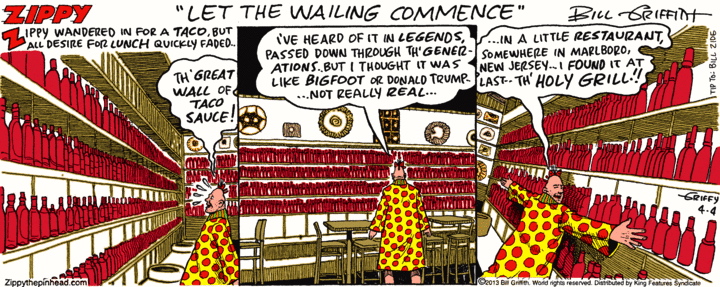
On Wednesday the Stanford QUEST group (queer staff and faculty) had our monthly happy hour, this time at Tacolicious in Palo Alto, a Mexican restaurant that not long ago replaced the Indian fusion restaurant Mantra (which succeeded the Japanese fusion restaurant Higashi West, which succeeded Old Uncle Gaylord’s Kosher Ice Cream Parlour, which I remember fondly from 30 years ago). (Restaurant turnover in Palo Alto is scandalous.)
Tacolicious is not just a taco place, but something trendier and more inventive. And crowded. And very noisy (probably by design, since the conversion from Mantra involved tearing out the entire interior of the restaurant and installing lots of reflective surfaces; noisy makes a restaurant “hot”).
This posting is going to be about the restaurant’s name. But first more on the place itself.
(more…)
Posted in Language and food, Language play, Libfixes, Playful morphology, Portmanteaus | 1 Comment »
April 30, 2013
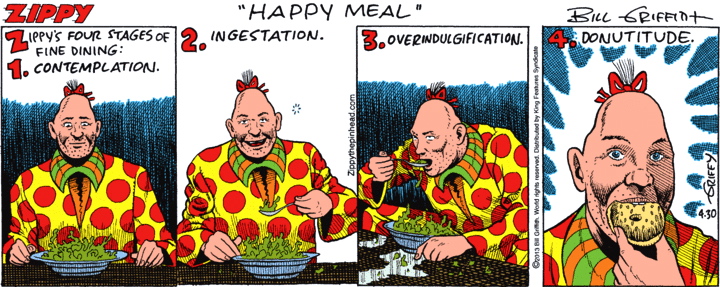
Today’s Zippy, with morphological play from Dingburgers:

One attested derived nominalization, contemplation from the verb contemplate; one over-extended derived nominalization, ingestation (rather that ingestion) from the verb ingest; one extremely over-extended derived nominalization, overindulgification (rather than overindulgence) from the verb overindulge; and one derived nominalization, donutitude. based on a noun (donut) rather than an adjective (as in similitude, based on similar) — each one more outrageous than the one before.
Posted in Language play, Linguistics in the comics, Playful morphology | Leave a Comment »
June 1, 2012
A new comment on “Dubious portmanteaus” (from last July):
I know this is an older article but I was just thinking today how much I hate portmanteaus. I hate ‘fandom’ and ‘cosplay’. I also hate the word ‘kidlet’, although I’m not entirely certain that it is a genuine portmanteau. I asked some friends who are parents and they seemed to think it is a combination of kid and piglet.
Two things here: the rage at a whole class of words (in this case, at portmanteaus in general), and the three specific examples that set off the commenter’s rage: fandom, cosplay, and kidlet.
(more…)
Posted in Derivation, Innovations, Language play, Morphology, Playful morphology, Portmanteaus, Usage attitudes | Leave a Comment »
May 11, 2012
ADS-L discussion has recently taken up two recent formations in -ista: normalista on the tv show Veep and structuralista in Paul Krugman’s NYT column today. Both have the derogatory tone of English innovations with this suffix.
(more…)
Posted in Derivation, Morphology, Playful morphology | Leave a Comment »
July 22, 2011
A Zippy with the surprising verb inexplicate (in the past tense):

We start with the adjectives perplexing and inexplicable. Perplexing is based on the verb perplex. What, then, is the verb that inexplicable is based on? Obviously, inexplicate, the meaning of which is hard to, um, explicate.
(The semantics of perplexing and inexplicable are, of course, quite different, and the in- of inexplicable is a negative prefix associated with the adjective explicable rather than with the verb explicate. But Bill Griffith understood that.)
Posted in Derivation, Linguistics in the comics, Morphology, Playful morphology | Leave a Comment »
 (#1)
(#1)