Archive for the ‘Language and the law’ Category

The Word of God

July 2, 2013

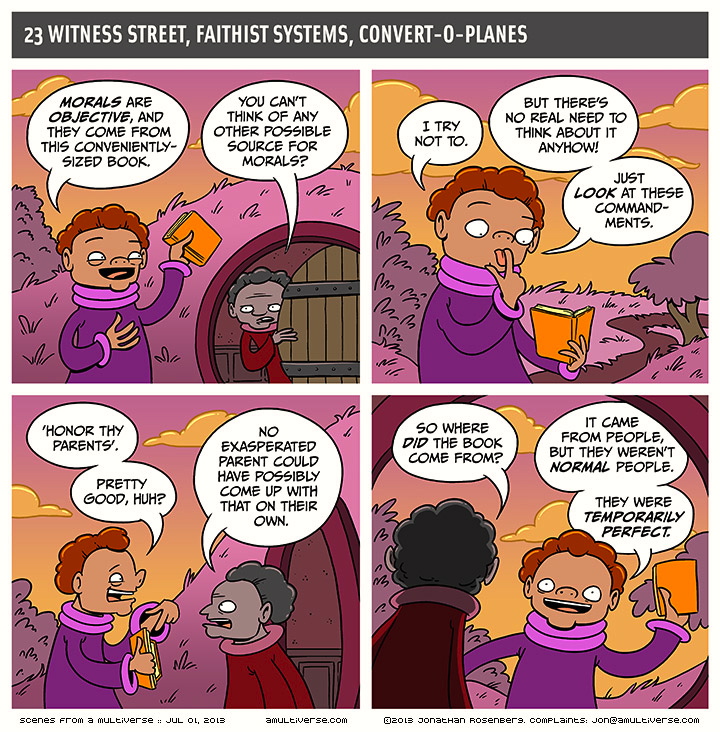
The most recent Scenes From a Multiverse:

This is an astonishingly common idea: that morality comes from the pronouncements of religion (which are assumed to be divinely inspired, so that ultimately, morality comes from God), and only from those, so that non-believers cannot, by definition, have morals. But reasonable people will challenge the assumption.

(more…)

For June 26th

June 27, 2013

From several sources on Facebook, this impressive photo of San Francisco’s City Hall in rainbow mode, in honor of yesterday’s U.S. Supreme Court rulings on DOMA and California Prop 8:

And tomorrow is Stonewall Day, followed immediately by Pride Weekend in San Francisco.

exoneree

June 19, 2013

From the NYT‘s Opinion pages on Sunday the 16th, “A Song for the Exonerated” by Francis X. Clines:

Having lost 16 years in prison on a wrongful conviction for rape and murder, Jeffrey Deskovic opted for the simple exuberance of karaoke to celebrate the master’s degree he earned late last month from John Jay College of Criminal Justice. “I enjoyed singing ‘Live to Tell,’ ” he says of his graduation visit to a loud and friendly bar.

“Too many things, not enough time,” says Mr. Deskovic, an unusual 39-year-old member in the growing category of “exonerees” — a word he loves — who have lived to tell their tales of bungled evidence, forced confessions and the deus ex machina of DNA. He eventually won millions in damages after Westchester police and prosecutors were officially excoriated for a “tunnel vision” investigation that mismanaged exculpatory evidence.

The word is exoneree — not in the OED, NOAD3 or AHD5, but very much in the news in the U.S. thanks to the Innocence Project and similar efforts at exoneration via DNA.

(more…)

Crowdsourced lexicography

June 8, 2013

In the NYT on May 21st, a front-page story by Leslie Kaufman, “For the Word on the Street, Courts Call Up an Online Witness”, beginning:

The wheels of justice move slowly sometimes, but not, apparently, as slowly as Webster’s New World Dictionary.

Slang has always been a challenge for the courts in cases that involve vulgar or insulting language. Conventional dictionaries lag the spoken word by design. That has lawyers and judges turning to a more fluid source of definitions: Urban Dictionary, a crowdsourced collection of slang words on the Internet.

The online site, created by a college freshman in 1999, has found itself in the thick of cases involving everything from sexual harassment to armed robbery to requests for personalized license plates, as courts look to discern meaning and intent in the modern lexicon.

(more…)

Annals of insult crimes

May 18, 2013

In my last foray into insult crimes, the legally actional insults were directed againt religion (the Russian Orthodox Church, Islam). Of course, in many countries, speech that’s perceived as denigrating a ruler is actionable. Which brings me to this NYT news flash on the 16th:

A Bahraini court jailed six people for a year on Wednesday for insulting King Hamad bin Isa al-Khalifa in messages on Twitter, the official news agency said.

The six were accused of posting remarks “undermining the values and traditions of Bahrain’s society towards the king on Twitter,” the head of the public prosecutor’s office, Nayef Youssef, said in a statement reported by the Bahrain News Agency. He said freedom of opinion and expression were guaranteed by the Constitution, law and international conventions, but should not be used in a way that contradicted the norms of society. The news agency gave no further information about the six.

Of course, the agency gave no information about what they said on Twitter, because that would be to disseminate the insult.

What struck me especially was the claim that Bahrain guaranteed freedom of opinion and expression — but only insofar as people conform to the norms of society. There is a genuine tug here between two different core values (a great many jurisdictions regulate obscenity in certain contexts, for example), but an appeal to “the norms of society” can easily be stretched to ban any unpopular or embarrassing expression of ideas. So just citing norms in a general way won’t do.
 

Synthetic compounds and back-formed verbs: rape

April 15, 2013

From discussions of rape in recent news, the synthetic compounds slut-shaming and victim-blaming — and, no surprise, the back-formed verbs slut-shame and victim-blame.

(more…)

Copyright

March 17, 2013

A Dinosaur Comics from 7/14/04 (link from Tim Wilson on Facebook):

What’s at issue here is the distinction between a work of art and its digital coding. I don’t know the law here, but I suspect that T-Rex isn’t standing on firm legal ground.


Words matter

March 8, 2013

This morning on KQED, a “Perspectives” piece by Bob Engel, a marriage and family therapy intern in Sebastopol CA, arguing that in matters of same-sex committed relationships, words matter; partner is separate from, and not equal to, husband/wife.

(more…)

Annals of obscene gestures

February 5, 2013

From today’s Miami Herald, a story on the wages of disrespect:

A woman facing a drug possession charge was sentenced to 30 days in jail for flipping the bird to a Miami-Dade judge.

Penelope Soto, 18, appeared in court on video after her arrest for possession of Xanax. In front of Circuit Judge Jorge Rodriguez-Chomat on Monday, she was asked about her assets.

Soto appeared as if the hearing was a big joke and laughed off the judge’s questions, blurted out “Adios” and then gave him the finger.

The judge, feeling disrespected, demanded she return to the podium and then sentenced her to 30 days in jail for contempt of court.

Judges do have that power.

Another chapter in the annals of phallicity, now on the gestural front.

(more…)

Bible banner news

October 21, 2012

The latest news in the Kountze TX Bible banner story, in the NYT on the 18th: “Cheerleaders Gain Ally in Free Speech Fight” by Manny Fernandez. The ally is Gov. Rick Perry of Texas.

(more…)