Archive for the ‘Language and the law’ Category

Pulpit Freedom Sunday and Bible banners

October 7, 2012

Today some U.S. churches engaged in a type of civil disobedience; see “Pulpit Freedom Sunday: Pastors Challenge IRS Ban On Political Endorsements” (HuffPo piece by Lily Fowler on the 5th):

As part of “Pulpit Freedom Sunday,” on Oct. 7, religious leaders across the country will endorse political candidates — an act that flies in the face of Internal Revenue Service rules about what tax-exempt organizations, such as churches, can and cannot do.

Also on the 5th, the NYT reported on a school story, in “Cheerleaders With Bible Verses Set Off a Debate” by Manny Fernandez, which begins:

Kountze, Tex. — The hand-painted red banner created by high school cheerleaders here for Friday night’s football game against Woodville was finished days ago. It contains a passage from the Bible — Hebrews 12:1 — that reads: “And let us run with endurance the race God has set before us.”

That banner, and other religious-themed signs made by the high school and middle school cheerleading squads in recent weeks, have embroiled this East Texas town in a heated debate over God, football and cheerleaders’ rights.

The two episodes illustrate the tensions in the first amendment to the U.S. Constitution:

Congress shall make no law respecting an establishment of religion, or prohibiting the free exercise thereof; or abridging the freedom of speech, or of the press; or …
(more…)

On the ethnic slur watch

October 1, 2012

From a column on September 24th by the Kansas City Star‘s public editor, Derek Donovan:

A caller this morning expressed his incredulity that The Star doesn’t normally print the name of Washingon’s NFL team: the Redskins.

“With all of the other things there are to worry about in the world, like homelessness and wars, why does anyone worry about this?” he asked.

As I’ve said many times, I’m not big on comparisons unless they’re awfully close parallels, and I fail to see any relationship between war and the name of a football team.

And here, I also agree very strongly with The Star’s longtime policy on this matter. I remain unconvinced by every argument I’ve ever heard that the name is not a racial epithet, plain and simple. And I’ll even break my usual rule about commenting on issues outside The Star’s journalism to say that I find it inconceivable that the NFL still allows such a patently offensive name and mascot to represent the league in 2012.

(more…)

Happy Birthday

September 7, 2012

Yesterday was my 72nd birthday — 72 is an excellent number, 23 ∙ 32 — and good wishes (including felicitations in Swedish, Italian, and Hebrew) flooded my Facebook page and my mailbox. Among these was a setting of “Happy Birthday to You” by violinist Rachel Barton Pine, a wonderfully wild performance. Which led me to reflect on the history of this song and its association with the Linguistic Society of America.

(more…)

Branding rules

July 26, 2012

A reader has sent me a tweet from Waterstones (the big British chain bookstore) in Oxford St., Mayfair, London:

@WstonesOxfordSt
So, as we can’t say the name of the big sporting event because we’re not a sponsor, we shall call it Voldesport. It which cannot be named!

What’s at issue here are very stringent branding rules about the use of the trademarks of the Olympics: the word Olympics, the interlocked rings, the Olympic torch. Only official sponsors of the games are allowed by law to use these trademarked names and logos in advertising, and the games organizers have been bulldogs in enforcing the rules. They have pursued shops that display versions of the rings — in bagels, doughnuts, flowers, or tissue paper — in honor of the games, as well as non-sponsors who use the words Olympics, Olympic, or Olympian in advertisements. It’s strictly pay to play.

Waterstones have puckishly offered the portmanteau Voldesport (Voldemort + sport) as a replacement.

(more…)

translating, interpreting

May 28, 2012

From a NYT editorial (“Lost in Translation”) on the 24th:

A persistent problem in American courts is the lack of translators to ensure that litigants who don’t speak or read English can take part in their cases. That’s the purpose of the Court Interpreters Act of 1978, which allows federal courts to order losing parties to pay prevailing parties the cost of interpreters.

In a disappointing 6-to-3 ruling, the Supreme Court defined “interpreter” narrowly to mean “one who translates orally from one language to another.”

This takes us into a thicket of complexities surrounding the verbs interpret and translate and the nouns interpreter, interpretation, translator, and translation.

(more…)

Marriage and divorce

May 21, 2012

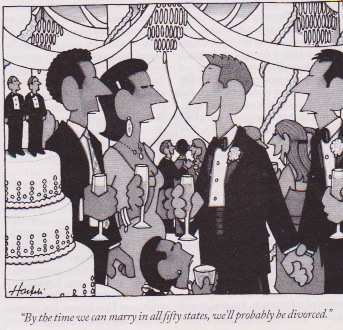
William Haefeli, on the changing definition of marriage, in the May 21st New Yorker:

Following up on President Obama’s support for same-sex marriage (as here).

Note the complaint of (some) religious authorities that the government — in the form of state legislatures and the courts — is defining marriage, when marriage is (these authorities say) the province of the churches (or the people in general, by popular vote).

Meanwhile, in the same issue of the New Yorker, the lead “Talk of the Town” piece, by Margaret Talbot, begins:

One day, not long from now, it will be hard to remember what worried people so much about gay and lesbian couples committing themselves to marriage.

and goes on to look at the sad story of opposition to interracial marriage:

In 1968, the year after the Supreme Court struck down Virginia’s anti-miscegenation law, seventy-two per cent of Americans disapproved of marriage between whites and non-whites, and only twenty per cent approved.

So it goes.

“Structure” or “work of art”

March 25, 2012

From the NYT Sunday Review today, this report (“Art Has Legs”) by Barbara Goldsmith about public art on Long Island:

It may seem an insignificant power spat in the small village of Sag Harbor, on Long Island. It isn’t. It is a quintessential example of a continuing, centuries-old battle over what can be deemed art, what can’t and who can rightfully judge the difference. I should say who among the living, for time has a way of sorting it all out.

For about four years, close to the side of their white clapboard home, the gallery owners Ruth Vered and Janet Lehr displayed a Larry Rivers mixed-media construction of a pair of attenuated fiberglass legs, 16 feet tall, modeled on a 1969 work called “40 Feet of Fashion.” Rivers, the provocative painter, sculptor and filmmaker, died in 2002. By 2010, a Rivers painting had sold for $1,142,500; that year, Fred W. Thiele Jr., the Sag Harbor village attorney and a state assemblyman, decided that Rivers’ “Legs” — which had long been established and exhibited as a work of art — was, in fact, a “structure.” As such, it was not a “conforming use,” according to the village code. (Mr. Thiele dug in his heels and told a Times reporter, “It’s a structure, and a structure is a structure is a structure.”)

Gayle Pickering, chairwoman of the Zoning Board of Appeals, tried to deflect the issue by saying: “This is not a decision about art. It’s about setting a precedent for building structures.” Try to get your head around that bit of specious reasoning.

The offending object:

After rancorous discussion, a decision has been put off until (at least) April 17th.

(more…)

persons

March 7, 2012

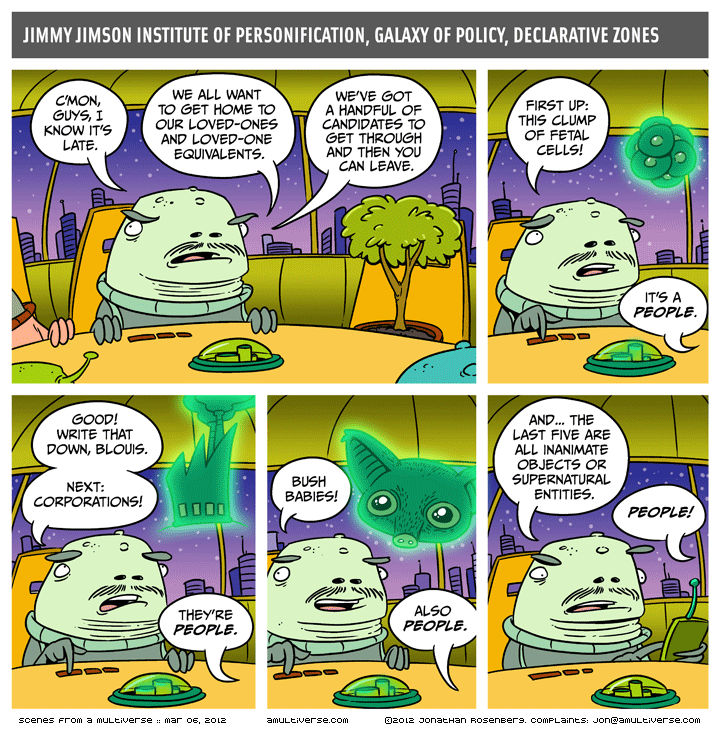
Yesterday’s Scenes from a Multiverse:

Personhood for fetuses, personhood for corporations, personhood for every damn thing!

(more…)

Officialdom’s semantics

February 8, 2012

From Monday’s “Metropolitan Diary” in the NYT, this letter from Gail Ann Mazin:

Getting up at 4 a.m. to catch an early flight from La Guardia, I decided to bring a bagel and cream cheese with me, since prices are so high for food at the gate. Rather than spending time slicing the bagel and spreading the remaining cream cheese from a practically empty container, I just tossed the container and bagel in a plastic bag with a small plastic knife and figured there would be plenty of time to prepare my breakfast at the gate.

As I was going through security, sans shoes, etc., the agent pulled my bag aside, unzipped it, opened the container and stated that I couldn’t bring creams onboard.

With a long line of impatient passengers, I decided it wasn’t worth an argument, but as I walked away, I called out, “What if I had already put the cream cheese on the bagel?,” to which she replied, “That would have been O.K.!”

I guess the whole breakfast is safer than its parts.

It seems to depend on what you mean by cream. Shades of fishing in the park!

(more…)

The appearance of Xing

January 31, 2012

Walter Stuart wrote to the NYT’s “Metropolitan Diary” yesterday about an encounter in Madison Square Park in which a park official treated the appearance of Xing as equivalent to Xing for the purposes of park regulations:

(more…)