Archive for the ‘Language and religion’ Category

Wencesla(u)s Day

September 28, 2024

Hana Filip (Professor of Semantics at the Heinrich Heine University in Düsseldorf, Germany, and a daughter of Moravia) reminds us on Facebook that today is Wencesla(u)s Day in the Czech Republic. St. Wenceslas Day is the feast day of the saint, commemorating his death in 935; and in 2000 also became a national public holiday, Statehood Day of the Czech Republic. The Duchy of Bohemia was founded in the 9th century; the Czech lands — Bohemia, Moravia, and Czech Silesia — were then integrated into the Holy Roman Empire and later the Austro-Hungarian Empire, emerging as part of the First Czechoslovak Republic in 1918, which was then peacefully dissolved into the Czech Republic and Slovakia in 1992 (yes, it’s complicated — well, the history stretches over 12 centuries and wars too many to count — but you can see why opting for the saint’s feast day as the national holiday makes some sense).

From the statue of Saint Wenceslas in Prague:


The statue in Wenceslaus Square (Flickr photo)

(more…)

Phaethon, Sisyphus, Putin, Darwin

September 11, 2024

It started with this rich (but baffling) painting on Pinterest a little while back:


(#1) A young boy, standing in a lake or river, holds up a fish he has caught on a line, while a band of intense light (a rocket launching?) shines from the far shore — a work by Irish figurative painter Conor Walton (born in 1970), who does still lifes and commissioned portraits, but also a lot of allegorical figurative painting, on mythological, cultural, and political themes

Some searching on Walton’s website identified #1 as Walton’s Phaethon (2015), so the subtext is mythological; comments to come. That search led to a clearly myth-based painting — a male nude to boot  — showing Sisyphus. Then to a political / cultural painting featuring Vladimir Putin, except that it’s also about Slim Pickens’s character Major Kong in the movie Dr. Strangelove, and, yes, it’s another male nude. And finally to a monumentally complex painting on a cultural / political theme, Darwinian evolution.

There’s a lot more, but these four should give you a feel for Walton’s imaginative side.

(more…)

In the midst of violent conflict, echoes of St. Sebastian

August 29, 2024

Found via Pinterest, a pointer to the Hi-Fructose site (“The new contemporary art magazine”), “On View: Johnny ‘KMNDZ’ Rodriguez & Nicola Verlato at Merry Karnowsky Gallery” on 2/14/2015 (details to come), in which appeared one of Verlato’s violent conflict paintings — they’re his specialty — showing Native American warriors impaling a settler to a tree with their arrows:


(#1) Verlato, The Settler (2015)

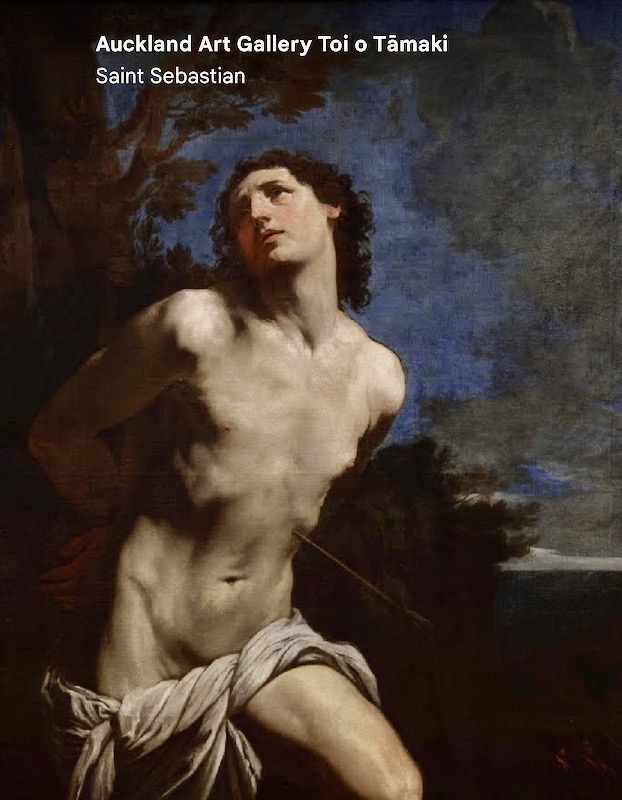
Echoes of St. Sebastian; compare #1 with two St. Sebastians that have come by on this blog in recent days:

(more…)

Diamonds, dildos, and in Seattle, clams

August 27, 2024

Acres, folks, acres. Diamonds and dildos got covered in my 8/26 posting “Acres of dildos”. Then from Wendy Thrash on Facebook the next day, more acres that I probably should have talked about in the first place. WT wrote:

Sorry, but as an old Seattleite this forces me to think of Acres of Clams

and referred to a Folk Music Blog posting, “The Songs of Ivar Haglund” by Jacqui Sandor on 5/28/19. I was just going to post WT’s note as a comment on my posting here, but then it occurred to me that “Acres of Clams” might not be familiar to everyone, and even if you know about the folk song (a text climaxing in acres of clams, set to an old Irish jig tune), the note might not have transported your imagination to Seattle, or, indeed, to Ivar Haglund. It might just have been baffling.

So now I will take you into a gigantic morass of the folk song world — in which, however, shines the canonical “Acres of Clams” text, which ends up being about Puget Sound (where Seattle is located), where clams abound, and where there’s a seafood restaurant founded by folksinger Ivar Haglund named Ivar’s Acres of Clams. You see, it does hang together. (And, despite the previous dildos, the clams in question are — surprise! — not lady-parts, but edible bivalves.)

The morass is a consequence of the fact that an extraordinary number of texts have been set to that same jig tune — possibly more than to any other folk tune — and then both the tune and all those texts have been popularly known by names that are phrases from the texts (you’ll see a small sampling of these names in a moment). Even the canonical clam text (from about 150 years ago) is so popular that virtually every folksinger who performs it alters the text to fit their own interests, passions, aims, and politics.

To set the stage, from the HistoryLink site:


(#1) From “Ivar Haglund opens Ivar’s Acres of Clams at Pier 54 in July 1946” by David Wilma on 6/19/00

(more…)

A Mexican in Paris

August 23, 2024

(About art, and about some Z-folk (yay us!), but the Z-folk are knee-deep in homoerotic art (yay for Team Sodomite!), and male bodies and man-on-man sex will be discussed in plain language, so this posting is off-limits for kids and the sexually modest)

A Mexican in Paris — Ángel Zárraga, a painter who has brought us yet another remarkable painting of St. Sebastian (I know, I know, when will this rain of Sebastians end?, you cry out; well, not quite yet), the sensuous Votive Offering, more commonly known as (The Martyrdom ofSaint Sebastian:


(#1) I’ll have a fair amount to say about the elements of this painting, but there are endless further questions about them: why the contrapposto stance, why this posing of the saint’s arms, why stars in the saint’s halo? why only one arrow, just barely embedded in the saint’s left nipple, and with handsome black and white checks on its fletching? and on and on; you’ll probably have more questions yourself

So we see what looks like a a fashionable Parisian woman in Art Nouveau dress, on her knees in devotion before a handsome Italian man with wavy black Romantic hair. He’s Saint Sebastian, dying for his Christian beliefs, from wicked sharp arrows penetrating into his flesh; she’s Saint Irene of Rome, tending to him and healing his wounds. But there’s no agony, no tears, only the striking of poses. There’s no exertion, no fear, not one drop of sweat. Remarkably, there’s not a drop of blood, either, only these two powerfully beautiful people, radiating sensuous elegance.

The inscription in the lower right corner is a genuinely pious and humble dedication by the artist of his work to the Lord; meanwhile, in the work, the body of the saint is framed as itself a votive offering, a gift to God. But let’s face it, this Sebastian is one hot number (and so is this very worldly Irene, in her own way), presenting himself as strikingly unmartyrial, more like something cooked up by Pierre et Gilles. I find it easier to imagine Zárraga’s Sebastian stud-hustling on a city street — well, I have actually seen his brothers in action, though with more clothes on and no arrow — than to see him as a blood sacrifice in the service of Jesus Christ.

(more…)

Saint Sebastian of Montreal

August 21, 2024

(Full frontal male nudity, but in serious artworks, so — under the Fine Art Exemption — I can show them in WordPress; but this material is not for kids or the sexually modest)

Encountered recently on Pinterest: Saint Sebastian of Montreal, as painted by Dan(iel) Barkley. Pained, worn, fierce, gay, and hung. To contrast with the beautiful young St. Sebastian of my earlier posting today (by Owe Zerge, whose studio was in a rustic Swedish village) and with the young, outrageously — goofily — gay St. Sebastians concocted by the French duo Pierre et Gilles, surveyed recently in another posting of mine.

Now I’m going to do a quick review of those two recent postings, to give you a feel for the landscape of gay Sebastians, so you can appreciate how Barkley’s gritty saint stands out.

(more…)

Sparky Schulz and the least of us

August 7, 2024

(Not my intention for a posting today, but you work with what you get, and I happened to have a piece of (what I think of as) Jesus’s DEI Sermon sitting on my desktop, waiting for a suitable occasion. Which came this morning in a lead from Henry Mensch on Facebook that took me to a website of Peanuts cartoonist Charles Schulz’s widow Jean; from Jean Schulz’s Blog “The Circle Continues”, on 2/23/19:

(more…)

This is the day which the Lord hath made

August 6, 2024

So begins Psalm 118:24, in the KJV; the verse in full:

24 This is the day which the Lord hath made; we will rejoice and be glad in it.

Two things: one, the way in which the restrictive relative clause (with non-human antecedent) is marked — here with the relativizer which rather than that, or, unmarked, with no relativizer (in a so-called zero relative); two, the framing of the new day, in which we are exhorted to rejoice, as a gift of God (versus viewing it simply as the welcome granting of another day of life).

I take this up because the late Ann Daingerfield Zwicky was accustomed to greeting the new day by reciting the whole verse, made personal by a shift from 1pl to 1sg, but also with the morphology and syntax altered to fit her own dialect and style — with has instead of the archaic form hath; and with the which relative replaced by the shorter zero relative:

(ADZ) This is the day the Lord has made; I will rejoice and be glad in it

but maintaining her Episcopalian / Anglican creedal commitments; from the Book of Common Prayer (1662):

I believe in God the Father Almighty, Maker of heaven and earth, and in Jesus Christ his only Son our Lord …

I admired her custom, followed her on the grammar and style, but altered the text to suit me as a non-believer:

(AMZ) This is the day I have been given; I will rejoice and be glad in it

(more…)

St. Arnold’s Day

July 8, 2024

According to the calendar on my computer, today is St. Arnold’s Day, and it is — just not the St. Arnold (the patron saint of hop-pickers and brewers, born in Flanders, now Belgium, around 1040 and died there in 1087) I had in mind, whose feast day is August 14. An earlier version of the beery St. Arnold’s Wikipedia page had him confused with St. Arnold of Arnoldsweiler (a musician — harpist and singer — who served at the court of Charlemagne and died around 800), whose feast day is  in fact July 8 — though the current version of his Wikipedia page has a typo in which his feast day is listed as July 18.

But most of St. Arnold of Arnoldsweiler’s story seems to be florid invention, with only a few solid facts known about him, while St. Arnold (Lat. Arnoldus) or Arnoul of Soissons (in northwestern France), aka Arnold or Arnulf of Oudenburg (in Flanders), had a fairly well-documented life full of event and accomplishment, so today I’m going to write about him, again, anyway.

(more…)

Benedico questa frociata

June 18, 2024

(Tasteless and obscene, in two languages, so not to everyone’s taste)


(#1) A rainbow raised fist, representing proud defiance; image from Redbubble, by designer MAS-S (in Berlin, Germany)

And now the frocio ‘queer, homo, faggot, fairy, queen’ mock-Pope intoning benedico questa frociata ‘I bless this faggotry’ (more literally, ‘this faggoting’) at the 6/15 Pride celebration in Rome, where t-shirts proclaimed “There is never too much frociaggine” — never too much faggotry — as participants enthusiastically embraced every vulgar insult they know (but especially frociaggine), turning them into proud badges of identity and defiance, raising the rainbow fist:


(#2) (photo from the National Catholic Reporter on 6/16/24)

(more…)