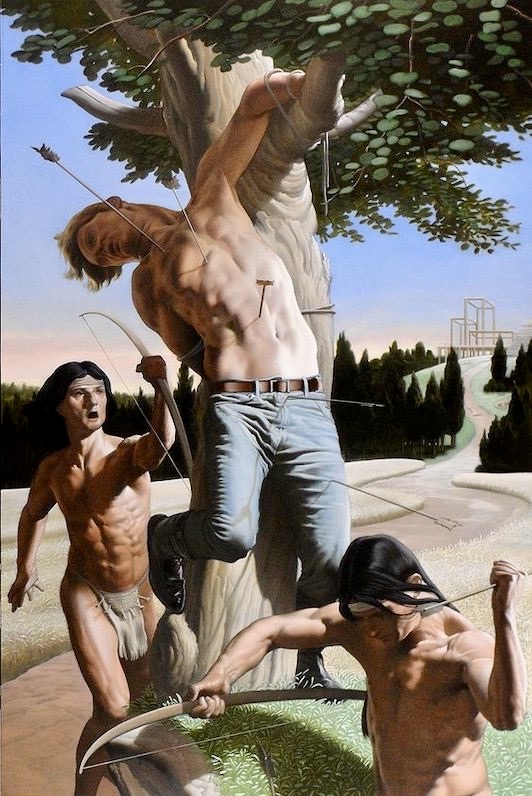
Found via Pinterest, a pointer to the Hi-Fructose site (“The new contemporary art magazine”), “On View: Johnny ‘KMNDZ’ Rodriguez & Nicola Verlato at Merry Karnowsky Gallery” on 2/14/2015 (details to come), in which appeared one of Verlato’s violent conflict paintings — they’re his specialty — showing Native American warriors impaling a settler to a tree with their arrows:
(#1) Verlato, The Settler (2015)
Echoes of St. Sebastian; compare #1 with two St. Sebastians that have come by on this blog in recent days:
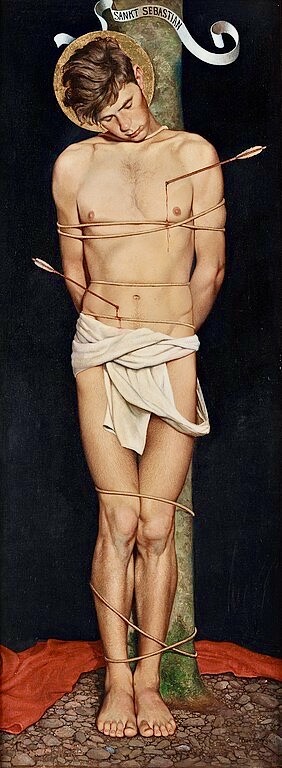
StS by Owe Zerge. From my 8/21 posting “Swedish male art from a hundred years ago”:
(#2) A 1925 Saint Sebastian painting by Swedish artist Owe Zerge (1894 – 1983); even in the crowded field of homoerotic St. Sebastian depictions, the martyred saint in Zerge’s painting stands out as an exceptionally beautiful young man
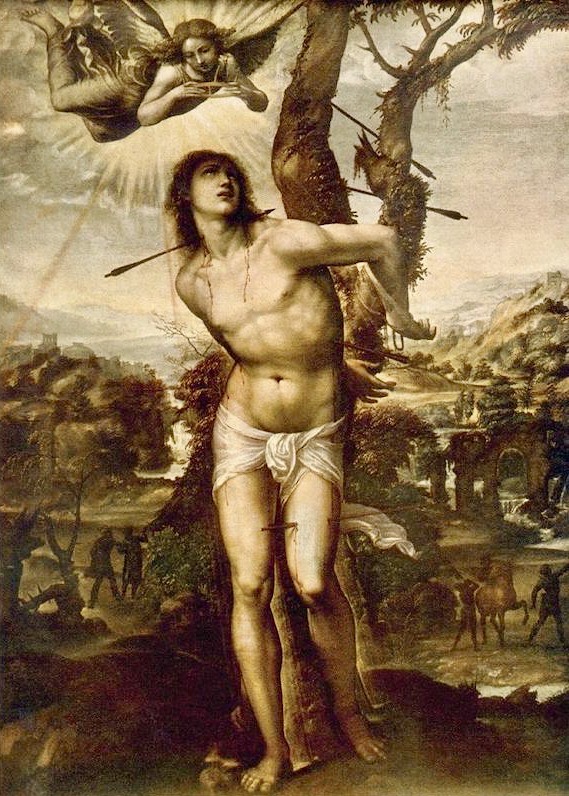
StS by Il Sodoma. From my 8/23 posting “A Mexican in Paris”:
(#3) From the world of depictions of the martyrdom of Saint Sebastian, this … sensuous (and quite plainly queer) 16th-century painting by Il Sodoma (whose nickname means just what you think it does)
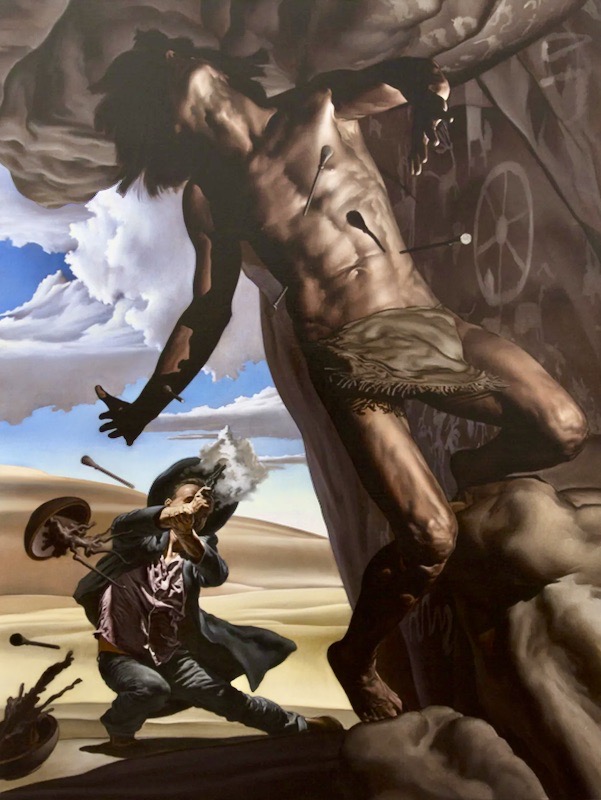
But wait! There’s more! At least one more Verlato. This time a Western gunslinger is firing his pistol, but still arrows pierce the central figure, who appears to exist in several (violent) worlds simultaneously:
(#4) Verlato, Shaman (2017)
From the Artsy site in connection with #4:
Specializing in fusing Americana, popular imagery, and traditional painting techniques, Nicola Verlato is best known for his highly refined allegorical surrealism that recalls the murals of Thomas Hart Benton and the heightened drama of 17th-century Italian baroque paintings. Featuring spectacular light effects, twisting nude figures, and dense compositions, Verlato’s work depicts a dark future that recalls a mythological past. In 2009, he represented Italy at the Venice Biennale with a series of sculptures and paintings, the latter recalling apocalyptic altarpiece panels.
About Verlato. From Wikipedia:
Nicola Verlato (born February 19, 1965 [in Verona]) is an Italian painter, sculptor, architect and musician [now] based in Los Angeles [formerly in Milan and then New York City] …
Nicola Verlato retains a kind of classicism that has traditionally implied conservatism, upholding a neorealist style evocative of Old Master painting, which he puts to use in near-apocalyptic, largely allegorical scenes of soldiers and bodies leaping from crashing vehicles. Verlato appropriates the campy, exaggerated violence common to the High Baroque and contemporary video games to comment on the clash of civilizations played out between polytheism and monotheism, and to underline its consequences for representation: cults of idols (figuration) versus prohibitions on graven images (abstraction). This is an important reminder of the different histories of form and the ideologies that underpin them, whose use depends on local context and other factors.
ー Painting Now by Suzanne Hudson (Thames & Hudson 2015)
From the Hi-Fructose site.
Now on view at Merry Karnowsky Gallery in Los Angeles, Johnny ‘KMNDZ’ Rodriguez and Nicola Verlato’s dual exhibitions paint uniquely personal pictures of conflict. There is no universal definition of what it means to struggle; whether we are emotionally conflicted with ourselves, or there is some form of friction between cultural groups, as in Verlato’s works. Interestingly, both artists portray this with symbols of weaponry.
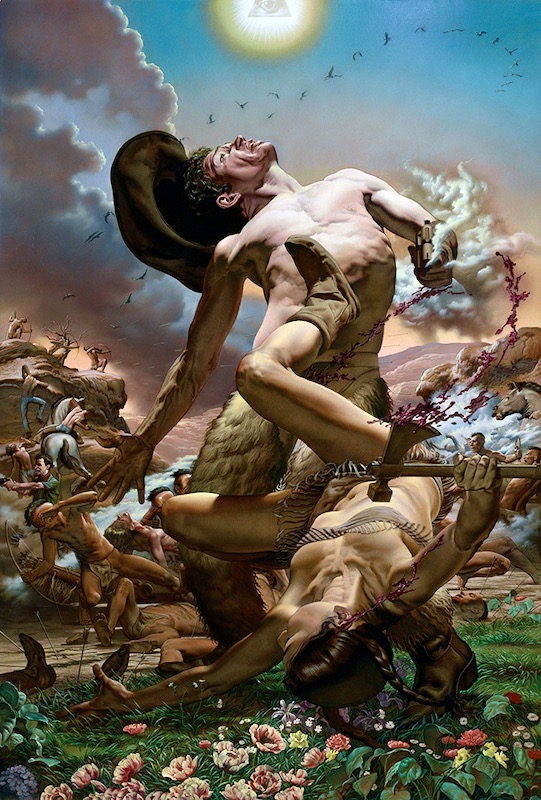
… Nicola Verlato stages his interpretation of conflict with a Western narrative in “Conquest of the West.” Verlato’s 2012 exhibition “How the West Was Won” featured a painting of the same name, where a cowboy, representing monotheism, shoots and kills a Native American woman, polytheism [wielding a bloody axe]:
e
(#5) Verlato, How the West Was Won; the painting is dense with strange details — the birds in the sky, the ominous clouds, the cowboy’s goat-fur legs, the remarkable flowers in the foreground, and moreHere, in these smaller portraits, Verlato zooms in to focus on the emotional intensity of the scene, in his Contemporary-Baroque art style. Their epic battle is mapped out in meticulously cross hatched sketches, also on display, in addition to the cast of a future-resin figure of a dying settler. It accompanies his largest piece in the show, of Native American warriors pinning the settler to a tree [#1 above]. For Verlato, conflict is at the core of Western progress which perseveres as structures and towns are built in the background.
Most of his paintings are disturbing, but in ways that make it hard to take your eyes off of them.
Leave a Reply