Paul Noth in the April 30th New Yorker:
 (#1) “Et tu, Little Caesar?”
Two contributing factors that intersect in the name Caesar.
Paul Noth in the April 30th New Yorker:
(#1) “Et tu, Little Caesar?”
Two contributing factors that intersect in the name Caesar.
Yesterday’s Zippy had a nutjob in a diner ranting:
Are you trying to lure me into a lexicographical, self-contradicting black hole of word play so heinous it defies logic?
And today, embedded within a thick matrix of allusions pointing in many directions:
a lexicographical, self-contradicting vortex so heinous, it defies Robert Mueller
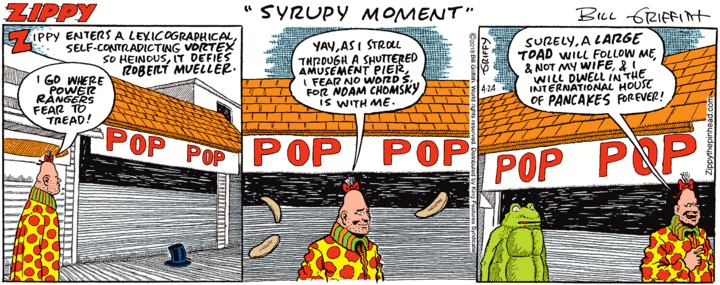 (#1)
(#1)
Today’s Zippy takes us to 449 S. Winchester Blvd. in San Jose CA (more or less next door to the Winchester Mystery House and across the street from Santana Row):
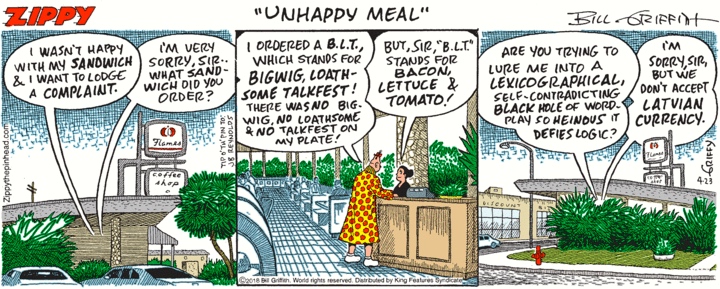 (#1) The title is an allusion to McDonald’s Happy Meal for kids
Two things: the location; and the goofy dispute over the meaning of the initialism B.L.T.
In the March 12th New Yorker, a Talk of the Town piece by Ian Parker on novelist Jay McInerney and his career writing fortune cookie fortunes: in print, “Pithy”; on-line, “When Jay McInerney writes your fortune: The novelist’s new line of fortune cookies are fit for a cynic: “If at first you don’t succeed, try Botox.””:

Caricature by Tom Bachtell
… or RotisserFoosball, depending on how you look at it. In the April 23rd New Yorker, this clever visual and conceptual hybrid of foosball and rotisserie chicken: a game played maniacally by chefs in their kitchen:
 (#1) Cartoon by John O’Brien, who often ventures into this hybrid territory
Earlier on this blog, a 6/4/16 posting on the cartoonist Jeff Hobbs, with this FoosKebab cartoon as #4 there:
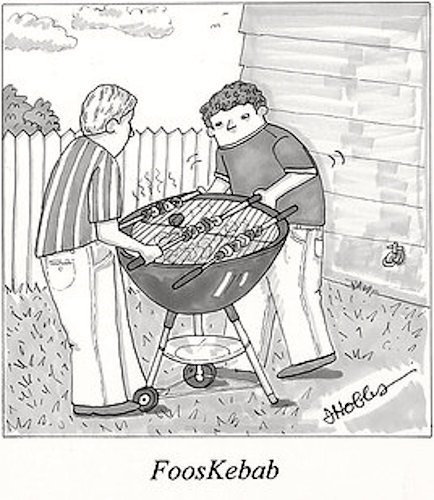 (#2) Kebabs on a grill, with the skewers treated like the bars in foosball (aka table football)
 (#3) A foosball table
In #1, rather than kebabs on skewers, we have chickens on spits in a rotisserie. From NOAD:
noun rotisserie: 1 a cooking appliance with a rotating spit for roasting and barbecuing meat. 2 a restaurant specializing in roasted or barbecued meat.
 (#4) Costco rotisserie
Rotisserie chicken is a chicken dish that is cooked on a rotisserie, using direct heat in which the chicken is placed next to the heat source. Electric- or gas-powered heating elements may be used, [supplying] adjustable infrared heat. … Leftover rotisserie chicken may be used in a variety of dishes, such as soup, chicken salad and sandwiches.
… In 2014, Costco sold approximately 76 million rotisserie chickens in the United States. (Wikipedia link)
About the artist John O’Brien, from his website:
 (#5)
(#5)
John O’Brien was born in Philadelphia, PA in 1953 and graduated from The Philadelphia College of Art in 1975.
In the course of his career, he has worked with many notable publishers, illustrating 83 children’s books, 8 of which he also wrote. He has done illustrations for publications such as The Wall Street Journal, Washington Times, Global Finance and Worth, and contributed to many other collections, anthologies and textbooks. He has also had a long relationship with Highlights for Kids Magazine for which he has contributed numerous covers and interior illustrations.
John has also had a long career as a cartoonist for many magazines, most notably The New Yorker, for which he created 17 covers and over 200 interior pieces. His cartoons have also been featured in the New York Times, Esquire, Fast Company and Omni, among others.
John resides in Delran, New Jersey in the spring and fall. In the summer he moves to North Wildwood, NJ, where he has been a lifeguard on the North Wildwood Beach Patrol since 1970 and is currently Senior Lifeguard. John spends the winter months in Miami, Florida.
He plays music both professionally and for entertainment, primarily Dixieland and Celtic. He most enjoys banjo and concertina but also plays piano, bass and guitar.
Two of his “hybrid” covers for the New Yorker:
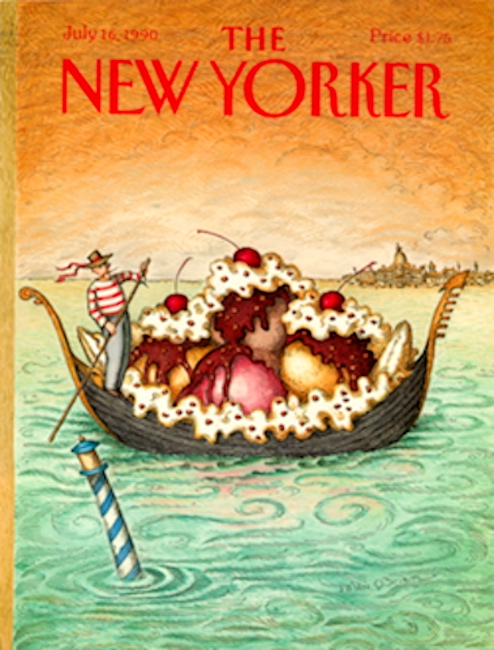 (#6) 7/16/90: a Venetian gondola and an ice cream sundae
 (#7) 2/4/91: a ski slope and a pinball machine
Two remarkable finds: on Facebook, passed on by Heidi Harley, cotton candy burritos; and on a Pinterest board, the Slippery Panties cocktail.
The idea of creating a sauce or dressing by blending mayonnaise with a smooth tomato preparation (tomato paste, tomato purée, or tomato ketchup) has occurred to cooks again and again over the years. To this tomato mayo base they have added any number of other ingredients: horseradish, mustard, vinegar, lemon juice (or lime juice or orange juice), cream, sour cream, pim(i)entos, chopped sweet peppers, red pepper flakes, tomato pieces, chopped pickles, chopped green olives, chopped ripe olives, chopped nuts (walnuts or others), chopped hard-boiled egg, chives, chopped onion, garlic, Worchestershire sauce, Tabasco sauce (or other hot sauce), barbecue sauce, herbs (for instance, parsley, dill, oregano, tarragon, or cilantro), and spices (for instance, black pepper, cayenne, paprika, cumin, or turmeric).
The Heinz company has now entered this culinary arena with a proposal for yet another basic tomato mayo sauce. From the WaPo today “Heinz promotes its new ‘mayochup’ and sparks an international controversy” by Samantha Schmidt, beginning:
… with a whiff of amyl nitrite. Featured on a Pinterest food board recently:
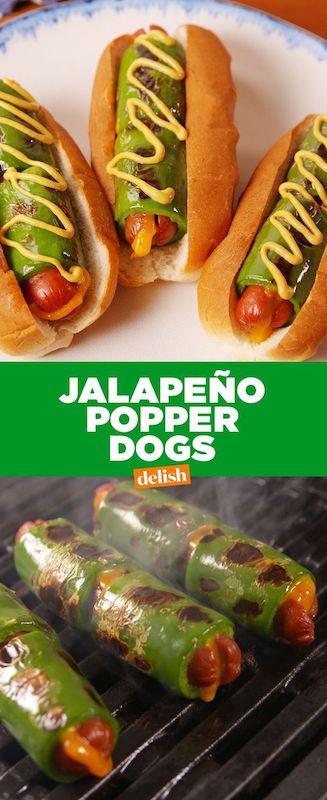 (#1) Looking for an easy hot dog recipe? These Jalapeño Popper Dogs from Delish.com are the best!
Erect green wieners, with dripping tips coyly peeking out. For your dining pleasure.
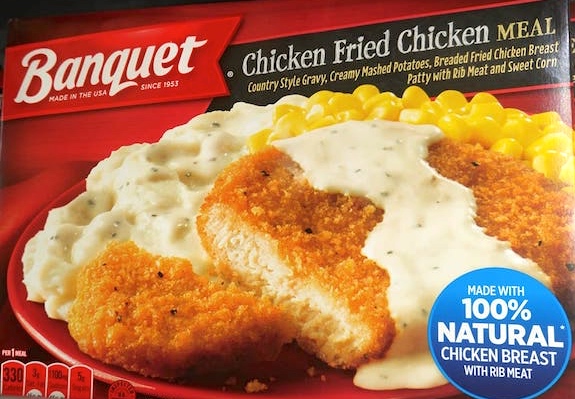
The subject of a somewhat confused exchange on Facebook a few days ago. Jeff Shaumeyer on the 9th:
 (#1)
(#1)
We were at the Safeway this weekend, when I saw this. I’m still perplexed by the idea of “chicken fried chicken”.
Chris Waigl on the source of the perplexity:
“Chicken fried steak” (I was taken aback by this one, too, at first) means “steak fried in the manner of fried chicken”. So “chicken fried chicken” would be “chicken fried in the manner of fried chicken”. That is, fried chicken.
Well, no. Chicken fried steak doesn’t mean ‘steak fried in the manner of fried chicken’; it’s the name of a dish, a fried steak preparation that resembles in some ways Southern fried chicken. As I hammer home again and again, Labels Are Not Definitions.
From Elizabeth Daingerfield Zwicky, on her Instagram site, a flaming script Z; and from colorcompanion @alphafoodie, a stunning rainbow sandwich: