Archive for the ‘Language and food’ Category

Cellarettes and cabinet drinks

October 9, 2025

Adventures in furniture inspired by a Benjamin Dreyer posting on Facebook yesterday:

Goshamighty, I completely forgot to mention, when I posted my Old Acquaintance piece a few hours ago, that in commencing this morning to read John Van Druten’s 1942 The Damask Cheek (co-written with one Lloyd Morris), I learned a new word! It’s cellarette: “a movable cabinet or container, often made of wood, designed to store and secure alcoholic beverages.”

If there’s a more perfect word to turn up in a play set in “The library of MRS. RANDALL’s house in the East Sixties, New York. December 1909,” [the  setting of The Damask Cheek] I can’t think of it.

BD locates the sociocultural milieu of the item (and then its name as well) as privileged urban upper class — traditional, elegant, and elite — and we will see that his classdar is first-rate.

I then broke in with the news that I have one of these things, a very nice one, of Danish design, made of teak, on wheels, with a durable bar top, in two parts that slide open to reveal the storage spaces within (there will be photos). I am neither elegant nor elite — I have several good points, but they are not these — but this clever and handsome object suits me (and it was mine and Jacques’s, and before that mine and Ann’s, so it comes with with waves of sweet memory; I will soon pass it on to my grand-child Opal).

But first, the cellaret / cellarette. The object and the name.

(more…)

The FY restaurant

October 5, 2025

Following on my 9/27/25 posting “From the annals of remarkable commercial names” (about the Chew Chew Grill / Chew Chew’s Diner in Toronto), Sim Aberson wrote on Facebook on 10/3:

— SA > AZ: While discussing commercial names, a very good Vietnamese restaurant in Miami, Phuc Yea — of course it’s pronounced fook yeh. [I omit commentary on the well-deployed SPAR (aka dangler) and the NP (topic-introducing) sentence fragment]

— AZ > SA: Oh my. No doubt intentional. Though I’ll point out that the enthusiastic intensive-modifier use of the F-word in Fuck yeah! is pretty much as low on the raunchiness scale as the F-word gets.

As it turns out, definitely intentional. And cheeky.

(more…)

entre más carne mejor

October 3, 2025

More from the annals of commercial names, thanks to this Facebook report from Steven Levine, on the road in Asbury Park NJ:

On the way to Ocean Grove NJ for a weekend with some friends, our culinary tour of the Jersey Shore, I passed this sign:


(#1) The Meat & More Corporation of Asbury Park: a butcher shop, noted here for its double entendre name

(more…)

Can I help?

October 1, 2025

🐇 🐇 🐇 rabbit rabbit rabbit for the new month, which is coming in locally with October showers (a tiny amount of rain, but always an excitement in what is still the dry season in this part of the world)

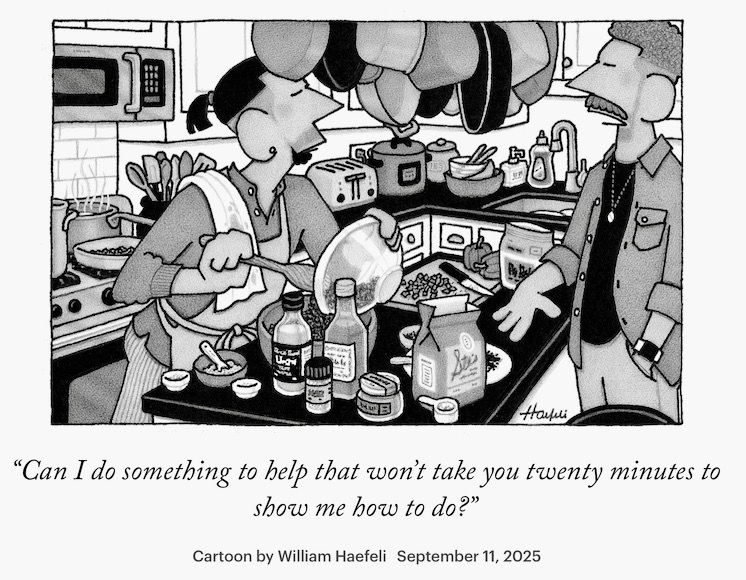
And now I turn to a William Haefeli cartoon from the New Yorker issue of 9/22/25 (this is only a bit behind the times; I have promised follow-up postings to first installments going all the way back to January, and my life is now spectacularly more difficult than it was before, so I’m just taking random shots). This cartoon:


(#1) All about the complexities in offers of help — from anyone, from someone who shares your household, from your spouse (or equivalent partner), or specifically from your same-sex partner, or (since this is Haefeli) even more specifically from your gay male partner; and also about the division of labor in households of all sorts

The cartoon is in face exceedingly rich, readable at several different levels. It is, in fact, funny even if you eliminate all the rich social specificity Haefeli has built into it.

A thought experiment: replace the highly socially located characters in #1 by cute indistinguishable cartoon creatures not identifiable by species or sex. One is engaged in some neutral task, like sorting unidentifiable objects; the other, standing by and observing, asks (in a way that presupposes that the observer doesn’t already know how to do the task):

Can I do something to help that won’t take you twenty minutes to show me how to do?

(This is an offer to help, couched indirectly, as a question, and also hedged, with a precondition on the offer.)

It’s still funny — because all tasks require skills, which must be learned (by observation or instruction, and then by practice), but there’s a wide range of complexity and difficulty for these skills, and at the upper end of the range, it could take a significant amount of time for a new helper to pick up the skill, so the observer conveys that their offer is conditional on the learning time being short; 20 minutes would be too great an investment for them. We then have some wry mockery of the observer’s attitudes — that they’ll do it, but only if it’s not too much trouble. They want the credit for offering, but don’t want to commit much to the task.

In real life, I have often had the experience, in difficult times, of having someone turn up offering to give me whatever help is needed, but then when asked to do some specific task, demurring on the grounds that “Oh, I couldn’t do that!” I have an especially unpleasant memory of my stepmother-in-law arriving in Cambridge MA (in the middle of a bitter winter, from Florida), after our daughter Elizabeth was born, to help out with the baby. Almost anything that would have helped us — doing some cooking, getting groceries, taking clothes to the laundromat, whatever — was greeted with “Oh, I couldn’t do that!”. After a few days she went back to Florida and out of our lives for a while, to our great relief.

But now in the social context. As soon as you add some social context, the cartoon becomes much richer.

First, the task is cooking, which is famously complex and time-consuming. And look at that kitchen! Crowded with pots and pans and, everywhere, ingredients. Conveying that helping out is likely to be no small undertaking.

Second, the the cartoon is about a cook and their housemate, so the division of household labor now comes to the fore: how does it come about that one person does all the cooking while the other merely observes, sometimes extending a conditional offer of help?

Third, domestic cooking in our sociocultural context is “women’s work”, so we would guess that the cook is female and the observer male, that these roles are assigned by gender-normative conventions, with the result that the observer is being cast as normatively masculine: pointedly not doing women’s work, because that would be feminine. But he might, um, lend a hand to the little lady. As a favor. If it wasn’t too much trouble. Then the cartoon is a poke at the pretensions of the observer.

But, wait! Fourth, the couple in the actual cartoon are both men. Whatever their relationship, if they are at least housemates, tasks have to get done, and somebody’s got to take the cook role. The roles have to be negotiated. And the cartoon is, again, a poke at the pretensions of the observer.

And then, in fact, the cartoon comes from Haefeli-land, a place of urban (very likely, NYC) upper middle class couples, many of them gay men. So fifth, the men in the cartoon are in fact a gay couple — and they are differentiated as two different types of gay men: the observer presenting himself as normatively masculine in appearance, the cook as deviating from these norms (earring, fashionable haircut, ponytail). Which, by playing on the norms (real men don’t cook), makes the cartoon an actual swipe at the pretensions of the observer.

The cartoon might have been titled “Sympathy for the Cook”. See, in this light, an earlier Haefeli cartoon:


(#2) Again, the cook

Real life is, of course, immensely complicated, and roles and presentations are distributed in all sorts of ways, at different times, in different contexts, for different purposes. This is literally the cartoon version.

 

From the annals of remarkable commercial names

September 27, 2025

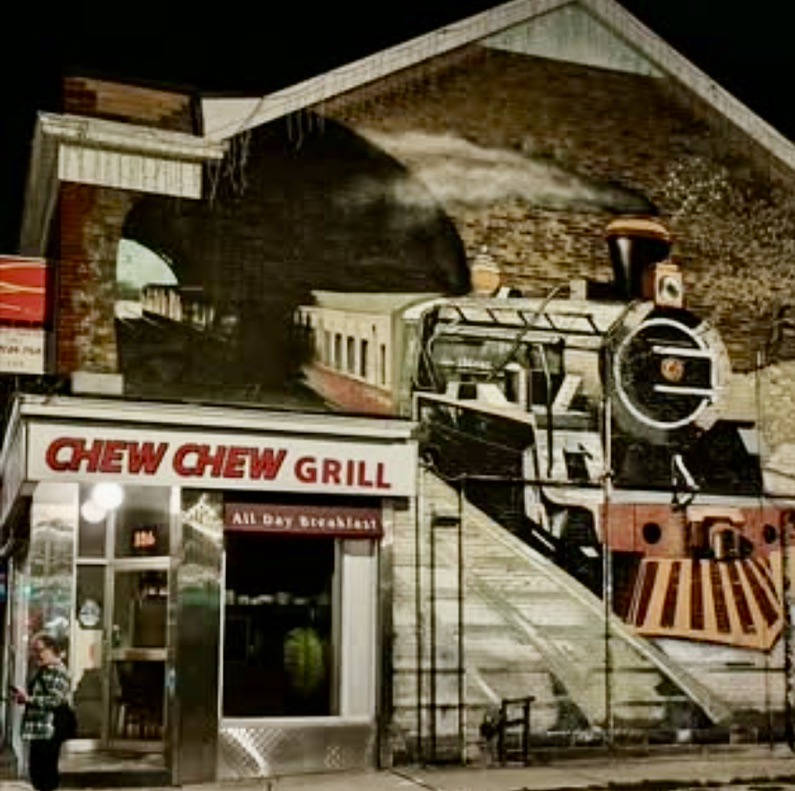
Briefly noted. From Randy McDonald on Facebook yesterday, a nighttime-atmospheric photo of the Chew Chew Grill / Chew Chew’s Diner, 186 Carlton St., Toronto ON (open 8 am to 4 pm):


All-day breakfast, hot sandwiches, and burgers in a space with booth seating and train-inspired decor

You get the remarkable name, a kind of ludic trifecta — punning (choo punning on chew), imitative (choo-choo  ‘train’), and metonymical (chew in the name of an eating place) — plus the wonderful train mural, especially vivid at night.


Monsters

September 25, 2025

In the new issue of the New Yorker (9/29/25), two monsters stalk the cartoons in its pages: Joe Dator’s hysterically creepy Wine That Breathes (It’s alive!) and Michael Maslin’s Cyclops waiter at work in an intimate little urban restaurant otherwise located in the waiter’s home territory, the hills of ancient Greco-Roman mythology.

(more…)

A seminar on raunchy play

September 23, 2025

(entertaining, but totally not for kids or the sexually modest)

The seminar was called to order on 9/21 on Facebook by Michael Thomas, who introduced the key background element, the internet fridge. The participants were three gay men, long-time friends (our shared backgrounds and the relaxed, playful atmosphere are important here): speakers Michael Thomas and me, with Michael’s husband Aric Olnes in a non-speaking role. From the transcript (somewhat edited):

— MT: We [MT and AO] hooked our fridge up to the internet the other day. Here’s a question for the ages: do fridges watch porn while the doors are shut?

— AZ: But of course. And then they fall asleep and dream of abusing electric sheep. And you thought that was condensation on the fridge walls, didn’t you?

— MT > AZ: fridge spunk. just scrape it off for your coffee in the morning.

— AZ > MT: Absolutely. The best jizz there is.

There’s an enormous amount of stuff packed into this — some from the widespread sexual culture of modern America or from popular culture but also some from gay male sexual culture. I will now do some unpacking.

(more…)

Sloths, penguins, and Buddhist joy

September 6, 2025

Birthday greetings: Slothful Salsa, the Penguins of Penzance, and zuiki.

“Slothful Salsa”: the title of a Jacquie Lawson animated ecard, from R&T (Rod Williams and Ted Bush), celebrating my birthday with a delightful salsa-style performance of “Happy Birthday” by a band of jungle animals under the direction of a drummer sloth. At the conclusion, going from the snake on bass to the leopard on guitar:


(#1) All together now! — a slothful salsa led by a salsic sloth; not many sloths are into salsa music, though there are reports of sloths enamored of the spicy sauce, which they consume with ponderous dignity, giving out little whimpers of pleasure (sloths don’t move fast, but they’re very earnest)

From NOAD:

noun salsa: 1 [a] a type of Latin American dance music incorporating elements of jazz and rock. [b] a dance performed to salsa music. 2 (especially in Latin American cooking) a spicy tomato sauce: a flour tortilla with salsa and shredded cheese. ORIGIN Spanish, literally ‘sauce’, extended in American Spanish to denote the dance.

“The Penguins of Penzance”: this wonderful artwork by Opal Armstrong Zwicky, made specifically as a birthday present for me:


(#2) G&S, The Pirates of Penzance — complete, presumably, with the leap birthday and the pilot / pirate confusion — but done with penguins (my original totem animal)

Opal was introduced to Pirates as a child, by her mother and me, and it took. So in addition to the familial Savoyardism, Opal is also an accomplished artist, with a wry sense of humor, and appreciates my attachment to penguins.

Buddhist deep joy. Finally, from Larry Schourup (a loving friend of 55 years now, living for many years in Japan), an e-mail with a birthday sentiment that just bowled me over:

The other day, while listening to a talk in Japanese, an unfamiliar Buddhist term caught my ear. Afterward, when I looked it up, I realized I’d found the perfect way to express how I feel about your momentous 85th.  The term, which means “a feeling of deep joy and gratitude for another person’s virtues” is zuiki.

Zuiki is (one version of) my name in Chinese. So for a moment I thought Larry had fabricated the whole wonderful business. But no, it’s all just as he said, and it’s deeply moving.

Bonus. All done in public, on Facebook. Starting with an astonishing encomium from my step-son Kit Transue (my man Jacques Transue’s son), to friends on FB:

— KT: Happy birthday, Arnold Zwicky! (Arnold is one of my two step-dads: he was my father’s partner through my father’s brain cancer, treatment, and subsequent early onset Alzheimer’s. Throughout the course of those challenges, he remained a source of unlimited love and gave my father unimaginable company and support.) Thank you for being true, for being loving, for being open, and for being loud*!

(*I’m no longer surprised by friends who know Arnold from his USENET posts; he now blogs [on WordPress here])

— AZ > KT: Wow. No, I’m not going to dispute that amazing encomium, beyond saying that in all those matters I’ve been doing what I thought I needed to do (not placing any burden on anyone else, also reminding people that I’m a real person, someone who makes mistakes, is often negligent, and sometimes screws things up badly). But yes, I did those good things. I’d just like to emphasize that there was a wonderful time before the first disastrous time, and a long deeply satisfying time with Jacques in between the two disastrous times. I’ve written a fair amount about J’s view of himself as my support staff and my protector (as well as my best friend and my lover and a second son for my dad) and about the pleasures and challenges of life together. He was a good man, the love of my life, still poignantly missed. It’s especially moving that you praise me in just the way your father did; being open (and highly visible) and being loud were not his ways, but he applauded my performances and the good that might come of them.

Life stories. Nothing really could follow the birthday wishes from Larry and Kit. But I also got birthday e-mail from X, who noted that we’d been friends for 51 years. (Larry goes back to Columbus OH, 55 years ago; Benita Bendon Campbell — a friend from Princeton, 66 years ago — survives, with her considerable wits intact; but surely the time-depth award for Surviving Friends of Arnold goes to Bill Richardson, whose friendship goes back to summer boys’ camp when we were but 10, fully 75 years ago.) I cast my mind back to the occasion when X and I met, what their previous life and mine had been like, and how our two lives, separately, then followed extraordinarily complex, and frankly unlikely, paths. And wrote them:

Would anyone believe your life story? Or mine? Bits of it, sure, but the whole thing, in sequence, I doubt it.

X then helpfully pulled out some of the more extraordinary recent turns in their life, which I agreed no one could have predicted, or maybe even imagined possible.


I’m Chiquito Quesito …

September 2, 2025

I’m Chiquito Quesito, and I’m here to say,
Cheese dip has to be made the Arkansas way

The jingle to go along with native Arksansan Bill Halstead’s reproducing (on 8/31) this silly dip pun he found on Facebook (from who knows what source):


(#1) The signage is for a dip in NOAD‘s sense 3a, wilfully misunderstood as about sense 2:

noun dip: … 2 a thick sauce in which pieces of food are dunked before eating: tasty garlic dip. 3 [a] a brief downward slope followed by an upward one: the road’s precipitous dips and turns. [b] an act of sinking or dropping briefly before rising again: a dip in the share price.

And queso is short for chile con queso  (‘chili with cheese’), which Wikipedia identifies as:

an appetizer or side dish of melted cheese and chili peppers, typically served in Tex-Mex restaurants as a dip for tortilla chips.

Now three further explorations: about dip signage; about dipspreads and dips in general, and varieties of queso in particular; and then some Facebook exchanges with Bill Halstead about cheese dip as a significant item in Arkansas’s food culture.

(more…)

Skyparty

August 21, 2025

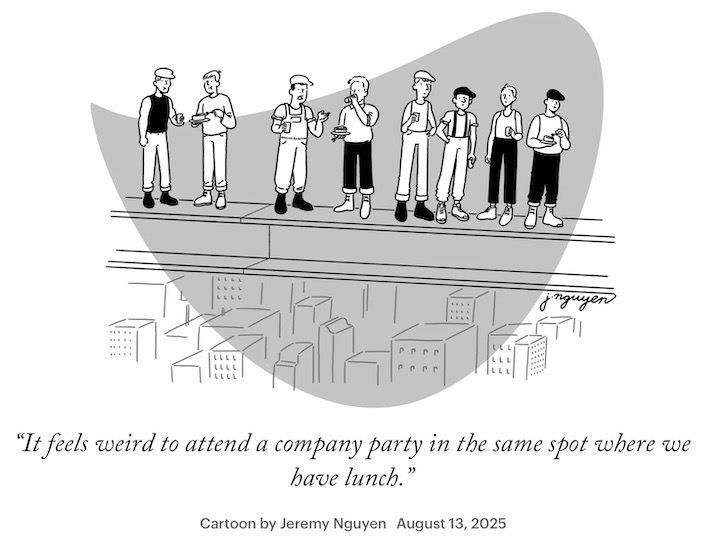
In the latest (8/25/25) New Yorker, a Jeremy Nguyen cartoon in which some construction workers party in the sky:


(#1) A play on the well-known “Lunch atop a Skyscraper” photo originally taken in New York in 1932 (which I have labeled Skylunch 1; it was followed by a series of Skylunch variants)

Nguyen has 8 men, grouped 2, 2, 2, 1, 1; they are working-class guys in casual dress (caps rather than hard hats, no harnesses), standing (rather than sitting) around with simple party fare (rather than lunch boxes) in their hands. What guy #3 finds remarkable is not that they are standing on a girder suspended far above the city streets, but that they’re getting their little party in what is for them their lunch spot. This is elephantlessness: missing the elephant — in this case, the floating girder — in the situation.

(more…)