Archive for the ‘Figurative language’ Category
December 16, 2024
An invitation on Facebook on 12/13 from linguist Jennifer Arnold, performing her musical role (crucial phrase underlined):
If you like to sing, come to the Chapel Hill Messiah open sing tomorrow evening! I’ll be in the viola section.
My response:
I had a confused moment when I thought you’d be singing the praises of the Messiah of Chapel Hill (whoever he is; I’m woefully out of touch with things, and thought I must have missed the rise of a Prince of Peace in the New South).
(more…)
Posted in Ambiguity, Compounds, Constituency, Lexical semantics, Metaphor, Music, Semantics of compounds | 4 Comments »
November 22, 2024
(Well, consider the title if this posting, which tells you that it’s going to get into some vivid descriptions of sexual parts and sexual acts — plus a photo that’s just barely WordPressable — and you’ll see that it’s not suitable for kids or the sexually modest; and from here on, you’re going to get the C-word raw and unconcealed, but your enthusiasm for this dirty talk will probably be diminished when it turns out that this posting is mostly about lexical semantics)
(more…)
Posted in Address terms, Context, Dialects, Gay porn, Insults, Language and the body, Language change, Lexical semantics, Metaphor, Metonymy, Personification, Style and register, Taboo language and slurs, Variation | 6 Comments »
November 10, 2024
(Vividly of sex among men, well pictured, and so no meat for the young or those whose eyes are modest; you must now leave — forgive me, gentles, for I am this third day immersed in Shakespeare (see this of yesterday) and speak as he would have me)
Glazed twinks: not Hostess Twinkies coated with sugar icing, but queerboys glistening with the jizz of many men. Hang on, friends, I’m still in transit from WillTalk, but fast recovering — a good thing, because it’s about to get raunchy, messy, and sticky (on the other hand, I will be offering some actual food as well as the sex). With its centerpiece a moment of carnal vulgarity, both verbal and visual, this 2002 gay porn dvd from the Kinky Twink studio, now, according to the ad in my e-mail this morning, on a November sale from Gay Empire (“Gay Porn Videos DVDs & Sex Toys”):
(more…)
Posted in Gay porn, Gender and sexuality, Language and food, Language and the body, Language of sex, Metaphor | 3 Comments »
November 9, 2024
… and, instead of taking the Zzyzx exit, catches a ride with a guy in a SYZYGY car to the end of the road, where one-point perspective takes you (so we are both out in the desert in San Bernardino County CA; and also in the artist’s meta-world, where perspective lines converge in a vanishing point, and that is truly the end of the road). All this in yesterday’s Zippy strip, which is rich in Z, Y, ZY / ZI, and ZYG. plus the occasional antic X:

(#1) Three things: Zzyzx Road; one-point perspective; and the word SYZYGY (the ZYG of which took my mind to the word ZYGOTE; while the concept of syzygy took me to A Midsummer Night’s Dream, which is a wedding-feast of syzygy — of counterparts, contrasts, conflicts, and oppositions)
And then there’s zig; from NOAD:
noun zig: a sharp change of direction in a zigzag course: he went round and round in zigs and zags.
(which can then be verbed to yield to zig ‘to take a zig’, as in my title)
(more…)
Posted in Art, Assonance, Comic conventions, Etymology, Language of sex, Language play, Linguistics in the comics, Metaphor, Names, Opposition, Placenames, Semantics, Spelling | 1 Comment »
November 7, 2024
In an on-line notice of a journal article, a language name that I don’t recall having come across before, but one I understood after a moment’s thought: Hexagonal French, the French spoken in the hexagon of France — that is, Metropolitan French, or more plainly, the French of France, France French, French French (occasionally referred to as European French or Continental French, but those terms would take in Belgian French and Swiss French, which are outside the hexagon). Meaning, of course, the standard, Paris-based, varieties of this language; there are plenty of provincial varieties in the country, plus other Romance languages related to French, and, even further afield, non-Romance languages within the hexagon, like the Celtic language Breton in Brittany.
From Wikipedia:
French of France is the predominant variety of the French language in France, Andorra and Monaco, in its formal and informal registers. It has, for a long time, been associated with Standard French. It is now seen as a variety of French alongside Acadian French [in the Maritimes], Belgian French, Quebec French, Swiss French, etc.
Lots to unpack here, starting with the hexagon. Which will lead immediately to names of regions, including those that constitute the land masses of political entities. including countries like France.
(more…)
Posted in Geography, Language and politics, Metaphor, Metonymy, Names | 5 Comments »
October 30, 2024
(Publicity for a gay porn video, entertaining in its way but absolutely off-limits for kids and the sexually modest)
🎃 🎃 🎃 three jack-o’-lanterns for penultimate October, Halloween Eve (that is, the day before the day before the day of the dead) — in my house, the day when the pussyboys go out to seek their phallic prey
Into this scene comes this morning’s e-mail from the Falcon | NakedSword Store, offering:
Hot House movie download discounts — full movies $11.95 each
With, right at the top, the crudely pun-titled video Swim Meat and its cover illustration, offering four fine pieces of swim meat, one (Johnny V’s) just barely concealed by his swimwear; plus three proudly jutting tubesteaks that I’ve had to suppress for WordPress modesty (but here you can view the uncensored cover, along with the publicity text):
(more…)
Posted in Compounds, Discourse organization, Gay porn, Holidays, Hyperbole, Language and the body, Language of sex, Language play, Lexical semantics, Metaphor, Puns, Semantics of compounds, Style and register, Taboo language and slurs | 1 Comment »
October 25, 2024
Posted to Facebook yesterday. I had been recalling Albert Camus’s play Caligula (adapted into English by Justin O’Brien), which I happened to see in February 1960, during its famously brief — one month long — run at the 54th Street Theatre in NYC — which led me to investigate Wikipedia’s long and intricate entry on
Gaius Caesar Augustus Germanicus (31 August 12 – 24 January 41), better known by his nickname Caligula …, Roman emperor from AD 37 until his assassination in AD 41.
and then to write on FB:
Was just musing on TFG as the new Caligula (vengeful, unclear on the separation of his personal fortune and the state’s coffers, declaring himself a god, etc.) when I thought to look for parallel uses in the press. I bring you
the Daily Beast in 2011, Benjamin Netanyahu as the new Caligula; the Times (of London) in 2015, Jeremy Corbyn, the new Caligula; the Irish Times in 2016, [Helmut Grabpussy], the new Caligula?; POLITICO.eu in 2020, Boris Johnson the new Caligula
(there are probably more)
(more…)
Posted in Figurative language, History, Language and politics, Names, Nicknames, Plays | Leave a Comment »
September 26, 2024
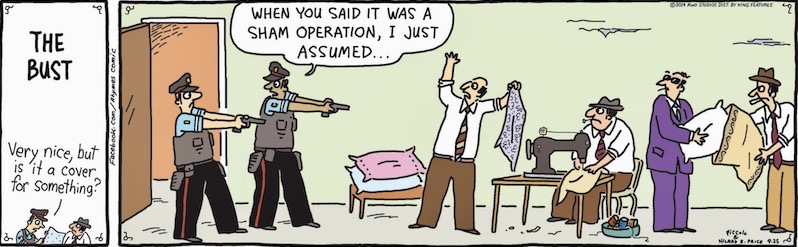
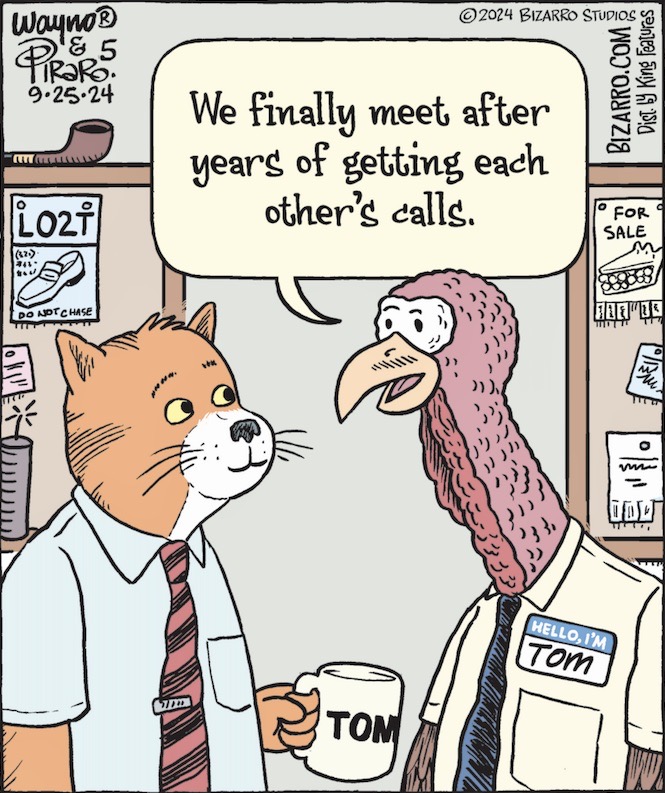
Complex ambiguities in the 9/25 comics: a Piccolo / Price Rhymes With Orange turning on the ambiguity of sham; and a Wayno / Piraro Bizarro turning on the ambiguity of tom:
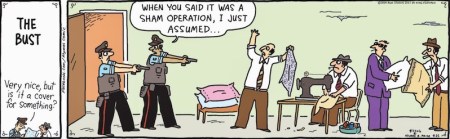
(#1) sham conveying fraud, hence illegality; vs. sham for a decorative pillow cover (being manufactured in a small workshop, though note the suggestion in the title panel that the place might be a cover — ambiguity alert! — in the sense ‘an activity or organization used as a means of concealing an illegal or secret activity’ (NOAD) — but why are these pillow coverings called shams?

(#2) Personified, talking animals: two toms, a tomcat and a tom turkey, presented as characters named Tom, who work for the same company and are encountering one another over coffee, hence Wayno’s title “Breakroom Encounter” (if you’re puzzled by the odd symbols in the cartoon — Dan Piraro says there are 5 in this strip — see this Page)
(more…)
Posted in Abbreviation, Ambiguity, Beheading, Comic conventions, Compounds, Conversion, Furnishings and tools, Language and animals, Linguistics in the comics, Personification, Semantics of compounds | 1 Comment »
September 2, 2024
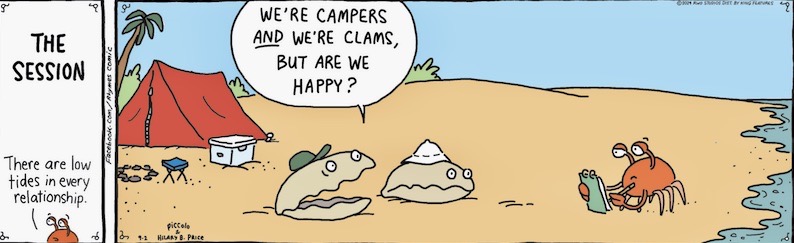
In today’s Piccolo / Price Rhymes With Orange, the clams are tenting tonight on the old campground, but find today’s experience to be unaccountably joyless; for some reason, the formulas just aren’t working:
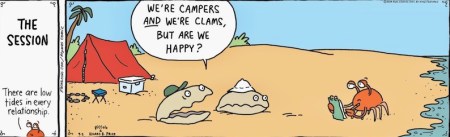
To understand this cartoon, you need to recognize two similarity-based formulaic expressions of English: the metaphor happy camper and the simile happy as a clam; yet neither is overt in the cartoon, though both are alluded to indirectly (we’re campers and we’re clams)
(more…)
Posted in Figures of speech, Idioms, Linguistics in the comics, Metaphor, Simile, Understanding comics | Leave a Comment »