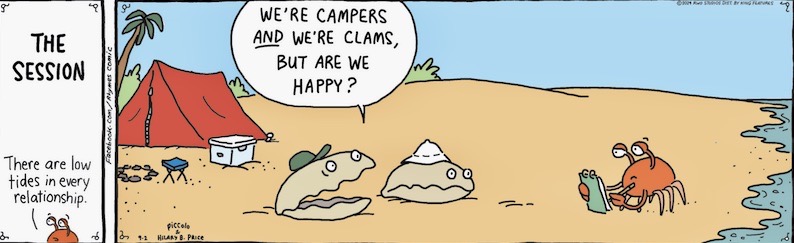
In today’s Piccolo / Price Rhymes With Orange, the clams are tenting tonight on the old campground, but find today’s experience to be unaccountably joyless; for some reason, the formulas just aren’t working:
To understand this cartoon, you need to recognize two similarity-based formulaic expressions of English: the metaphor happy camper and the simile happy as a clam; yet neither is overt in the cartoon, though both are alluded to indirectly (we’re campers and we’re clams)
Note: happy as a clam. My 11/29/18 posting “OBH information” has a section on the formulaic happy as a clam, with a folk etymology, plus the real source (from Michael Quinion’s World Wide Words site), as a truncation of happy as a clam at high tide / water (the short form is venerable, first recorded in 1830 but is certainly older than that).
Note: happy camper. From NOAD:
nominal happy camper: informal a comfortable, contented person: I was making a living mopping floors then and I was not a happy camper | give me a good book, a Caribbean beach, and I’m a happy camper.
OED3 (revised 2013) notes that it is frequent in negative contexts, especially in not a happy camper; its first idiomatic cite (clearly not about actual campers) is from 1957:
‘I simply want to be a happy camper,’ says ‘Pocahontas’ whose real name is Miss Edna Riley (New York Amsterdam News)
The reference is clearly to summer camps for kids, but the details of the idiom’s origin are unclear.
Leave a Reply