Archive for the ‘Ambiguity’ Category

Verbing awry

December 12, 2014

(Warning: sexually explicit language. Not for kids or the modest.)

Passed on by Robert Coren, this message from the South Dakota Office of Highway Safety:
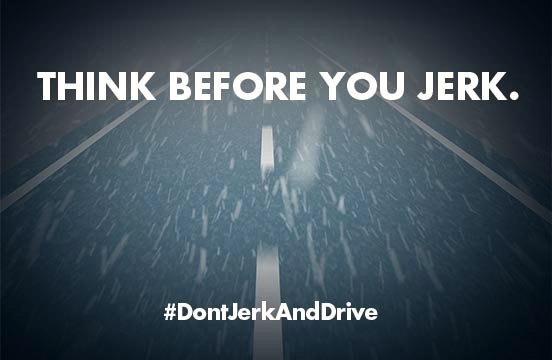
Looks like they were aiming for the verbing jerk ‘be a jerk, be an obnoxious person’, but missed the potential ambiguity with the jerk of the sexual idiom jerk off ‘jack off, masturbate’.

[Correction: it seems I was wrong about the SDOHS’s intentions, though the ambiguity problem remains. Reader isotopeblue writes:

Actually, if you go to http://www.drivesafesd.com/, it appears they’re concerned with jerking the wheel, not verbing the noun “jerk” for an aggressive driver.]

[Further developments: Chris Ambidge on Facebook reports that they’ve pulled the ad.”Officials have admitted that the double entendre was intentional”, with this news report:

public safety campaign in South Dakota backfired when officials heard its “Don’t Jerk and Drive” push and forced them to pull the ad.
Officials admitted the double entendre was intentional, the Sioux Falls Argus-Leader reported in its story.
The campaign was based on raising awareness of jerking the steering wheel on icy roads. But, “jerk” also has other sexual meanings.
Department of Public Safety Secretary Trevor Jones said in a statement that he pulled the ad. “This is an important safety message, and I don’t want this innuendo to distract from our goal to save lives on the road.”

Several readers have noted that the story is a lot less fun if the double entendre was intentional.]

(more…)

Admissions

November 23, 2014

Today’s Bizarro, with a Sunday pun:

A play on the noun admission, whose ambiguity tracks back to the verb admit, with two quite different senses. Then there’s the board game Clue.

(more…)

Green Eggs and Ham

October 22, 2014

From Facebook friends, this use of Dr. Seuss’s Green Eggs and Ham:

(#1)

The Muppets Kermit the Frog and Miss Piggy inquire of the narrator of Green Eggs and Ham about their missing son, who is presumably green (like Kermit) and porcine (like Miss Piggy) and so, ewww, might be the source of that green ham on the platter.

Two things: one, about the source of this cartoon; two, about the children’s book and, especially, about the parsing of green eggs and ham.

(more…)

A youth hostile?

October 19, 2014

Today’s Bizarro:

A pun on the noun hostel vs. the adjective hostile — a perfect pun for those who have /ˈhastl/ (with syllabic l) for both (so that it’s ambiguous), an imperfect pun for those who have this pronunciation for hostel, but have /ˈhaˌstajl/ for hostile.

hedgehogs

September 25, 2014

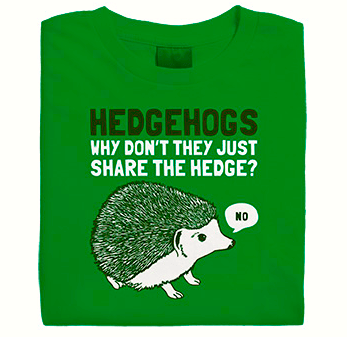
In a sale on the Mental Floss site, this delightful t-shirt:

N + N compounds are notoriously interpretable in many ways, so they lend themselves to (perfect) puns, as here, where two different senses of hedgehog are both at play.

(more…)

Three Saturday cartoons

September 6, 2014

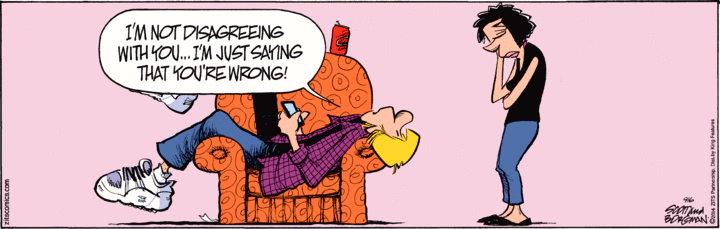
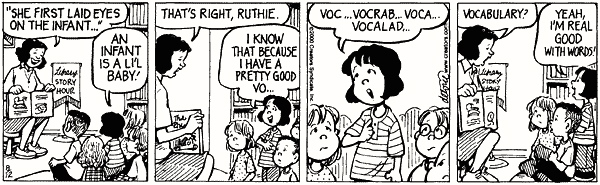
… on language matters, and none of them is a Saturday Morning Breakfast Cereal. A Zits, on disagreement; a Mother Goose and Grimm, with an uncomplicated ambiguity; and a One Big Happy with Ruthie searching for the right word:

(#1)

(#2)

(#3)

(more…)

-ese

August 4, 2014

Today’s Bizarro:

A play on the uses of the suffix -ese.

(more…)

toast

July 29, 2014

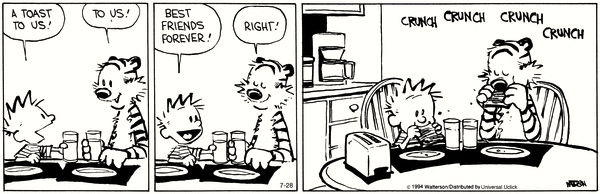
A recently reprinted Calvin and Hobbes:


The strip exploits the ambiguity of toast as a noun (delightfully, to my mind). But, astonishingly, the two nouns (though clearly quite distinct in modern English, as are the corresponding verbs) have a common historical source. The tale is one of those stories that might make you believe in any damn fanciful etymology.

(more…)

Cartoon ambiguities

July 25, 2014

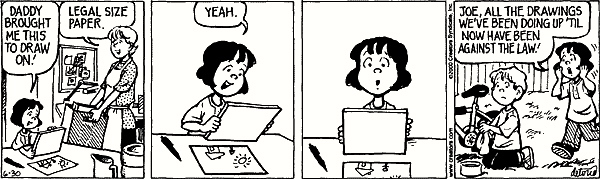
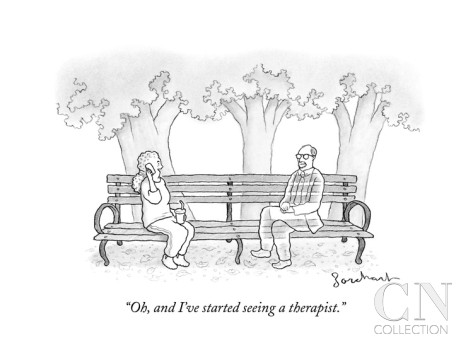
A recent One Big Happy, with Ruthie alarmed by her understanding of legal size (paper); and a David Borchart cartoon from the latest (July 28th) New Yorker that turns on the multiple meanings of the verb see:

(#1) (#2) (more…)

Title or slogan?

June 20, 2014

The Bizarro of 3/20/14, which I seem to have missed when it came up in March, but caught yesterday reproduced in the July issue of Funny Times:


An ambiguity — Miss France as a (NP) title in a beauty pageant vs. Miss France as a VP remnant of a declarative S, conveying ‘I miss France’.  This gross difference in syntax and semantics corresponds to a pragmatic difference, whether the expression is viewed as printed on a sash (as in beauty pageants) or as the equivalent of a t-shirt slogan — very different sociocultural contexts.