Archive for the ‘Ambiguity’ Category

Quiz questions

February 2, 2015

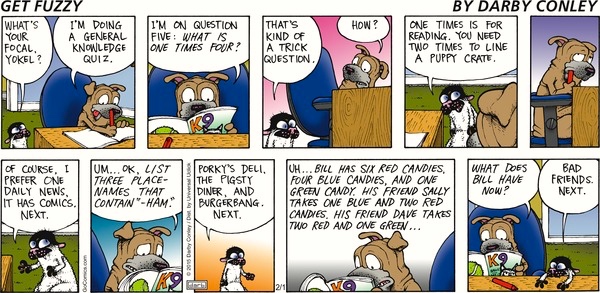
A linguistic Get Fuzzy passed on to me by Jack Hamilton:

Satchel Pooch, taking a general knowledge quiz, is subverted by Bucky Katt.

(more…)

Type names and individual names

January 31, 2015

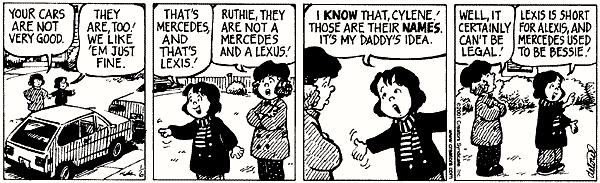
Today’s One Big Happy turns on names of types vs. names of individuals, in the world of cars:

Mercedes and Lexus are the names of types (makes) of cars. But you can easily give individual cars their own “personal” names, as many people do. Nothing illegal about using the same (Mercedes) or similar (Lexus / Lexis) names in the two cases, but yes, potentially misleading. (On the other hand, the type names are count nouns, and occur with determiners — a Mercedes — while the individual names are anarthrous — Mercedes — so the syntax normally disambiguates the senses.)

Finding Jesus

January 25, 2015

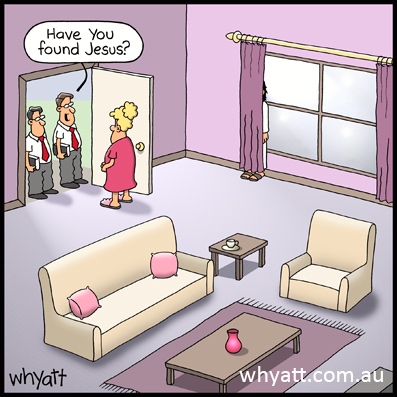
Yet another cartoon — this seems to be Cartoon Weekend — this time another one about proselytizing, following on the Phil Selby “We’d like to talk to you about cheeses” cartoon: a Tim Whyatt strip passed on to me by Michael Covarrubias:

A play on find Jesus: literal find ‘discover (someone or something) after a deliberate search’ (NOAD2) vs. the figurative find Jesus ‘develop a personal relationship with God’.

(more…)

What would you do?

January 25, 2015

Today’s Mother Goose and Grimm:

(#1)

Without a piece of cultural background, this is just a silly story about a polar bear opening a bar in the Klondike. If you have that background, it’s a bit of language play turning on the ambiguity of Klondike bar.

(more…)

Bizarro’s 30th

January 24, 2015

The Comics Kingdom site tells me that the 21st was the 30th anniversary of Bizarro comics by Don Piraro, the first having been published on 1/21/85. Here are two Bizarros with linguistic content that haven’t been blogged on here: one from 12/18/13, one from much earlier, possibly from 3/29/89 (I have trouble reading the data):

(#1)

(#2)

(more…)

Unintended ambiguity

January 23, 2015

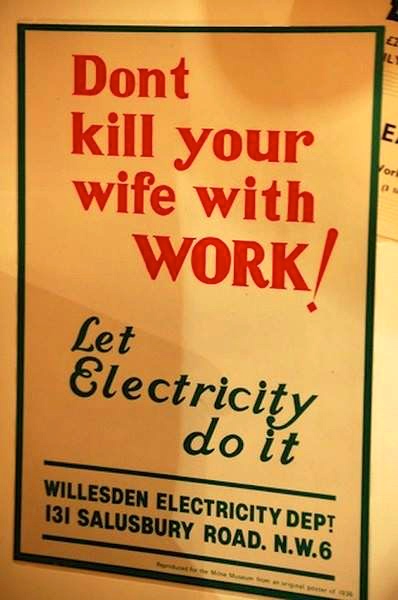
Now appearing on many sites, this vintage (1936) promotional ad for the Willesden Electricity Dept. (in northwest London):

The (presumably) intended reading is that it is anaphoric to work; ‘let electricity do the work’. But do it is a VP anaphor as a whole, so that the reading ‘let electricity kill your wife’ is only too easy to get.

The caption identifies the source as the Milne Museum — the Milne Electrical Collection at the Amberley Museum in West Sussex.

Indian

January 16, 2015

Today’s Bizarro:

A long-standing and often troublesome ambiguity, but rarely an issue in restaurants, since there are few restaurants specializing in Native American cuisine.

(more…)

Scoping

January 6, 2015

In today’s NYT, the headline

AirAsia Jet That Crashed Had Lacked All Clearances to Fly, Regulators Say

This is a classical case of scope ambiguity, involving negation and universal quantification:

in the domain J of jets and C of clearances C for jets to fly, for some specific j ∈ J, the contrast is between

NEG-Q: ¬ (∀x ∈ C)) j(x) — it’s not the case that j has every C; there are clearances that j doesn’t have

and

Q-NEG: (∀x ∈ C) ¬ j(x)  —  for any C, j does not have C; j has no clearance at all

I am strongly inclined to read the headline as Q-NEG, but given context either interpretation is possible.

[Amendment 1/7/14: It’s clear in the story that the intended interpretation of the headline is NEG-Q: there were clearances the jet didn’t have, so it should not have been allowed to take off.]

I’m no semanticist, but it seems clear to me that the choice of lexical items biases the interpretation considerably: lack all tilts things to Q-NEG, not have all to NEG-Q. No doubt there is significant technical literature on the matter, but, as I said, I’m not a semanticist.
Glücklich ist, wer vergisst, was doch nicht zu ändern ist

January 2, 2015

On New Year’s Eve I got to enjoy a classic pleasure of the occasion, listening to a performance (in German) of Johann Strauss’s Die Fledermaus (The Bat). The 1874 operetta offers trickery, disguise, seduction, and waltzes, waltzes, waltzes (on the occasion of a New Year’s Eve ball in Vienna). It’s a standard feature of New Year’s Eve in Vienna (at the Volksoper) — followed on New Year’s Day by a danceful concert by the Vienna Philharmonic — and also in New York City (at the Metropolitan Opera). Delightful.

The title of this posting is a celebrated quote from the operetta, sometimes translated as “Happy is he who forgets what can’t be changed”. (“Happy is the person who forgets what can’t be changed” or “Happy are those who forget what can’t be changed” would eliminate the masculine generic pronoun, and “who forgets the things that can’t be changed” would clarify a subtle ambiguity in “who forgets what can’t be changed” — on the latter point, see below.) (On Facebook, Steve Anderson offers “Fortunate is the one who forgets what cannot be altered”.).

(more…)

Santa jack

December 29, 2014

(This posting has a fair amount of linguistic content, but also pretty much gay sexual content, in sometimes very plain language, plus an image at the edge of X-rated. If such material is offensive to you, or merely unwelcome, please pass on this posting.)

It starts with a bit of language play, turing on an ambiguity in the verb come: between the motion verb (as in Santa Claus came to our house on Wednesday night) and the orgasm verb (as in He came like a fountain).

(more…)