Archive for the ‘Ambiguity’ Category
April 27, 2019
(Mesh Man in his underwear, leading us in many directions, but with plenty of sexual content — not suitable for kids or the sexually modest.)
From the 12th: Mesh Man returns to the Daily Jocks underverse, flogging their fabulous Varsity Mesh Shorts, flaunting his famous receptive organ — he’s all man and a foot deep — kneeling with feeling in #1 and flashing a finger gun to his fans in #2:

(#1) Party shorts! (see the ad below) — I go down on one knee to go down on my guy
(more…)
Posted in Ambiguity, Art, Clichés, Compounds, Gesture, Idioms, Language and religion, Language and sports, Language and the body, Language in advertising, Language of sex, Linguistics in the comics, Metaphor, Movies and tv, Music, Parody, Phallicity, Photography, Signs and symbols, Underwear | 10 Comments »
April 16, 2019
A celebrated example of word breaking or splitting (from the 1959 movie High Society), giving a joke turning on an ambiguity in how the the first part of the split word is to be understood: on its own, giving the off-color She got pinched in the ass; or as merely the first part of the split word, giving the less risqué She got pinched in the Astor Bar (in one or another sense of pinched).
Then I note that the first understanding has the in of body location, the second the in of event location — a distinction I’ve explored in three previous postings. This is the fourth, with some illumination in it, I think.
(more…)
Posted in Ambiguity, Books, Homosexuality, Jokes, Lexical semantics, Movies and tv, Music, Puns | Leave a Comment »
April 8, 2019
The grand old city of Baltimore has been suffering mightily in recent times, and now there’s an old-school scandal to add to the roster of municipal woes. Mayor Catherine Pugh has published a set of “Healthy Holly” children’s books, ostensibly to show kids the way to a better life through exercise and diet. From the Washington Post story “Critical Carlos reads ‘Healthy Holly’: Inside the children’s book that has landed Baltimore’s mayor in a political scandal” by Carlos Lozada on the 5th:

(#1) “Copies of Baltimore Mayor Catherine Pugh’s self-published “Healthy Holly” illustrated paperbacks for children. On April 1 Pugh announced an indefinite leave of absence, just as a scandal intensifies over what critics call a “self-dealing” book-sales arrangement. (Jerry Jackson/The Baltimore Sun via AP)”
There’s the political story, which appears to involve an elaborate influence-trading scheme. There’s the books themselves, which “Critical Carlos” and his three critical children savage in Lozada’s Sun book review as examples of the very worst sort of stilted writing for children. And there’s the title Fruits Come in Colors Like the Rainbow, which, with a stunningly tin ear for English in its various sociocultural contexts, disregards alternative understandings of the noun fruits, the verb come, and the rainbow as a cultural symbol.
I’m mostly after the title here. But it’s all connected.
(more…)
Posted in Ambiguity, Books, Language and politics, Music, Taboo language and slurs | Leave a Comment »
April 5, 2019
Through a chain of people on Facebook, who passed it from one hand to another, this painting (captioned by an unknown wag):
 (#1)
(#1)
Ah, in a different genre of art, a version of this joke that I’ve posted on a couple of times:

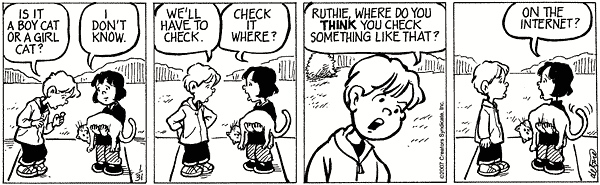
(#2) A One Big Happy strip
(more…)
Posted in Ambiguity, Art, Constituency, Lexical semantics, Linguistics in the comics, Parsing | 5 Comments »
April 1, 2019
From Karen Chung on her (public) Facebook group NTU Phonetics yesterday, this texty cartoon with a pun:
 (#1)
(#1)
The joke turns on the (perceptual) homophony of chants and chance, parallel to the cents / sense and prints / prince cases in my 3/27/19 posting “Two cents, common sense, incense, and peppermints”.
(more…)
Posted in Ambiguity, Language play, Linguistics in the comics, Music, Philosophy, Puns, Understanding comics | 1 Comment »
March 21, 2019
From Karen Chung on Facebook a while back, this complex pun in the 9/25/15 Bizarro, illustrating (among other things) a nice contrast in accentual patterns: front stress (or forestress), the default for N + N compounds, in MOVING sale; back stress (or afterstress), the default in Adj + N nominals, in moving SALE:

(#1) (If you’re puzzled by the odd symbols in the cartoon — Dan Piraro says there are 5 in this strip — see this Page.)
So the hinge of the pun is the ambiguity of moving: as N, (roughly) ‘the act or process of changing residence’; or as Adj, (roughly) ‘causing strong emotion, esp. of sadness’ (both senses are ultimately semantic developments from the simple motion verb move, intransitive or transitive; but they are now clearly distinct lexical items). Then from the difference in syntactic category follows the difference in accentual pattern.
(more…)
Posted in Ambiguity, Common vs. proper, Compounds, Derivation, Linguistics in the comics, Movies and tv, Names, Phonology, Pop culture, Semantics, Syntactic categories, Variation | 3 Comments »
March 4, 2019
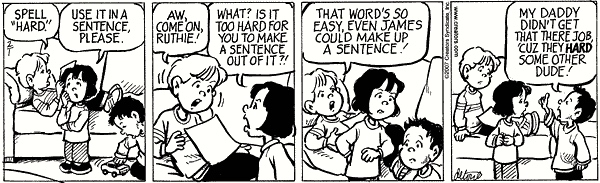
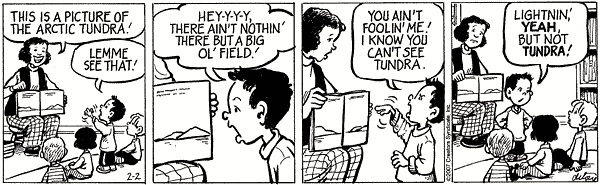
Adventures in cross-dialect understanding in the One Big Happy strips of 2/1 and 2/2, both featuring Ruthie and Joe’s playmate James:
 (#1)
(#1)
 (#2)
(#2)
(more…)
Posted in Ambiguity, Dialects, Errors, Humor, Linguistics in the comics, Perception, Phonetics, Phonology, Pop culture, Usage attitudes, Variation | 1 Comment »
February 17, 2019
Yesterday’s Wayno & Piraro Bizarro:

(#1) (If you’re puzzled by the odd symbols in the cartoon — Dan Piraro says there are 3 in this strip — see this Page.)
A play on desserts (on the menu) vs. the deserts of just deserts. Plus a small cascade of idioms on oral humiliations. With a nod to the nasty rough edges of the verb eat (and, while we’re on the subject, suck). (Eventually, this will lead to some very plain-language talk — not for kids or the sexually modest — about some social and sexual practices among gay men. I’ll warn you when the topic is imminent.)
(more…)
Posted in Ambiguity, Figurative language, Gender and sexuality, Homosexuality, Idioms, Language of sex, Linguistics in the comics, Metaphor, Parody, Puns | Leave a Comment »