Archive for the ‘Ambiguity’ Category
September 1, 2019
In recent tweets from Hong Kong about protests and the governments attempts to put them down, New York Times columnist Nick Kristof repeatedly writes water canon instead of water cannon (both with /kǽnǝn/) — not an uncommon sort of spelling error, but somewhat surprising from an experienced journalist, and one that introduces an unintended misinterpretation, since it happens that CANON is the spelling of an English word (a number of different English words, in fact) distinct from CANNON. And that opens things up for little jokes about what a water canon might be. On Facebook I was responsible for one such joke, a bit of musical foolishness:
The reference is of course to the round “By the Waters of Babylon”. Though I doubt it’s effective against throngs of protesters.
(more…)
Posted in Ambiguity, Art, Errors, Music, Spelling | 4 Comments »
August 31, 2019
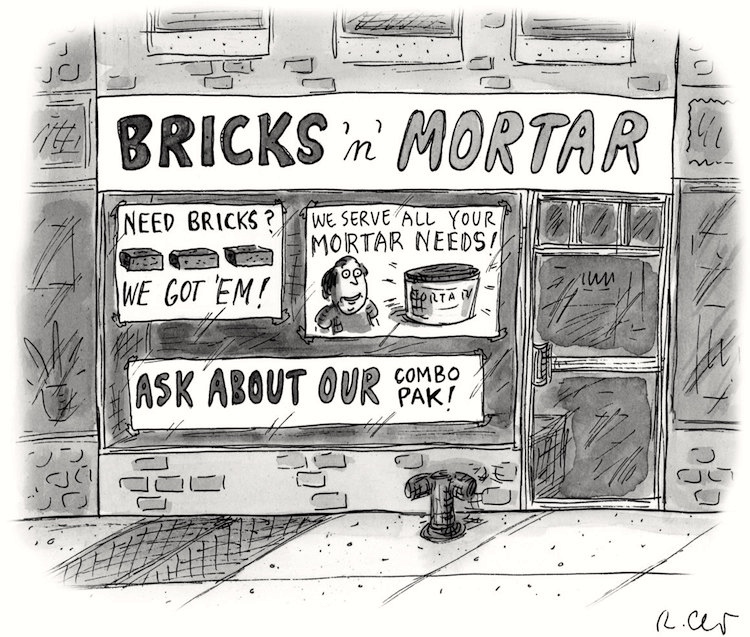
Roz Chast in the September 2nd New Yorker:
 (#1)
(#1)
An exercise in the semantics of N + N compounds, exploiting an ambiguity that might not have occurred to you:
in the semantics of the modifying N, N1 (here, the coordinate N bricks and mortar);
in the semantics of the head N, N2 (here, the understood N store);
and in the semantics of the relation between N2 and N1 (here, ‘N2 for N1, (specifically) N2 selling N1’, in this case ‘store selling bricks and mortar — rather than the ‘N2 (made) of/from N1’ relation in the familiar conventionalized compound brick(s) and mortar store ‘store (made) of/from bricks and mortar’.
(more…)
Posted in Ambiguity, Compounds, Figurative language, Linguistics in the comics, Metaphor, Metonymy, Semantics of compounds, Subsectivity | 1 Comment »
July 24, 2019
In a recent comics feed, the 6/27 One Big Happy, with an exchange between Grandma Rose and the grotesquely smiling Avis
 (#1)
(#1)
In panel 2, the baggage of emotional baggage is a conventional metaphor, one no longer requiring the hearer to work out the effect of the figure and so now listed in dictionaries. But then Rose immediately brings it back from dormancy to life in a long riff of creative metaphor (in panels 2-4), composed on the spot and calling up a complex and vivid scene for the hearer.
We use the same term, metaphor, for both phenomena, and the mechanism is the same in both — but one is a historical phenomenon (whose figural character is usually out of the consciousness of speaker and hearer), while the other is a phenomenon of discourse production and comprehension in real time.
(more…)
Posted in Ambiguity, Figurative language, German, Language and the body, Linguistics in the comics, Metaphor, Puns, Spanish | 3 Comments »
July 15, 2019
Although, or perhaps because, I live in one of the world’s avocado toast hot spots, I’d hoped to avoid posting on the silly fad for avotoast, but then this Mother Goose and Grimm cartoon — with its pun on toast — appeared in my comics feed:

(#1) Up off the counter and onto the table
Three things: avocados, toast, and avocado toast.
(more…)
Posted in Ambiguity, Child language, Culture, Language and food, Linguistics in the comics, Puns | Leave a Comment »
July 12, 2019
Friday’s Wayno/Piraro collabo Bizarro strip (titled “Shaving Cream Pie”):

(#1) (If you’re puzzled by the odd symbols in the cartoon — Dan Piraro says there are 3 in this strip — see this Page.)
Ordinary barbers use shaving cream; clown barbers use cream pies. It’s just like spas: ordinary spas use facial creams (for moisturizing); clown spas use cream pies.
Bonus: the cartoon shows a clown barber twice over: a barber who is a clown, and also a barber for clowns.
(more…)
Posted in Ambiguity, Brevity vs. Clarity, Comic conventions, Compounds, Language play, Lexical semantics, Linguistics in the comics, Metaphor, Morphology, Semantics of compounds | Leave a Comment »
June 26, 2019
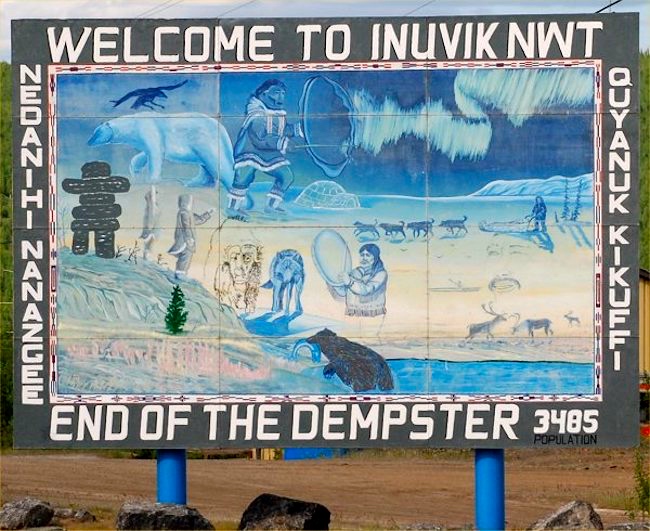
From the northern edge of the world, specifically: the town of Inuvik NWT in Canada, from which a postcard showing this welcoming billboard:
 (#1)
(#1)
The card was from Chris Waigl (bought in Dawson City YT), who mailed it from the extremely small town of Chicken AK.
And now there’s a surprising lot of stuff to say about the card.
(more…)
Posted in Ambiguity, Books, Common vs. proper, Metaphor, Movies and tv, Names, Semantics, Technical and ordinary language | 1 Comment »
May 21, 2019
A facebook exchange back on the 6th, between Andrew Carnie (professor of linguistics and dean of the Graduate College at the Univ. of Arizona) and Karen Chung (associate professor at National Taiwan University, teaching courses on linguistics and English).
Andrew: [Student], who only came to class less than 50% of the time, and turned in a bunch of assignments (really) late: These homeworks are way. too. hard. It’s unfair.
Karen: “Homework” as a countable noun? Is he/she a native speaker of English?
Academics will recognize Andrew’s note as the plangent lament of a professor facing the grading tasks at the end of a term, confronted with a self-entitled student who believes they are really smart, so preparation outside of class shouldn’t take much work (and they should be able to ace the final without much studying).
But what Karen picks up on is the use the noun homework as a C(ount) noun, clearly so because it occurs in the plural form homeworks here; for the M(ass) noun homework, the usage would be: This homework is way. too. hard. Or else: These homework assignments are way. too. hard.
Much as I sympathize deeply with Andrew’s lament — having had nearly 50 years of similar experiences (fortunately far outweighed by students who were a delight to teach) — what this posting is about is the C/M thing. There’s a fair amount to get clear about first, and then I’ll have some analysis, some data, and some reflections on larger matters (language use in particular communities of practice, the tension between brevity and clarity as factors in language use).
(more…)
Posted in Ambiguity, Beheading, Brevity vs. Clarity, Count & mass, Lexical semantics, Semantics, Social life, Usage | Leave a Comment »
May 18, 2019
(OPAs, for short.) The contrast is to inconspicuously playful allusions, what I’ve called Easter egg quotations on this blog. With three OPAs from the 4/20/19 Economist, illustrating three levels of closeness between the content of the OPA and the topic of the article: no substantive relationship between the two (the Nock, Nock case), tangential relationship (the Sunset brouhaha case), and tight relationship (the defecate in the woods case).
The three cases also illustrate three degrees of paronomasia: the Nock, Nock case involves a (phonologically) perfect pun; the Sunset brouhaha case an imperfect pun; and the defecate in the woods case no pun at all, but whole-word substitutions.
I’ll start in the middle, with Sunset brouhaha. But first, some background. Which will incorporate flaming saganaki; be prepared.
(more…)
Posted in Acronyms, Allusion, Ambiguity, Idioms, Implicature, Jokes, Language and animals, Language and food, Language play, Metaphor, Metonymy, Movies and tv, Names, Pragmatics, Puns, Quotation, Sarcasm and irony, Semantics, Speech acts | 3 Comments »