Archive for May, 2015

Conjunction or preposition?

May 21, 2015

In the NYT yesterday, p. 19, in “Happy Rockefeller, 88, Whose Marriage to Governor Scandalized Voters, Dies” by Robert D. McFadden:

many Americans were shocked when Margaretta Fitler Murphy, called Happy, and Mr. Rockefeller, who was nearly 18 years older than she, married on May 4, 1963.

The point is than she, with a nominative pronoun in construction with than — where many people (I am one) would have used the accusative her. There’s a long-standing issue in usage here, which I’ve posted about on this blog (as “Dinosaur grammar”), in connection with a Dinosaur Comics.

(more…)

Inspirational words

May 21, 2015

(A Dilbert, to introduce a recently-finished inventory of Dilbert postings about language matters on Language Log and this blog, here on this blog.)

Yesterday’s Dilbert, in which Dogbert offers a (not very encouraging) inspirational, motivational saying to Dilbert:

  (#1)

This particular aphorism is a quote (“In the long run, we are all dead”) — from John Maynard Keynes in 1923.

(more…)

Morning harmony

May 20, 2015

Yesterday’s morning name was L’Estro Armonico:

L’Estro Armonico (Harmonic Inspiration), Op. 3, is a collection of twelve concertos for one, two and four violins written by Antonio Vivaldi in 1711. It augmented the reputation of Vivaldi as Il Prete Rosso (The Red Priest) [so called because of the color of his hair, a family trait; Vivaldi was ordained as a priest at the age of 25]. Vivaldi scholar Michael Talbot described the set as “perhaps the most influential collection of instrumental music to appear during the whole of the eighteenth century”. (Wikipedia link)

On YouTube, a recording of Concerto #06 in A minor for solo violin, strings and basso continuo, RV 356:

Fig time

May 20, 2015

A couple days ago I caught a snippet of a discussion on KQED-FM about overwintering fig plants. Why people were discussing the topic as we near the beginning of summer I don’t know, but there it was. I’m not caring for any fig plants here in Palo Alto, but back when I lived in Columbus OH most of the year I had two: a Ficus benjamina, a very common house plant in temperate climates; and a Ficus carica, the plant the people on the radio were talking about (an ornamental and the source of the figs we eat), which I grew in Columbus as a potted plant, to serve as a reminder of California.

Now some figgy reflections, starting with some Ficus plants and then wandering on to other fig-related matters: the fig leaf of modesty, figgy pudding, Fig Newtons, and the negative polarity item care/give a fig.

(more…)

Intervention

May 19, 2015

Part 1:  Back in my posting on “Words to eliminate”, I looked at a site that proposed to get you to improve your writing by eliminating 15 words from it. (Yes, a silly idea.) One of these was that:

[Mashable advice] It’s superfluous most of the time. Open any document you’ve got drafted on your desktop, and find a sentence with “that” in it. Read it out loud. Now read it again without “that.” If the sentence works without it, delete it.

The idea is fraught with problems, most turning on the fact that there are several distinct lexical items that, with a large number of uses, and with distinct syntax, discourse functions, and sociolinguistic statuses for each use.

Part 2: On one of these items, the complementizer that, and its use to mark the object complement of a verb, as in

They know (that) pigs can’t fly.

(where the that variant and the ∅ variant are both fine).

But then I started an e-mail to a friend:

 I do wish people would credit sources.

(with the ∅ variant; the that variant is also possible) and thought to link to previous context with a though — but then the ∅ variant struck me as very awkward indeed:

?? I do wish, though, people would credit sources.

though the that variant is fine:

 I do wish, though, that people would credit sources.

What’s crucial is that material intervenes between the complement-taking verb and the complement. It turns out that this intervention effect is well-known in the variation literature.

(more…)

Ten-foot …

May 19, 2015

Today’s Mother Goose and Grimm:

A pun — a phonologically perfect pun on pole / Pole — that works here only because the text in the strip is all uppercase, so that the orthographic distinction between the two items vanishes.

so (that)

May 19, 2015

A sideline in an investigation of “optional that“– that is, variation between that and ∅ — that I’ll post more on in a little while: so that vs. so as conjunctions. I have a bit of personal history with this variation.

(more…)

Jury of English majors

May 18, 2015

Via Gregory Ward, a Mark Parisi cartoon from 5/19/09 showing a man in a witness box protesting “I didn’t do nuthin’!”, with the jury all thinking “Ooo! A confession!” — a jury of English majors, as the caption says.

In the popular imagination, English majors are so committed to the idea of grammatical correctness that they are unable to understand non-standard varieties.

(more…)

Reading out loud

May 18, 2015

In yesterday’s NYT Book Review, a set of reviews of audiobooks, including one by by Kathryn Harrison of Jo Nesbo’s Blood on Snow as read by Patti Smith. Harrison sees a mismatch between the novel’s protagonist Olav as she understands him and Olav in Smith’s speech style (which Harrison refers to as diction).

(more…)

Don’t shade your eyes

May 18, 2015

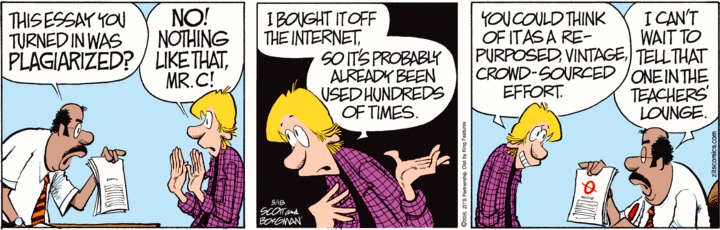
Today’s Zits:

Has Jeremy been involved in “the practice of taking someone else’s work or ideas and passing them off as one’s own” (NOAD2)? Well, he’s certainly passed off as his own work something that was not. His defense appears to be that there is no person whose work this was; he wasn’t stealing from anyone. A bold move, but one that’s not flying with his teacher.

(more…)