Yesterday, a posting on “California’s iconic food”, the avocado, in which I noted that California in the name of a food preparation usually conveys the presence of avocado in it: California salads, California burgers, California (sushi) rolls, California club sandwiches. Then, after posting this, I went to breakfast at the Peninsula Creamery with my daughter, only to discover that their breakfast special for the day was California eggs (with, of course, avocado).
Archive for May, 2015
More California food
May 24, 2015The giant glass slipper
May 24, 2015Today’s Bizarro:

Portmanteau of Godzilla and Cinderella.
(If you’re puzzled by the odd symbols in the cartoon — Dan Piraro says there are 5 in this strip — see this Page.)
xx
The New Yorker on subsectivity
May 23, 2015Michael Maslin in the latest (May 25th) New Yorker:
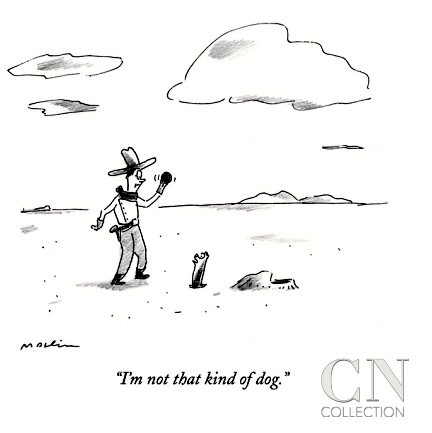 (#1)
(#1)
(You need to recognize from the setting that the creature the cowboy is faced with is a so-called prairie dog — not any kind of dog, but instead a kind of ground squirrel.)
The echo of “I’m not that kind of girl” adds to the humor.
Cavemen at the dawn of writing
May 23, 2015Today’s Bizarro:

Self-reflective cavemen, with a keen sense of lexical semantics in English. Most people use the word prehistoric in a sense NOAD2 labels “informal”:
very old, primitive, or out of date: my dad’s electric typewriter was a prehistoric machine
But the cavemen understand it in its technical (and etymological) sense:
of, relating to, or denoting the period before written records: prehistoric man
(If you’re puzzled by the odd symbols in the cartoon — Don Piraro says there are 2 in this strip — see this Page.)
But wait!
May 23, 2015(This would be an occasion to announce that an inventory of Mother Goose and Grimm postings, on Language Log and this blog, is now available as a Page “MGG cartoons” on this blog.)
Today’s Mother Goose and Grimm:
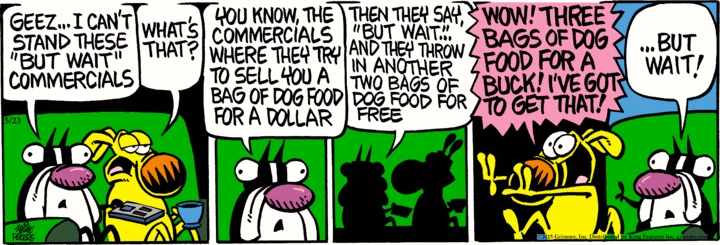
Grimmy is lured by the tv commercials. From my “Pitchmen” posting of 2009:
The Atlantic City “boardwalk product pitch” plays a big role in the development of the television infomercial, from its beginnings with Ed Valenti and his business partner (Ginsu knives, “But wait! There’s more!”, and “Call now!”, among other things)
California’s iconic food
May 23, 2015In the NYT yesterday, a feature story on agriculture’s contribution to the California drought. The teaser on the front page:
How We Drain California
Each week, the average American consumes more than 300 gallons of California water by eating food that was produced there. To fundamentally alter how much water the drought-ravaged state uses, everyone may have to give something up. A guide to thirsty foods, like the avocado.
Illustration: a slim sliver of avocado, with the caption:
The average American eats a sliver of California avocado each week. It takes 4.1 gallons of water to produce.
Alas, the avocado is California’s iconic food. Avocados would be a considerable sacrifice for Californians, and everybody, Californian or otherwise, would have to give up guacamole, even on Super Bowl Sunday.
That time again
May 22, 2015Time for Stanford to appoint me as a Consulting Professor of Linguistics for the coming academic year, so I’ve been asked to supply an updated c.v. This is a requirement that comes down from the School of Humanities and Sciences, which actually makes the appointment. But somewhere along the line, my department is involved.
Now, my c.v. is gigantic (I’ve been a university professor since 1965, after all.), but I passed it along. But, thinking that my colleagues might be concerned about what I’ve doing recently, I added a side note:
for some years, my scholarly work has been conveyed almost entirely on-line, through Language Log (since 2002), my own blog (since 2008), and the American Dialect Society mailing list. I’ve posted about 10,000 times in these places (over 5,000 in my blog alone); this work is sometimes technical, but often it’s essentially educational, making linguistic topics available to a wide audience (my blog is viewed 1000 to 1500 times a day). Some of the topics covered on a regular basis:
language play; language in the comics; the language of sex and sexuality; the language of food; grammar, style, and usage; several types of anaphora (Verb Phrase Ellipsis, so-called “dangling modifiers”, anaphoric islands); morphology (especially synthetiic compounds, back-formation, and what I’ve called “libfixes”); and some semantic/pragmatic topics (e.g., negative polarity items and implicature).
I’m hoping this will be acceptable.
Or what?
May 22, 2015A Meg Biddle cartoon in the June 2015 Funny Times:
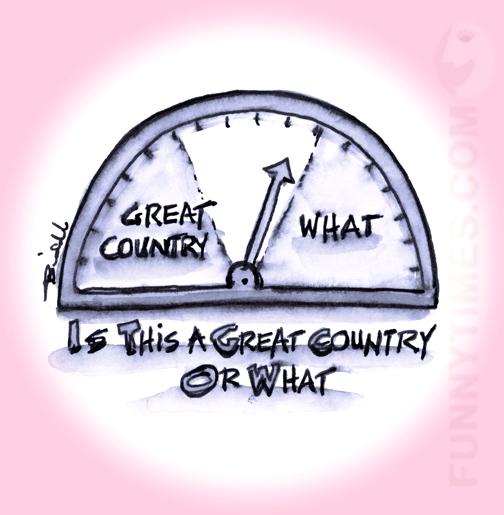 (#1)
(#1)
Yes-no questions with the tag or what? are regularly used to emphatically assert the truth of the questioned proposition. So
Is this a great country, or what?
has the effect of proclaiming that this is indeed a great country. But the question has at least one other reading, merely asking for an alternative answer to Is this a great country?, and that’s the reading Biddle is playing with in the cartoon.
A panderthon
May 22, 2015The cover of the June 2015 Funny Times, by Matt Wuerker:
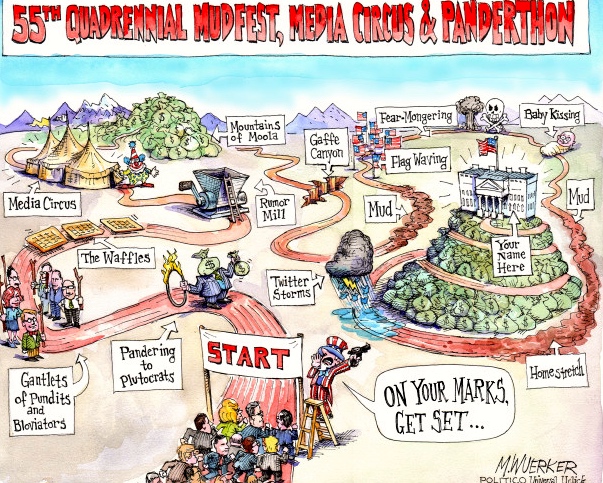
What caught my eye was panderthon, (roughly) ‘an interminable occasion of pandering’, with the libfix -(a)thon. The word is especially associated with political pandering, as here.
The literalist
May 21, 2015Today’s Mother Goose and Grimm, with a literalist Ralph coping with Grimm’s could care less:
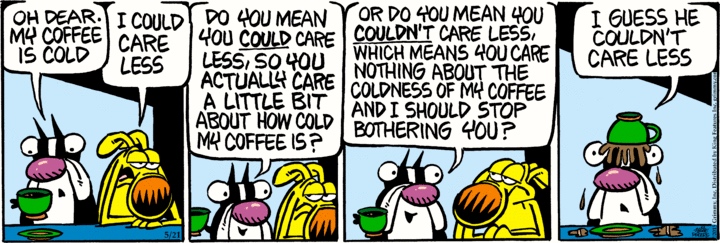
could care less has been a perennial topic on Language Log and this blog. But in all the discussion among linguists and psycholinguists no one disputes that there’s an idiom here, and it has a negative element of meaning that is not overt. Ralph the literalist essentially denies this, implicitly taking the position that if Grimmy meant he couldn’t care less he should have said that.