Archive for May, 2013

Briefly noted: mind-bottling

May 18, 2013

Just went past me on KFJC (Foothill College in Los Altos Hills CA), in an aural montage, this exchange from the 2007 movie Blades of Glory:

Chazz: Mind-bottling, isn’t it?

Jimmy: Did you just say mind-bottling?

Chazz: Yeah, mind-bottling. You know, when things are so crazy it gets your thoughts all trapped, like in a bottle? (link)

A lovely eggcorn for mind-boggling (noted on the Eggcorn Forum, but not yet in the database), complete with the mark of a great eggcorn find, the speaker’s rationalization for the form they use.

(more…)

Idiomaticity

May 18, 2013

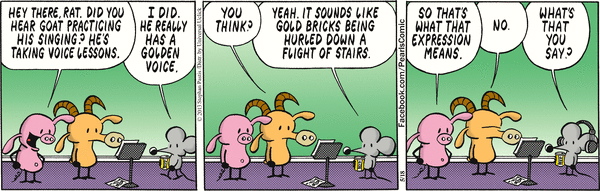
Today’s Pearls Before Swine:

The idiom golden throat ‘a widely admired singing or speaking voice’ is both metonymic (throat for ‘voice’) and metaphorical (golden ‘like gold in value’), but it’s complex enough that someone could not see that. Rat, of course, just turns things to his own ends.

(more…)

More shaker phallicity

May 18, 2013

(Mostly on artifactual phallicity.)

From Steven Levine on Facebook, found on eBay, a pair of

DEPRESSION GLASS SALT & PEPPER SHAKERS-PINK GLASS WITH PLASTIC TOP

  (#1)

Steven’s comment:

It must have been a more innocent era. These are described as “a peachy shade of pink”. Um, yeah sure.

(more…)

Vocabulary surprises

May 17, 2013

For some purposes, you can function fairly well with material in another language, so long as the topic stays within domains that are familiar to you — like linguistics, say. But when you wander into other domains, especially those that are closely tied to sociocultural conventions, things get messy, even if you stick to nouns; there’s just so much to know about cultural artifacts and customs, for example, and a huge vocabulary to acquire in these areas, in the names of animals and plants, etc.

I can deal pretty well with technical material in French, for example, but I’m easily stumped when it comes to artifacts, animals, plants, and the like. By way of illustration: my daughter gave me a big box of postcards on The Art of Instruction, with images of school materials from the 1950s, from mostly French but also some German sources. The German items have no text, but the French material (from Éditions Rossignol — the name is great; rossignol means ‘nightingale’) is heavy with text. For animals and plants, much of the vocabulary is technical teminology from zoology, anatomy, or botany, and that’s fascinating, but I can’t be expected to know these expressions. However, there are also the common names for animals and plants, and they contain many surprises.

That brings me to the tadpole.

(more…)
Demonyms

May 17, 2013

In the letters section of the May 20th New Yorker, this piece:

NEW YORKIANS

In “Draft No. 4,” [April 29th], John McPhee writes that a copy editor sometimes provides a writer with a word like “a rare gold coin.” He recalls how Mary Norris, copy editing one of his pieces, suggested “Mancunians” for “Manchestrians.” McPhee goes on to rank it on a selective list of names for residents of specific locales. Readers wrote in with their own demonyms:

(more…)

Philip Taaffe

May 17, 2013

(About art rather than language.)

Andrea K. Scott, “Critic’s Notebook: Imaging Systems”, in the May 20th New Yorker:

Remember beauty? For a refresher course, visit Philip Taaffe’s new show – a dozen kaleidoscopic big paintings and a wall of sixteen black prints – his first at the Luhring Augustine gallery, to which he decamped from the international supermarket chain that is Gagosian. Taaffe, fifty-eight, has spent years honing his unique approach, applying sourced imagery to canvas with stencils, rollers, and stamps. The results are pictorial conflations of organism and ornament that suggest the botanical studies of Karl Blossfeldt tiled at the Alhambra or Ernst Haeckel’s “Art Forms in Nature” inlaid at the Taj Mahal. Not every new canvas here thrills, but taking in the wheeling symmetries of “Illuminated Constellation” feels like chanting ecstatically with your eyeballs. Taaffe’s paintings are analogue all the way, but his fascination with layers, his nonhierarchical spirit – he’s as influenced ny the biomorphic patterns of sea kelp as he is by Mark Rothko’s Surrealism – and his restless circulation of images should make him a hero to the digitally minded young artists of the twenty-first century.

(more…)

Another OBH roundup

May 16, 2013

From Benita Bendon Campbell, three more One Big Happy strips: on questions, compound nouns, and tense in nouns. And then, as a bonus, four strips on Ruthie’s interpretations of words.

(more…)

Paul Sietsema

May 16, 2013

(About art rather than language.)

In the mail recently, a flyer for an exhibition at the Wexner Center for the Arts at Ohio State, featuring work by Paul Sietsema. In particular, this fascinating reflection on painting (in several senses):

  (#1)

Sietsema was new to me, but he bears looking into.

(more…)

Manwich and Beefaroni as portmanteaus

May 16, 2013

My “Grocery store semiotics” posting looked briefly at two canned-food preparations: Manwich and Beefaroni. Manwich: “a canned sloppy joe sauce … The can contains seasoned tomato sauce that is added to cooked ground beef in a skillet” to yield a filling for hamburger buns. And Beefaroni: “pasta with beef in tomato sauce”, essentially a ground beef casserole in a can. Both names are portmanteaus, and both are somewhat opaque in their meaning.

(more…)

Morphology for swine

May 16, 2013

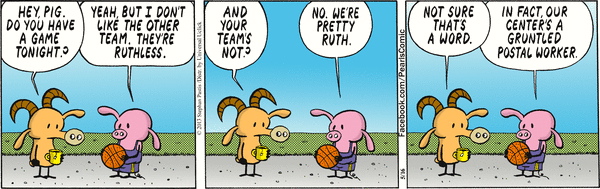
Today’s Pearls Before Swine:

Pig indulges in resurrecting “lost positives” (ruth from ruthless, gruntled from disgruntled) — there’s a site on which people nominate lost positives, often quite fancifully — but gets the morphological structure of ruthless wrong.

(more…)