Archive for January, 2013

cowtailing

January 28, 2013

Early this month, some discussion on ADS-L about cow-tailing / cowtailing, set off by Jon Lighter’s quoting from the Wordnik entry on cow-tail, which has plenty of examples of references to cow’s tails and things resembling them, but also this quote from Talking Points Memo:

This Republican is convinced that Barack Obama represents the very best option for this country if for no other reason it is because he refuses to cow-tail to the antics of the DNC.

That’s cow-tail for kowtow, pretty clearly an eggcorn — a reanalysis of the expression that finds two familiar parts in it, though what kowtowing has to do with cow’s tails is entirely unclear.

Four things: some irrelevancies to get out of the way; more eggcornish examples of cowtail; earlier blog discussion of the variant cow-tow; and the developing semantics of kowtow.
(more…)

Annals of phallicity: the breadstuffs

January 28, 2013

I should have realized when I posted about baguette — surprise! no foodie bague! — that there would be all sorts of stuff about baguettes as phallic objects. And there are. Carrots, corncobs, cucumbers, sausages, celery, whatever, and of course long thin crusty rolls of bread, they’re all cocks you can eat. (As someone who finds men’s cocks to be genuine objects of desire, I find all of this enormously amusing.)

Which brings me to a playful set of pastry penises on the website Expat Postcards: Miss K’s Random Guide to Here and There of 1/5/12:

(more…)

boys

January 27, 2013

Back on December 31st, I posted on male photographer David Arnot and his Boy Next Door calendars (for 2012 and 2013), with a full set of the images from the 2012 calendar. On Facebook, Michael Newman then inquired:

On a language point, doesn’t “boys next door,” imply a kind of (pseudo)unposed twinkish look? If so, these guys may be hot, but not in a boy-next-door way.

Michael is both a card-carrying linguist and a gay man, so brings two kinds of inside information to the discussion, both relevant, and, in this case, his critique is right on. These  guys might or might not be hot — that’s a matter of taste — but they’re not boys next door, in modern American English, at any rate

(more…)

Antonio Frasconi

January 27, 2013

(About art, not language.)

NYT death notice (by Douglas Martin) for Antonio Frasconi (in print in the Art & Design section on the 22nd, in the general obits yesterday):

Antonio Frasconi, Woodcut Master, Dies at 93

In 1953, Time magazine called Antonio Frasconi America’s foremost practitioner of the ancient art of the woodcut. Four decades later, Art Journal called him the best of his generation.

Mr. Frasconi did not reach this pinnacle by adhering to orthodoxies. He found inspiration in comic books as well as the old masters. He decried art education, saying the average student does not learn the pertinent questions, much less the answers. He abhorred art that dwelt on aesthetics at the expense of social problems. He repeatedly addressed war, racism and poverty, and devoted a decade to completing a series of woodcut portraits of people who were tortured and killed under a rightist military dictatorship in his home country, Uruguay, from 1973 to 1985.

(more…)

baguette

January 27, 2013

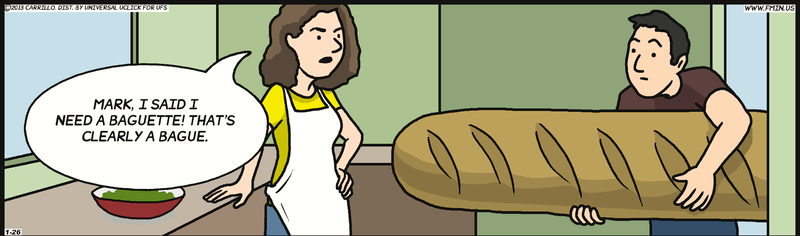
Yesterday’s F Minus cartoon, sent to me by Jan Freeman:

The food name baguette, in English and French, looks like a straightforward diminutive, derived from a base bague, which would then refer to a larger form of French bread (as in the cartoon). But in fact there’s no French food name bague (and so no English one either). English got foodie baguette from French, yes, but its history in French involved no base bague.

(more…)

Reinventing NYC

January 26, 2013

(More art/cartoons.)

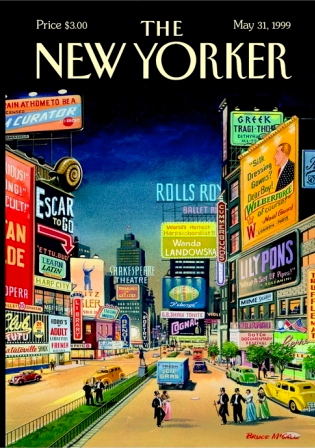
In a set of postcards of New Yorker covers, this wonderful reinvention by Bruce McCall of Times Square (“Lost Times Square”, 5/31/99):

  (#1)

Learn Latin!

(more…)

Ocho Loco Press

January 26, 2013

(About art, not much about language.)

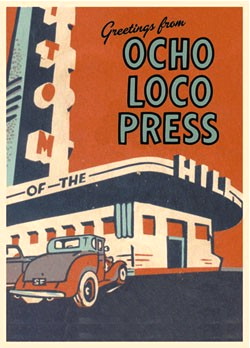
This morning I passed on to my grand-daughter a nice wooden box with this image on its cover:

Opal translated the name of the press as ‘Eight Crazy Press’ (but without enlightenment, and I still don’t know the source of the name), and she worked out that the image was an ad for a place called Bottom of the Hill (which I recognized as a famous San Francisco music venue and bar). Turns out the whole business is a San Francisco thing.

(more…)

Define “living room”

January 25, 2013

(About my life, but with a linguistic hook.)

Back on December 30th I recovered my living room. For four months, my (nominal) living room had functioned as my bedroom: I slept, sitting up, in a chair (a recliner), and the coffee table next to it served as my bedside table, covered with all the things that would normally have been kept in my bedroom; meanwhile, my (nominal) bedroom served as a kind of storage room for stuff that had to be moved out of the rest of the house (to accommodate the family and friends who were helping to care for me).

Though there were places for a few people to sit in the room I was sleeping in, the function of the room was clear to visitors, who were a bit disconcerted by the arrangement. (By the way, for a considerable part of this time I was living in my bathrobe, or just a t-shirt and sweatpants, which functioned like pajamas, so I looked a lot like a man in his bedroom, whichever room I was in.) I’ll go through some of the history in another posting, but my immediate interest here is how to talk about these things. What goes along with the labels living room and bedroom?

(more…)

Bruce Weber

January 25, 2013

(About photography rather than language.)

On AZBlogX, a posting about photographer Bruce Weber, the man who (among other things) made homoeroticism a central feature of men’s clothing ads. It’s on my X Blog because three of the six images there (from Weber’s book of male photography Bear Pond) show full frontal nudity.

The other three are of hot male models in their underwear.


Watersports

January 24, 2013

(Not about language.)

On AZBlogX, three substantial postings on gay watersports (the sexual fetish, not the athletic competitions). These postings look at the Gayland (fantasy) version of these practices and also at the real-life practices (the roles, routines, and rituals that organize this sexual subculture). The first prong is a kind of literary analysis, of the sort I’ve used in talking about Gayland in other postings; the second is a kind of anthropological analysis, of the sort I’ve used in talking about the customs and practices of the (real-life) gay baths in other postings.

(more…)