I recently bought a new hairbrush, which came labeled
BOAR BRISTLE
A wonderful compound, bristling with /b/s and growling with /r/s. I might be a linguist, but like everybody, I have my moments of sheer word appreciation, and I savor boar bristle.
I recently bought a new hairbrush, which came labeled
BOAR BRISTLE
A wonderful compound, bristling with /b/s and growling with /r/s. I might be a linguist, but like everybody, I have my moments of sheer word appreciation, and I savor boar bristle.
After seeing myself cited repeatedly as the source of
Zwicky’s Law, which states categorically that “The more irrelevant garbage you put into a sentence, the better it sounds.”
I pondered. This is from this source, but all the cites go back to John Lawler. The sentiment is one I’ve expressed several times (in connection with grammaticality judgments on specific sentences), though not in fact categorically, and usually light-heartedly, but I didn’t recognize this wording, and couldn’t find the source. So I wrote John to pin the thing down. Turns out it’s Linguists’ Lore.
Two recent postings on my X Blog: “Snarky fashion” (with four vintage men’s fashion ads, amended by sexual dialogue between the men in them) and “More Falcons at Fallingwater” (with two more postcards of Falcon Studio pornstars, Karl Tenner and Colby Taylor, amended by decorative designs by Frank Lloyd Wright, completing a series begun earlier in January).
These Falcons at Fallingwater postings (like the earlier “Trent Reed”, “Falcon models”, “Billy Brandt”, and “Hammond organs”) use postcards sent to me by Max Vasilatos, and they include images of the men in action in their films (along with comments on that action, and on the presentations of the men’s bodies), so they’re wildly too X-rated for WordPress.
The snarky fashion images, on the other hand, are visually unremarkable (though, omigod, I remember those regrettable clothes, from my early days), but my captioning makes them dirty, and there’s no linguistic point to them, so off to the X Blog they go. (I’m into captioning as an art form.)
[Added February 8th: three more snarkily captioned fashion ads, here.]
Yesterday’s Zippy:
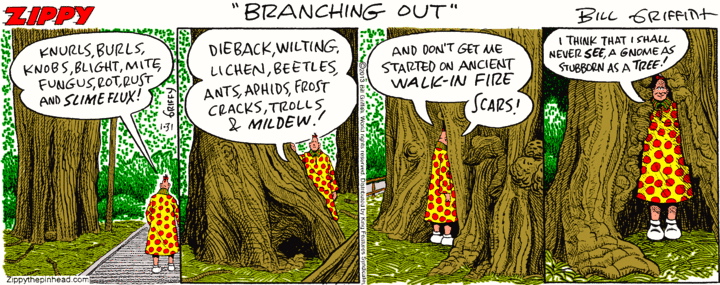
A catalogue of ills afflicting trees, but also a catalogue of vocabulary that entertains Bill Griffith, beginning with the rhyming knurls and burls, moving through knees (echoing knurls) and on to the rhyming blight and mite, and so on (with trolls thrown in for fun, and a gnome at the end).
Back on December 5, Lynne Murphy reported in Facebook about an essay-marking game — drinking a shot of liquor or eating something whenever a particular expression occurred in a student essay:
‘concordance’ to mean ‘example found in a corpus’, as in ‘COCA has three concordances of this collocation’.
… I’ve read this so many times, that I actually looked it up to see if this terminology was polysemous in ways I had not yet appreciated.
(No evidence for it I could find in dictionaries.)
So an error, but what kind? Mishearing (of occurrences)? Classical malapropism (perhaps as a result of learning the technical term concordance)? Eggcorn? Examples like this can be remarkably hard to classify.
From a correspondent in Germany, an e-mail query about there vs. over there in English. My correspondent reports that when he was in vocational college (in Germany) he had a teacher from Great Britain who explained to the class that the difference between the two expressions was that there was used for relatively short distances, over there for significantly longer distances.
She said you can ask someone over the phone, who lives in China “How’s the weather over there?”. But asking “How’s the weather there?” is, according to her, grammatically incorrect.
Oh lord, another invented “rule”, of a sort that linguabloggers (notably on Language Log) have been wrestling with for years. Teachers and amateur usageists are especially prone to come up with misguided advice — for reasons that are pretty clear.
Posted by Mike McKinley on Facebook this morning:
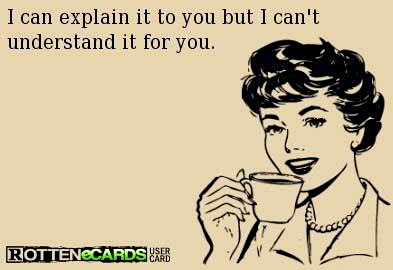
Ah, I recognized this as a variant of a quotation I have long admired. From Boswell’s Life of Johnson, courtesy of the Samuel Johnson Sound Bite Page:
Johnson having argued for some time with a pertinacious gentleman; his opponent, who had talked in a very puzzling manner, happened to say, “I don’t understand you, Sir;” upon which Johnson observed, “Sir, I have found you an argument; but I am not obliged to find you an understanding.”
(Not about language.)
On the cover of the latest Undergear catalog, and inside (p. 5), a model in Gabriel Grey colorblock briefs (brief, jock brief, and trunk), presented as a football player. The cover photo:

Nice body, but it’s a male-model nice body, rather than a rugged-jock nice body, and the shoulder pads and the black grease paint under his eyes just make him look somewhat ridiculous.
For obvious reasons, athletes are a common focus of gay porn, and though some porn actors have genuine jock credentials, many are not fully convincing as jocks, so that this porn requires a certain suspension of disbelief to sustain the fantasy.
(No linguistic interest here. All about men I find attractive, so it’s filed under “Gender and Sexuality”.)
Will Parsons posted on Google+ two days ago about the tv series Wild Things with Dominic Monaghan:
I love that someone referred to this as… “The Crocodile Hunter: Hobbit Edition” [a reference to Monaghan’s Hobbit role in the Lord of the Rings movies] … a quote from the show “this is the very last piece of the largest snake I’ve ever had the pleasure to hold onto” [ok, unintended double entendres] … He isn’t naked enough in this show.
My response:
I’ve been a fan of Monaghan’s since the Hetty Wainthropp days (1996-98). Cute, sweet, sexy. But Will is almost surely right that there won’t be nearly enough of him naked.
And Will in return:
What impressed me is his absolute commitment and willingness to place himself in personal danger. This doesn’t strike me as a “let’s put a cute actor near the baby tiger and get a photo” kind of show. He is doing some seriously risky stuff with these wild critters.
Well, Monaghan is definitely one of my “types”: a relatively small guy (5′7″), slim. And projecting sweetness, openness, and earnestness. (For me, hotness is as much a matter of character as body type.)
Recently arrived at my house, Volume VI (the last) of the Dictionary of American Regional English (Harvard Univ. Press, 2013, ed. by Joan Houston Hall with Luanne von Schneidemesser): Contrastive Maps, Index to Entry Labels, Questionnaire, and Fieldwork Data. From the acknowledgments:
The materials in this volume are the results of efforts by DARE Fieldworkers, Pre-Editors, Editors, Proofreaders, Production Assistants, and students over a period of 47 years.
Whew!