Archive for 2013

Annals of obscene gestures

February 5, 2013

From today’s Miami Herald, a story on the wages of disrespect:

A woman facing a drug possession charge was sentenced to 30 days in jail for flipping the bird to a Miami-Dade judge.

Penelope Soto, 18, appeared in court on video after her arrest for possession of Xanax. In front of Circuit Judge Jorge Rodriguez-Chomat on Monday, she was asked about her assets.

Soto appeared as if the hearing was a big joke and laughed off the judge’s questions, blurted out “Adios” and then gave him the finger.

The judge, feeling disrespected, demanded she return to the podium and then sentenced her to 30 days in jail for contempt of court.

Judges do have that power.

Another chapter in the annals of phallicity, now on the gestural front.
(more…)

The Koch bleep

February 5, 2013

In an apparently endless series of postings on taboo avoidance in the NYT, this bit from James Barron’s piece on Ed Koch’s funeral, with Christine Quinn, the City Council speaker, saying

that Mr. Koch had frequently offered her advice, but that “at the end of every coversation he would say, ‘Just do what you want, and if people don’t like it, just bleep ’em’ “

This time it looks like the bleep (which the NYT wouldn’t use, because it’s ostentatious avoidance, and therefore against its fastidious principles) isn’t an insertion by writers or editors at the paper, but is a straightforward quotation of what Quinn actually *said* at the ceremony. Since it comes from her, not from them, they can print it. It’s her exact words.

Sometimes these practices look like the parsings of religious texts. Fine lines, fine lines.

[If Quinn had quoted Koch as saying ‘just fuck ’em’, then the Times would have had to resort to something bleepless, say

… if people don’t like it’, just screw ’em.”

(with the taboo word paraphrased, more mildly, outside of quotes) or maybe

… if people don’t like it, then the hell with them’ (but in stronger words)”. ]


(Re)name that book

February 5, 2013

Back in September, Michael Erard approached his Facebook friends with this query:

The UK publisher that’s putting out Babel No More [: The Search for the World’s Most Extraordinary Language Learners] doesn’t like the title, “Babel No More,” so they want to change it, and “Superlinguists” is their suggestion. This presents a slight problem, as science-of-language linguists (to whom I have more than a small allegiance) often resent the other sense of the word (a person who speaks many languages, often professionally) because it muddies laypeople’s perceptions of what they do. What do you think?

The technical term Michael uses in his book is hyperpolyglots. I gather that the UK publisher found the American title too opaque (fully comprehensible only through the subtitle) and balked at Hyperpolyglots because of its technicality. Michael’s friends gave advice that was all over the map.

As of this morning, no decision had been made. Michael gave them alternatives and was concerned that they would try to get Superlinguists into the business somehow.

(more…)

Dingburger faces and gestures

February 5, 2013

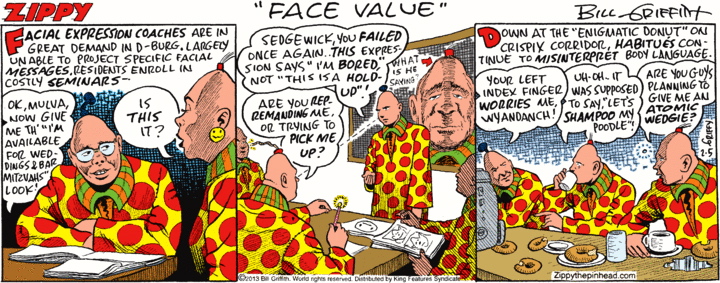
Today’s Zippy, in which Dingburgers exhibit an incapacity for conveying (very specific) meanings by facial expressions and gestures:

Note the absurd specificity of some of these meanings: ‘I’m available for weddings and bar mitzvahs’ and ‘Let’s shampoo my poodle’.

(more…)

Annals of phallicity: or are you just happy to see me?

February 4, 2013

Over on ADS-L, the quotation hounds have been considering

Is that a gun in your pocket, or are you just happy to see me?

which is widely attributed to a flirty Mae West — it *sounds* like the sort of thing she would have said — but without any actual source in some particular movie. There’s a huge family of variants here, constituting the verbal counterparts to the examples of visual phallicity I’ve so often posted about.

(more…)

laughing out loudly

February 4, 2013

The German correspondent of “Another invented rule” writes with another teacher-inspired query, going back to when he was a senior in high school. His story (lightly edited):

I had an English teacher back then, who abhorred (still abhors) AmE, and preferred BrE. He is neither American nor is he British. He’s German. According to him, Americans cannot speak English.

One day, we were asked to write a letter. We had to create a story of two people who are pen pals and who love sharing each other’s everyday stories.

I made up a story, wrote it down, and in one line I had written.. I was laughing out loud….

After a few days we got our homework back. What struck me the most was that he had marked laughing out loud as a mistake. Above, he he had written laughing out loudly.

Now that I’ve checked on the Corpus of Contemporary American English, there is no entry with an -ly ending. But when I type laugh out loud, I get many results.

My question for you is : Was my teacher correct? If not, why is it wrong to say “laughing out loudly”?

High marks to my correspondent for checking COCA, rather than relying on raw googling, since web searches will yield a respectable number of instances of laughing out loudly (and even a few of laughing aloudly), though these are wildly outnumbered by the standard English (Br or Am) laughing out loud.

(more…)

God’s preferred languages

February 4, 2013

In today’s NYT, in the New York Region section, a charming, funny, affectionate piece about Ed Koch: “Services to Reflect Koch: Proudly Jewish on His Own Terms” by Sharon Otterman. Much to admire in this piece, but as a linguist I was especially taken by Koch’s views on God’s preferred languages.

(more…)

The Gray Lady stands her ground

February 4, 2013

Another chapter in the saga of taboo avoidance in the New York Times — in this blog, the last chapter was here — this time in the Public Editor’s Journal on January 30th: “Does The Times Have Its Act Together on Vulgar Language?” by Margaret Sullivan, which begins by posing the question:

Should The Times write about a company if it can’t – or won’t — put the name of that company in the article?

(more…)

Cooking with T-Rex

February 4, 2013

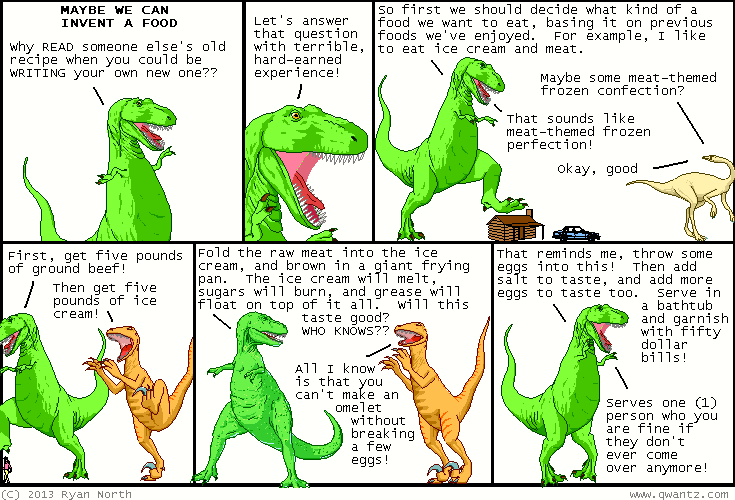
In the January 24th Dinosaur Comics, T-Rex invents a food:

Dinosaur Comics fan Aviatrix took this as a challenge.

(more…)

Conversion, solidification, and externalization

February 3, 2013

A recent discussion on ADS-L combined three themes of enduring interest on this blog: conversion of N to V and vice versa; the alternation in spelling between separated, hyphenated, and solid spelling of compounds (see recent discussion by Mark Liberman on Language Log about the V + Prt compounds build out, build-out, and buildout); and the inclination to externalize inflection in compounds that have come to be viewed as unitary lexical items (see a collection of V/N = V + Prt examples here).

The ADS-L discussion was about mouse over / mouse-over / mouseover, which I’ll refer to as MO in what follows.

(more…)