Archive for November, 2012

Three musicians walk into La Côte Basque…

November 9, 2012

(Only a little bit of language in this one.)

Long obituaries for Elliott Carter this week, celebrating a very long career — he was still composing almost up to his death at 103 — characterized by, among other things, great independence of mind. The New York Times gave Allan Kozinn a huge amount of space to reflect on Carter’s life and works (“Elliott Carter, Composer Who Decisively Snapped Tradition, Dies at 103”), including some anecdotes (it’s easy to catalogue the Pulitzer Prizes and other awards, not so easy to give a feel for what someone was like and what moved them).

Which brings me to a story that was in the print version of the obit but was snipped out of the on-line version. Carter and Igor Stravinsky are joined by a third man…

(more…)

Breathless

November 8, 2012

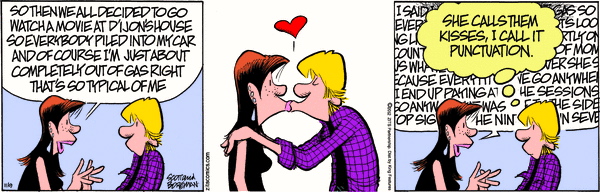
Friday’s Zits returns to some old themes for the strip:

The theme is that women — especially, teenaged girls — talk talk talk, in a rapid, never-ending stream, one sentence flowing into the next, one story into the next, without pause. You can’t get a word in edgewise, the saying goes. (The truth is far from this, of course.)

But Jeremy has found the solution, a very satisfying one: the punctuational kiss.


Toga toga toga!

November 8, 2012

Today, from the Undergear people, hype for some loungewear that looks like it’s intended for rentboys in a male brothel — in particular a toga far removed from either ancient Rome or John Belushi in Animal House:

Note the well-worn double entendre on Greek. In fact, the smoldering young men are so taken with their sexy clothes and what they’re leading to that they’ve fallen into a line of iambic tetrameter (with the internal rhyme shapesdrapes).

On the left: P.O.V.® TOGA SLEEVELESS SHIRT & P.O.V.® TOGA CROPPED PANT [$49 & $38], with the ad copy:

Turn bedtime into your own private party with this sexy men’s loungewear from the P.O.V. Collection. Named for their alluring shape and silky drape, the P.O.V. Toga men’s sleeveless shirt and cropped pants are made from a light, airy blend of nylon/spandex with a sexy cutaway front. The lounge shirt’s sensual stripes, comfy pullover and cutaway front is sure to lead the way to the bedroom. The matching pants feature an elastic drawstring waist for a great fit and easy access.

And on the right: P.O.V.® TOGA ROBE [$55], with almost the same copy:

Turn bedtime into your own private party with this sexy sleeveless men’s robe from the P.O.V. Collection. Named for its alluring shape and silky drape, the P.O.V. Toga Robe for men is made from a light, airy blend of nylon/spandex with a sexy sleeveless design. The lounge robe’s sensual stripes, comfy hood and thin rope belt is sure to lead the way to the bedroom.

If these garments seem too modest and understated, Undergrear also offers some sheer black fishnetwear that will show off your junk for the enjoyment of your, um, companion of the evening; these can be viewed on AZBlogX, here, under the heading “Slutty loungewear”, along with a digression on the sarong.

Now on (male) hustlers, who also work under the names callboy, escort, and rentboy / rent-boy / rent boy. (Some trade on their careers as models, pornstars, or (sexual) masseurs, and advertise themselves under those job titles. Male sex worker now seems to be the technical term used most often by researchers on this world.) From Wikipedia:

Male prostitution is the act or practice of men providing sexual services, usually to other men, in return for payment. When compared to female prostitutes, male sex workers have been far less studied by researchers, and while studies suggest that there may be differences between the ways these two groups look at their work, more research is needed.

[and back to the toga theme:] … Male brothels existed in both Ancient Greece and ancient Rome

There is, however, a fair amount of literature written primarily from “inside” the hustler world. Among the books in my library:

Adams, Matt. 1999. Hustlers, escorts, and porn stars: The insider’s guide to male prostitution in America. 2nd ed. Las Vegas NV: Insider’s Guide.

Dorais, Michel. 2005 [French original 2003]. Rent boys: The world of male sex workers.  McGill-Queen’s Univ. Press.

Friedman, Mack. 2003. Strapped for cash: A history of American hustler culture. LA: Alyson Books. [the glossiest of these books]

Itiel, Joseph. A consumer’s guide to male hustlers. NY: Harrington Park Press.

– 2002. Sex workers as virtual boyfriends. NY: Harrington Park Press.

Lawrence, Aaron. 1999. Suburban hustler: Stories of a hi-tech callboy. Warren NJ: Late Night Press.

– 2000.  The male escort’s handbook: Your guide to getting rich the hard way. Warren NJ: Late Night Press. [nuts and bolts for a guy who’s thinking about getting into the life]

Rechy, John. 1963. City of Night. NY: Grove Press. [fiction]

– 1967. Numbers. NY: Grove Press. [fiction]

– 1977. The sexual outlaw: A documentary. NY: Grove Press. [nonfiction]

Steward, Samuel. [writing as Phil Andros, a number of fiction books with hustler characters]

– 1991. Understanding the male hustler. NY: Harrington Park Press.  [fiction presented as memoir]

Sycamore, Matt Bernstein. 2000. Tricks and treats: Sex workers write about their clients. NY: Harrington Park Press. [sex workers both male and female]

Whitaker, Rick. 1999. Assuming the position: A memoir of hustling. NY: Four Walls Eight Windows.

(Not all the authors have been able to resist the lure of jokey phrases in their titles: “getting rich the hard way”, “tricks and treats”, “assuming the position”.)

There is at least one documentary about guys in the life:

101 Rent Boys [produced/directed by Fenton Bailey and Randy Barbato] is a 2000 documentary film that explores the West Hollywood hustler scene. The producers recruited 101 hustlers from on and around Santa Monica Boulevard and paid each of them $50 for their time. The boys, who were from diverse ethnic, racial, regional and economic backgrounds, were interviewed in motel rooms on such topics as how they entered into prostitution, their sexual orientation, drugs and their first johns. The film focuses on a few of the boys more extensively while much smaller clips of other subjects are used. (link)

The film is, by turns, thought-provoking, funny, bleak, moving, and disturbing.

Meanwhile, the world of gay porn is packed with films featuring hustlers; the rentboy looking for love, or finding it unexpectedly, is a recurrent theme of the genre (which often veers between romance and hard-driving sex), though sometimes the hustler life is just an easy hook to hang a series of sex scenes on. And then there’s the puppy-dog enthusiasm of the guy who runs the Gay Rentboys site:

I travel the world looking for the hottest hustlers money can buy, film my interactions with them like reality style TV, and get them to have hot gay sex for my cameras. Then I review them for you. I love to get these hot and horny young guys to do all kinds of kinky stuff like pissing on each other and getting straight hustlers to get gay fucked for the first time. Currently my site features US rent boys, Czech rent boys and Thai rent boys and I will be filming in a city near you soon!

(Regular readers of this blog will have noticed the verb gay fucked, of course.)
 

Repetitions

November 8, 2012

On Monday Nancy Friedman offered this awkward example to me:

“One of the things that you always want to be for, whether you’re a Democrat or a Republican, is that you want everyone who’s eligible to vote to vote.” – Steve Schmidt, McCain strategist in 2008 (link)

There’s nothing syntactically wrong with this sentence, but the repetition of to vote might give you a moment’s pause. Nevertheless, the first to vote is an ordinary infinitival complement of be eligible (They are eligible to vote), in a relative clause modifying everyone (Everyone who’s eligible to vote is coming), and the second to vote is an ordinary infinitival complement of want in combination with a direct object of that verb (We want everyone to vote), and to vote to vote is merely part of what you get when you put these pieces together in ordinary ways.

Repetitions like this one — repetitions I’ll call Toto examples (Totos for short), after to vote to vote and in recognition of the passing feeling of oddness that they can produce (“Toto, I’ve a feeling we’re not in Kansas anymore”) — are quite common, though a careful stylist might want to avoid some of them as distracting. But then there are syntactic constructions that specifically call for repetitions of constituents. And still other configurations that you’d expect to be acceptable — more Toto examples — that are nevertheless just ungrammatical (for some speakers).

(more…)

We don’t need no steenkin’ land lines

November 7, 2012

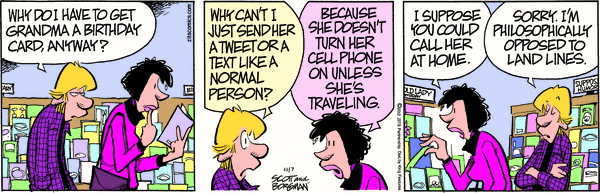
Today’s Zits returns to a familiar topic on this strip and on Zippy: changes in how we communicate across a distance:

Once we wrote letters by hand; then we had the telegraph for important messages; then for quick everyday communication we had phones with dials and (later) phones with buttons; then came cellphones (making us mobile) and e-mail (combining the speed of phones with the asynchronous advantages of letters); and then texting, social media, and tweeting. Who uses which modes of communication for which purposes changes, and very different styles of using the technologies emerge.

Jeremy is so over land lines.

Taboo not appropriate

November 7, 2012

Mark Leibovitch interviewing Sen. Joe Lieberman (“The Last Days of Joementum”) in the NYT Magazine on Sunday (the 4th), p. 14:

[Leibovitch] I’m told you recently enjoyed a Shabbat dinner with Senator McCain in Israel. [Lieberman] He said that traveling with me compelled him to put up with all this Shabbat stuff — well, he actually used another term, but it’s not appropriate.

We’re to suppose that McCain said shit, not stuff — which Lieberman judges to be “not appropriate”. Lieberman could have meant “not appropriate to appear in the New York Times“, and that’s certainly the NYT‘s opinion. But probably he meant something like “not appropriate in talking about the holy day of the week”. Then the question is: Why is Joe Lieberman telling us this? How is McCain’s word choice relevant to the story of the visit to Israel? Lieberman could, after all, just have said “Shabbat stuff” and left it at that.

The usual point of quoting exact wording in cases like this is to shed some light on the personality or character of the person quoted — in this case, to communicate something of McCain’s coarseness and his disregard for Judaism (as Lieberman judges these things). “Shabbat stuff” would have done for the second, but not the first, and to do that Lieberman had to convey something of the flavor of McCain’s actual speech. Lieberman could have reported “Shabbat shit”, but that would have been unprintable in the Times, and it would also have tarred Lieberman with the same brush as McCain.

So we got: “he actually used another term, but it’s not appropriate”.


Bubbles

November 7, 2012

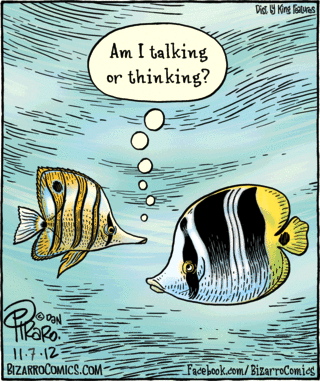
Today’s Bizarro, with bubbles:

Two visual conventions for cartoon bubbles: one, to indicate bubbles of air under water; and two, to indicate that a cartoon balloon (also known as a bubble) with text in it represents thought rather than speech (see here). So: under water in a cartoon, everything looks like thought.


Brief mention: toolbook

November 7, 2012

An NBC news analyst, reporting on the U.S. Presidential election last night:

We need to look at our toolbook — I mean our toolbox, our playbook…

A blend of two (somewhat) idiomatic compounds, conveniently identified for us in the speaker’s own correction.

Note that the contributors to the blend are very similar in structure: both are N + N compounds, both Ns are monosyllables, and box and book are already very similar phonologically. General principle:

The greater the degree of morphological and phonological similarity, the more likely semantically similar items are to interfere with one another in blends.

Related blends: pitchfork from pitch pipe + tuning fork (from a musician); rocket surgery from rocket science + brain surgery (dismissively, in contexts like It’s not ___); jerry-rigged from jerry-built + jury-rigged; heart-wrenching from heart-breaking + gut-wrenching; Achilles’ tooth from Achilles’ heel + sweet tooth.

And note that toolbook also exists as a deliberate portmanteau, presumably of toolbox and handbook:

ToolBook is a Microsoft Windows programming environment, released in 1990 by Asymetrix Corporation (later known as click2learn and SumTotal Systems). In that day ToolBook was a competitor to Visual Basic as a programming environment. Over the years ToolBook has been enhanced to allow for the creation of web-based (HTML) content as well. (link)


Ay papi!

November 6, 2012

(Not about language.)

An arresting image posted on Facebook by Arne Adolfsen, from the Papacito site (a trove of steamy but not X-rated male photography; perfil dedicado a la belleza masculina… los mejores cuerpos, los más sexys y mucho chico guapo):

Arne comments:

This has got to be one of the funniest pictures I’ve seen in I don’t know how long. I would love to see what a semiotician makes of this since it’s such an over-determined photograph.

(more…)

Inhabiture

November 6, 2012

New in  my neighborhood, a block and a half from my house (up Ramona St. at Hamilton Ave., in a corner space that housed, for years, a Radio Shack, then a succession of short-lived retail enterprises): inhabiture home, an earnest green home furnishings store, that

features beautiful reclaimed and recycled, non-toxic, organic, and locally-produced home accessories and furniture. inhabiture home takes pride in providing healthy furnishings, sustainably produced.

The name is a somewhat grandiose portmanteau, of inhabit and furniture (with, maybe, echoes of nature and architecture thrown in). The merchandise includes both hand-crafted items and stylishly antique odds and ends of no great utility:

(more…)