(More Sunday morning silliness.)
From John Lawler on Facebook, a link to this video:
Yes, “O Fortuna” from Carl Orff’s Carmina Burana, in a mondegreened English version by YouTube user FamishedMammal, with visuals.
(Not about language, but a contribution to the continuing Annals of Amazing Underwear.)
From Arne Adolfsen on Facebook, this remarkable ad for Good Devil underwear from Down Under Guys Gear:
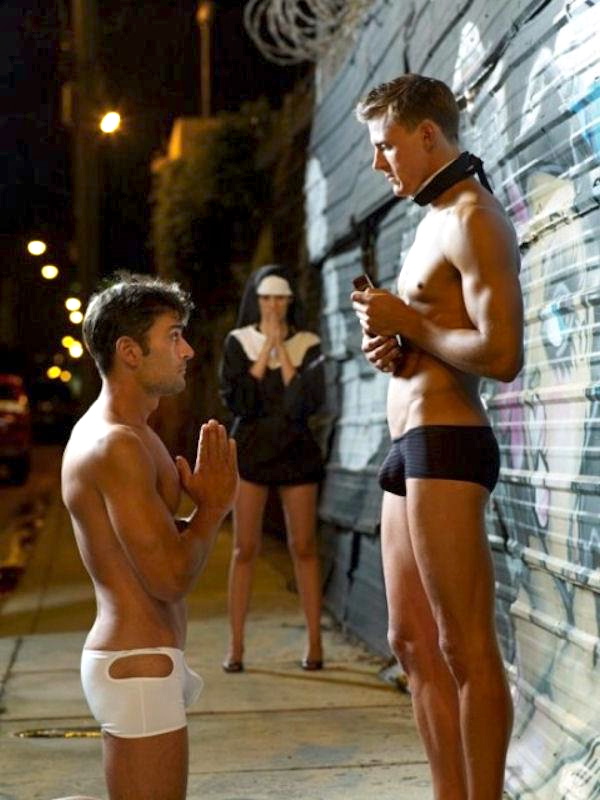
The text:
Sexy looking underwear from Good Devil, something different, something sheer, something mesh!
The latest (6/6/12) issue of the Princeton Alumni Weekly reports (on p. 22) on the retirement of 11 faculty members, including two with a notable public presence (Cornel West in the Center for African American Studies and dark-matter proponent Jeremiah Ostriker in Astrophysical sciences) and two with whom I have a personal academic connection: Philip Johnson-Laird in Psychology (who was my colleague in Experimental Psychology at Sussex when I visited there in 1976 and 1977) and Seiichi Makino in East Asian studies (who was a student of mine at the University of Illinois, Urbana-Champaign, back in the 60s).
Pleasant memories.
From Charles Rosen, “Freedom and Art“, New York Review of Books of 5/10/12, p. 28:
The critical problem of the battle between conventional meaning and individual expression was best laid out many years ago in Meyer Schapiro’s apparently controversial insistence that the forms of Romanesque sculpture could not be ascribed solely to theological meaning but were also a style of aesthetic expression. What that meant at the time was quite simply and reasonably that the character of the sculptural forms could not be reduced only to their personification of theological dogma, but possessed a clear aesthetic energy independent of sacred meaning.
The fallacy that Schapiro was attacking has reappeared recently in musicological circles with the absurd claim that music could not be enjoyed for purely musical or aesthetic reasons until the eighteenth century since the word “aesthetics” was not used until then. (This naive belief that independent aesthetic considerations did not exist before 1750 without social and religious functions would strangely imply that no one before that date could admire the beauty of a member of the opposite sex unless it could be related to the function of the production of children.)
Odd forms of extreme Whorfianism turn up in the oddest places.
A t-shirt available from the Mental Floss store:

Copy on the site:
This is the grammar police. You have the right to remain silent. Anything you say can and will be held against you in a court of grammatical law.
Grammar Police is an instance of the X police snowclonelet (which I haven’t posted on before), and a very popular one at that. But if you look at some of the enormous number of sites using the expression, you’ll see that most of them aren’t about what linguists think of as grammar, but about what I’ve called garmmra (largely spelling and punctuation).
Back on May 21st, Victor Steinbok posted an example from a comment on Google+:
(1) Does anyone see what’s the tactic is?
noting that such things were common in comments and in speech, and observing that (1) could be seen as a blend of
(2a) … what’s the tactic?
(2b) … what the tactic is?
(If you’re dubious about (2a), hold that thought for a moment.)
Searching for more examples of the form {“what’s the * is”} was pretty much hopeless, thanks to the flexibility of Google searches, but I did pull up a large number of examples of the form:
what’s the Expletive is
and then, more generally:
what’s/who’s the Expletive FormOfBE
and also
what’s the Expletive FormOfDO
which have no natural analysis as blends. Instead, the expletive examples look like they have an excrescent ‘s, reinforcing or emphasizing the WH interrogative word — as in non-standard how’s about, how’s come, what’s about, etc. mentioned here (section 11).
The eruption of disaster-mageddon words continues: weather -mageddons, traffic -mageddons, political -mageddons, and more (some links here). And now, shrill cries of disaster from foodies: the California foie-mageddon / foiemageddon, as reported (for example) in yesterday’s New York Times, here (“Waddling Into the Sunset: California Chefs Mount a Repeal of Foie Gras Ban Set for July 1” by Jesse McKinley):
Griffy bemoans the wave of superhero and fantasy comics, with homoerotic musclemen and phallic dragons, washing over the comics he loves:

I don’t get all the references — in particular, “Needle-Noodle” and “The Z-Thing”. Help!
Carl Hiaasen, interviewed in the NYT Book Review on June 3rd:
What book is on your night stand now?
“Raylan,” by Elmore Leonard, one of my writing heroes. There is nobody better at lowlife dialogue.
That is, at representing the speech of small-time crooks, con men, wiseguys, and the like. Well, white American lowlifes; there’s plenty of social and geographical variation in these things.